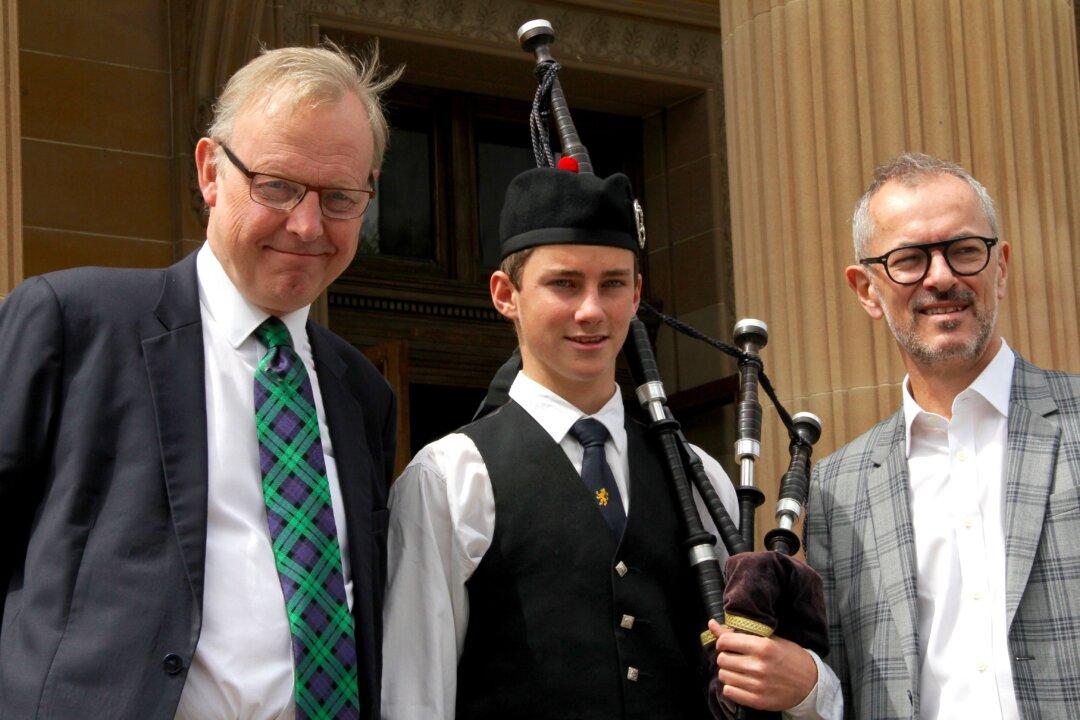
In his first major art exhibition since becoming the new director of the Art Gallery of New South Wales, Dr Michael Brand opened America: Painting a Nation with obvious pride.
“It is the most comprehensive survey of American art to be shown in Australia,” he said at the media preview on Nov 7.
The exhibition, which consists of over 80 paintings, spans 200 years of American art from 1750 to 1966, and is displayed in chronological order.
Dr Brand has a strong feel for American art, having spent part of his childhood in Washington DC, and attaining an MA and a PhD at Harvard University. He is also a former director of the J Paul Getty Museum in Los Angles and the Virginia Museum of Fine Arts (VMFA) in Richmond. It was through the latter connection that he was able to negotiate the inclusion in the Sydney exhibition of VMFA’s major work—House at Dusk (1935) by prominent American realist Edward Hopper.
“The Hopper painting speaks to a time where US paintings became a universal language,” he said.
Dr Chris McAuliffe, the show’s curatorial consultant, believes Australian audiences will find a lot to engage with in the exhibition.
“It’s an opportunity to visit America, to delve deeply into its history and to meet, I think, the roots of American personality, American character and American values,” he said.
Dr McAuliffe said Australians have been well exposed to post World War II artists like Jackson Pollock, Mark Rothko and Andy Warhol, but are not so familiar with the earlier artists like Thomas Cole, Winslow Homer and James Abbot McNeill Whistler.
“They haven’t seen the back story,” he told Epoch Times on the sidelines of the show.
The 200 year span of art is particularly interesting when weighed against Australian art. “There are different responses to the landscape and to the frontier experience,” Dr McAuliffe said.
Although some of the earlier colonial era landscapes are grand on the scale of Australia’s Eugene Von Guerard or Conrad Martin, later artworks exhibit a confident, industrious, “go ahead” energy not seen in Australian art of a similar era.
“Australian art of that period is much more pastoral, with more lyrical images of rural activity,” Dr McAuliffe said.
American art also has a strongly mythical quality to it, he said, referring to the expansive Grand Canyon by Thomas Moran.
The painting “is both about deep antiquity and palaeontologic image, but it is almost cinematic in scale,” he said. “I mean it is almost hallucinogenic. You kind of lose yourself in this infinite space. I think it is very mythical.”
Artists in the US also embraced modern life more enthusiastically than their counterparts in Australia, gritty images of urban life and modernity, jazz venues and street life evident.
“American artists are a little more embracing of the kind of energy and bewilderment that came with modern experience,” Dr McAuliffe said. “Australian artists are a little more elegant, decorative in their engagement with that world.”
Dr McAuliffe said he hopes people will take the time to explore below the surface of the paintings.
“There are national symbols, national mythologies, powerful characters,” he said.
There is also much for Australian artists to embrace. He pointed to the technical integrity of the paintings noting that, despite the abstract representation of their art, US modernists were masters of detail.
He highlighted Georgia O’Keeffe’s paintings which include both broad abstraction and attention to technique.
“You can see that technically they are very meticulous—there are lots of incredibly subtle gradations of stroke, density and colour.”
While it may be a treat for Australians, who have never before seen this historical reach and variety of US art in one exhibition, it will also be the envy of many Americans, according to David Bomford, director of conservation at the Museum of Fine Arts in Houston (MFAH).
Though individual regions in the US have their own collections and guard their art works tightly, “it is rare to get such an overview in America,” Mr Bomford said, as he took the time to quietly survey the exhibition as a whole.
MFAH is one of five arts institutes in the US that have donated works for the exhibition. The Los Angeles County Museum of Art, the Philadelphia Museum of Art and the Terra Foundation for American Art in Chicago are also contributors.
Dr Brand acknowledged the great sacrifice the arts institutes had made to allow the works to travel.
“They denuded their collections to bring the show to Sydney,” he said.
Originally curated for South Korea, the works have been honed down to a smaller, tighter show for Australia. Mr Bomford said the result was “excellent”.
‘America: Painting a Nation’ opened at the Art Gallery of New South Wales November 8 and continues till February 9, 2014.