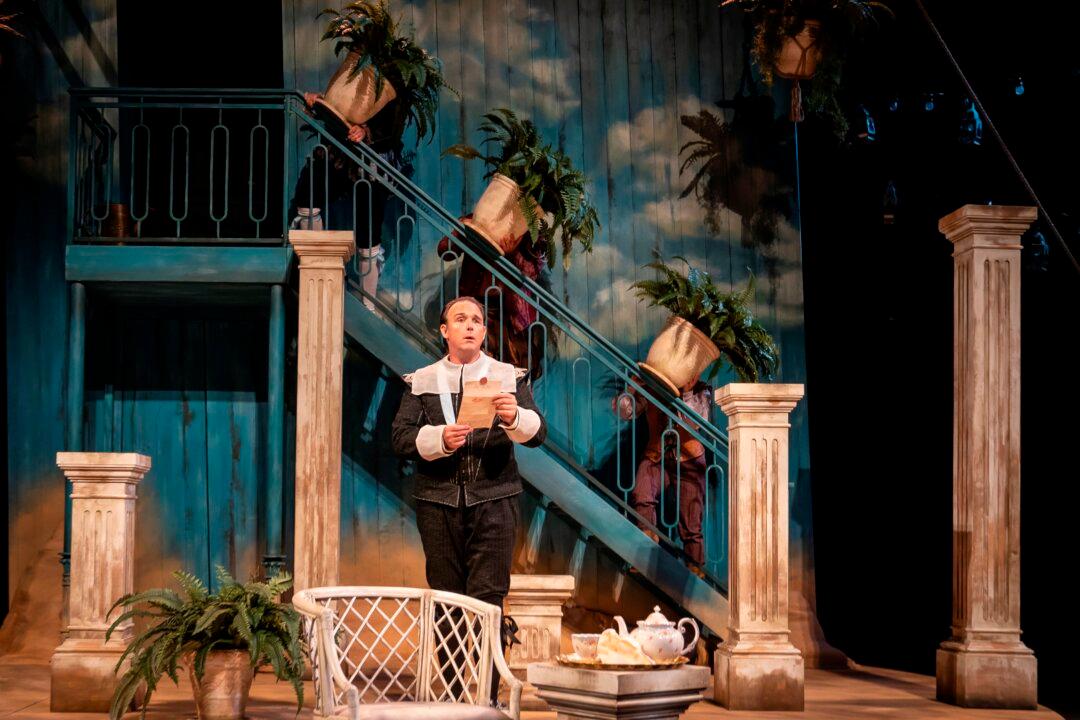

CHICAGO—Watching L. Walter Stearns’s production of Sunday in the Park With George at Porchlight Music Theatre on Stage 773 is like seeing a painting (a painting by Seurat to be exact) up too close—so close that you can’t make sense of the whole picture.
Unfortunately, this effect works against a major theme of the piece: that it is the artist’s point of view that survives ultimately, swallowing up and reinventing its subjects’ little points of view with their petty squabbles and interests.
But in this production, the particles remain large-as-life people and we cannot easily focus our eyes on the larger composition—we really needed to be further away from the stage.
With that said, there are some interesting choices made in this production.
Act 1 introduces painter George Seurat (Brandon Dahlquist)—the account of Seurat’s life is fictional—and his model and lover Dot (Jess Godwin). George is working on what will be his pointillist masterpiece “A Sunday Afternoon on the Island of La Grande Jatte.”
We soon see the tension between George’s obsession with painting and his love for Dot. George’s obsession wins, from Dot’s point of view, when he refuses to take her out for an evening as he had promised.
Hurt, Dot leaves Seurat and settles into a new life: She takes up with a prosaic baker who loves her. Eventually she will move to America and raise George’s daughter, Marie. Dot chooses life; George chooses art.
In Act 2, George’s great-grandson (played by Dahlquist), also an artist, is touring with his grandmother, Marie (Godwin again), who introduces his show with a dedication to this famous forefather. Later at a cocktail party, we see that this modern George handles his career as a businessman, soliciting funds with a smirk and a nod and hating himself for it.
The story resolves with the modern George having a conversation with his great-grandmother’s spirit, and she assures him that he should move on with his life and art.
Stearns handles the whole with a light touch aided by his excellent leads.
Petite Jess Godwin as Dot, George’s true love, has a lovely shimmering soprano and enough of an ethereal quality about her to help us see why it is that George thinks she, out of anyone he knew, could both understand and accept him.
With Act 2, Godwin relies more on her comic instincts as the elderly Marie.
Brandon Dahlquist as Seurat shows an incredible vocal range necessary to the piece (with the soft high notes that remind us of Patinkin, but with a clearer tone). His George catches the gentle and sensitive side of the artist: one who is aware of everything that is going on around him, but finds the ugliness of it a bit overwhelming. Although he manages to connect lovingly to the figures on canvas and in life—it just isn’t enough for those that need him (Dot, his mother).
Dahlquist, then, plays a benevolent artist, a role we hardly associate with artists anymore; he imposes beauty and order on chaos—and his interactions with others, although restrained, are touching.
Because of this, Dahlquist sets up a nice contrast with his modern counterpart in Act 2, a schmoozing artist, who relies on his charm. We are reminded that artists today are unable to retain little of the dignity once associated with their profession.
Like Seurat’s painting itself, though, it is the music that ultimately carries the force of this piece. Sunday in the Park With George, Putting It Together, We Do Not Belong Together, and Move On are among Sondheim’s most moving songs, despite the fact that they center on a man accused of being unfeeling and needing no one.
Each cast member of this production plays both a person in the painting and a role in modern times, and each did an admirable job: Shaun Nathan Baer, Cameron Brune, Kelly Hackett, Sarah Hayes, Laney Kraus-Taddeo, Bil Ingraham, Michael Pacas, Hillary Patingre, Doug Pawlik, Jennifer Tjepkema, Daniel Walters, and Heather Townsend.
Sara Stern should be singled out as George’s mother in Act 1, who in her duet Beautiful helps clarify just how well this mother and son do, in fact, connect.
As mentioned, the set by Amanda Sweger would work very well at a distance—as it is, the canvas backdrop arranged in bundles on the floor in the opening is unattractive. But the screens and moving elements (semicircles for bushes) work well with lighting effects by Mac Vaughey, and some of the interaction is carried on inventively between the projections and actors. The costumes by Mina Hyun-Ok Hong are vivid.
This production has been accused of not going deep enough. I would suggest that the lighter touch allows us to appreciate that restraint has its own points to make.
Sunday in the Park With George
Stage 773
1225 W. Belmont Ave., Chicago
Tickets: 773-327-5252 or at www.stage773.com
Running time: 2 hours, 20 minutes
Closes: Oct. 31
Unfortunately, this effect works against a major theme of the piece: that it is the artist’s point of view that survives ultimately, swallowing up and reinventing its subjects’ little points of view with their petty squabbles and interests.
But in this production, the particles remain large-as-life people and we cannot easily focus our eyes on the larger composition—we really needed to be further away from the stage.
With that said, there are some interesting choices made in this production.
Act 1 introduces painter George Seurat (Brandon Dahlquist)—the account of Seurat’s life is fictional—and his model and lover Dot (Jess Godwin). George is working on what will be his pointillist masterpiece “A Sunday Afternoon on the Island of La Grande Jatte.”
We soon see the tension between George’s obsession with painting and his love for Dot. George’s obsession wins, from Dot’s point of view, when he refuses to take her out for an evening as he had promised.
Hurt, Dot leaves Seurat and settles into a new life: She takes up with a prosaic baker who loves her. Eventually she will move to America and raise George’s daughter, Marie. Dot chooses life; George chooses art.
In Act 2, George’s great-grandson (played by Dahlquist), also an artist, is touring with his grandmother, Marie (Godwin again), who introduces his show with a dedication to this famous forefather. Later at a cocktail party, we see that this modern George handles his career as a businessman, soliciting funds with a smirk and a nod and hating himself for it.
The story resolves with the modern George having a conversation with his great-grandmother’s spirit, and she assures him that he should move on with his life and art.
Stearns handles the whole with a light touch aided by his excellent leads.
Petite Jess Godwin as Dot, George’s true love, has a lovely shimmering soprano and enough of an ethereal quality about her to help us see why it is that George thinks she, out of anyone he knew, could both understand and accept him.
With Act 2, Godwin relies more on her comic instincts as the elderly Marie.
Brandon Dahlquist as Seurat shows an incredible vocal range necessary to the piece (with the soft high notes that remind us of Patinkin, but with a clearer tone). His George catches the gentle and sensitive side of the artist: one who is aware of everything that is going on around him, but finds the ugliness of it a bit overwhelming. Although he manages to connect lovingly to the figures on canvas and in life—it just isn’t enough for those that need him (Dot, his mother).
Dahlquist, then, plays a benevolent artist, a role we hardly associate with artists anymore; he imposes beauty and order on chaos—and his interactions with others, although restrained, are touching.
Because of this, Dahlquist sets up a nice contrast with his modern counterpart in Act 2, a schmoozing artist, who relies on his charm. We are reminded that artists today are unable to retain little of the dignity once associated with their profession.
Like Seurat’s painting itself, though, it is the music that ultimately carries the force of this piece. Sunday in the Park With George, Putting It Together, We Do Not Belong Together, and Move On are among Sondheim’s most moving songs, despite the fact that they center on a man accused of being unfeeling and needing no one.
Each cast member of this production plays both a person in the painting and a role in modern times, and each did an admirable job: Shaun Nathan Baer, Cameron Brune, Kelly Hackett, Sarah Hayes, Laney Kraus-Taddeo, Bil Ingraham, Michael Pacas, Hillary Patingre, Doug Pawlik, Jennifer Tjepkema, Daniel Walters, and Heather Townsend.
Sara Stern should be singled out as George’s mother in Act 1, who in her duet Beautiful helps clarify just how well this mother and son do, in fact, connect.
As mentioned, the set by Amanda Sweger would work very well at a distance—as it is, the canvas backdrop arranged in bundles on the floor in the opening is unattractive. But the screens and moving elements (semicircles for bushes) work well with lighting effects by Mac Vaughey, and some of the interaction is carried on inventively between the projections and actors. The costumes by Mina Hyun-Ok Hong are vivid.
This production has been accused of not going deep enough. I would suggest that the lighter touch allows us to appreciate that restraint has its own points to make.
Sunday in the Park With George
Stage 773
1225 W. Belmont Ave., Chicago
Tickets: 773-327-5252 or at www.stage773.com
Running time: 2 hours, 20 minutes
Closes: Oct. 31