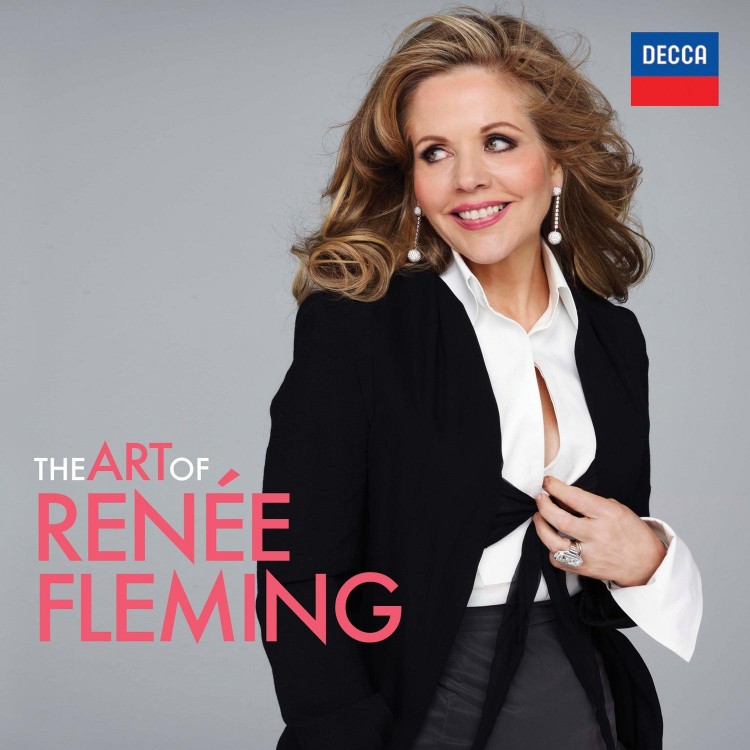
Renée Fleming opened her four-concert Perspectives series at Carnegie Hall with a joint concert with her long-time friend and fellow opera star mezzo-soprano Susan Graham. The two were accompanied by pianist Bradley Moore in a program of French art songs and arias from the “Belle Époque” era (1871-1914). It takes immense artistry to perform salon music in a venue this vast but that is what the three delivered.
The evening began with recorded comments by the celebrated Scottish-American soprano Mary Garden (1874-1967), who was a favorite of French composers of the early 20th century, including Debussy and Massenet. Then, the two stars came out, dressed to the nines. (As Graham noted after the intermission, “What did you expect? Two divas. Four gowns.”) They introduced each section of the program with information about the composers and the singers who inspired them. Some of these stories were funny. (Garden was once asked by an elderly admirer what kept her dress up. She answered, “Your age and my discretion.”) Others were tragic (e.g., Sibyl Sanderson, from California, who became an alcoholic and died at age 38).
The pair started the musical program with duets of three pieces by Saint-Saëns: “Pastorale” and “Viens! Un flute invisible.” In contrast to the latter’s lyrics about eternal love, the composer’s later work,“El desdichado” (“The Unhappy One”), set to an anonymous Spanish verse, warns against the “drunkenness” of romance. The duets continued with several Fauré songs inspired by his love affairs (“Puisqu‘ici-bas, Op. 10, No. 1” and “Pleurs d’or, Op. 72”) followed by his most famous melody, the “Pavane in F-shar Minor, Op. 50.” Bradley Moore played an exquisite solo piano rendition of Debussy’s “Clair de lune” after which Fleming took center stage for two more Debussy songs: “Mandoline” (with words by Paul Verlaine) and the melancholy “Beau Soir,” which contains “a plea to relish the charm of life.”
The second half of the concert featured Graham in a mesmerizing set of songs by Reynaldo Hahn. She explained his idiosyncratic style of playing the piano with a cigarette in his mouth. The composer set works by leading poets, including Theophile Gautier and Verlaine, in fact the same words that Debussy used for “Mandoline.”
Then, the two stars performed more duets: Berlioz’s tragic “La mort d‘Ophelie” (ostensibly about the death of Ophelia but also about the failure of the composer’s marriage to the actress he first saw playing the part in a production of “Hamlet.”) They then switched gears and sang the comic “Blance-Marie et Marie-Blanche,” from Les p’tites Michu by André Messager (about two girls who mistakenly believe they are twins), followed by the entrancing “Barcarolle,” from “Les contes d’Hoffmann,: and the ”Flower Duet“ from Lakmé. For encores, they sang duets from Mozart’s ”Così Fan Tutte“ (to commemorate Mozart’s birthday) and Humperdinck’s ”Hänsel und Gretel.“ Then Graham came out with a cigarette in her mouth (in imitation of Hahn) and accompanied herself on piano in a resplendent version of ”La Vie en Rose.“ Fleming returned for ”Malurous qu'o uno fenno“ (”Unhappy is he who has a wife"), one of Canteloube’s delightful songs of the Auvergne. The audience didn’t want to leave.