[ NTD Competition Brings Ancient Dance to the Modern Stage ]

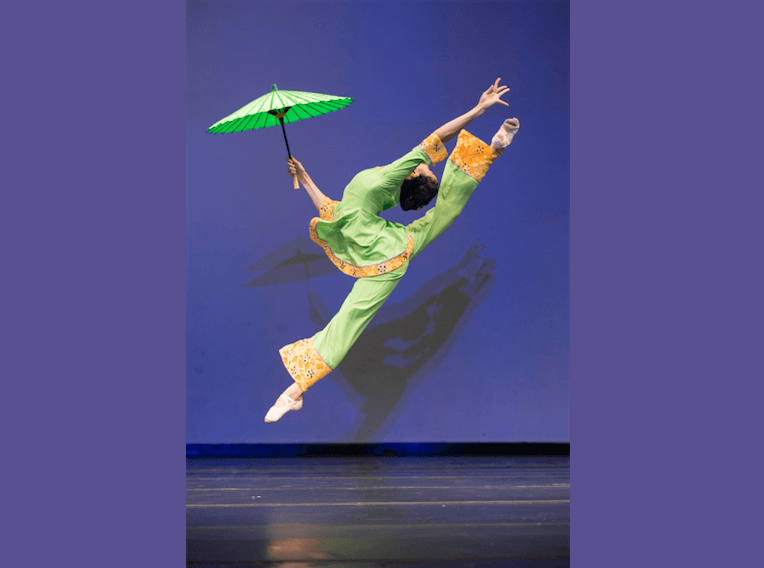
PURCHASE, NY—”When a dancer performs classical Chinese dance at a very high level, his or her audience will feel like being completely brought into the dancer´s world. I was able to experience such a feeling many times today,” said Chen Yung-Chia, spokesperson of the Judges´ Committee of New Tang Dynasty Television´s Fourth International Classical Chinese Dance Competition in conclusion of the grand event.
Aimed to provide a platform for qualified dancers of classic Chinese dance from different parts of the world to share and improve, the competition welcomed dozens of dancers from the United States, Canada, France, Australia and New Zealand this weekend at the Performing Arts Center of Purchase College, SUNY in Westchester County, New York.
“Contestants of this year´s competition demonstrated very good skills. The judges took their use of form and bearing in their self-choreographed dances into consideration to see if they have accurately portrayed the characters. The next thing is if they could master high level acrobatic techniques such as flips and turns,” said Chen.
The form and bearing Chen talked about are the key characteristics of classical Chinese dance. Form refers to the coordination of intricate dance movements, such as a good balance between direction of the eyes, pose of the fingertips, and the body. Bearing is the expression of one´s inner feelings through dance movements. Together with various challenging techniques, these characteristics make classical Chinese dance one of the most profound dance systems in the world.
At the competition, contestants gave the audience a glimpse of the essence of Chinese culture. They portrayed historical figures, heroes, scholars, and celestial beings as well as important values from traditional beliefs such as loyalty, honesty, righteousness, and filial piety, and thus brought China´s 5,000 years of civilization alive on stage.
Choosing the winners from the group of accomplished dance professionals and students was no easy task for the judges. At the award ceremony following the finals on Sept. 12, multiple winners were announced for a good number of categories.
Miranda Zhou-Galati, along with two other contestants, won the first place among contestants of the junior female division with her piece Mulan Returns. The dance portrayed the filial Mulan´s return to her hometown. Mulan dressed up as a boy in order to replace her ill father to enlist in the army.
Galati first wowed the audience with a series of marvelous jumps and flips portraying Mulan riding a horse, and continued with gentle and feminine movements as the character looked into the mirror in her bedroom upon coming home.
“It was important for me to know the historical setting and the inner feelings of the character and imagine to be her to find out if a movement should be gentle or agile,” said Galati.
Cindy Liu, a contestant of the adult female division, was crowned for her dance Celestial Melody.
Use of special costumes and props is common in classical Chinese dance. The contestant carried a pipa, a traditional Chinese string instrument to portray a celestial maiden.
Steven Wang from the adult male division performed a sword dance. He portayed a puzzled knight who eventually enlightens that he should use his skills to do noble deeds. On the stage, Wang´s dance was infused with splendid swiftness and grace. His back flips gained wows from the audience.
“I’ve practiced back flips for more than six years. There is a saying: ‘ten years of hard work leads to one minute of performance on stage.’ That really is the case for a dancer. You have to work many years to have a solid grasp,” said Wang.
Inner cultivation is also important for an advanced dancer of classical Chinese dance. Wang said that Chinese people put an emphasis on the mind, breathing, posture, and sitting positions when educating youth in ancient times. “A dancer should also keep a calm mind. That is the key for showing solid dance movements,” he said.