



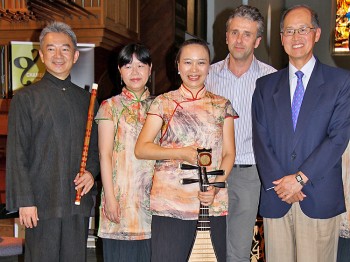
In “Silk and bamboo, a musical journey to Taiwan,” Chai Found Music Workshop provided a lively show on the last day of ChamberFest, Ottawa’s internationally renowned festival of chamber music.
The players performed traditional Sizhu music. Each plays one of the most representative instruments of a genre that originated in late nineteenth century teahouses in southern China where musicians would gather in a circle to play and drink tea.
Chai Found Music Workshop was formed 20 years ago by Chen-Ming Huang, artistic director and erhu virtuoso, Hui-Kuan Li, pipa (Chinese lute) player, and Chung-Hsien Wu who plays the di (bamboo flute).
The other members play the guzheng (Chinese zither), ruan (Chinese banjo), and yangqin (Chinese dulcimer).
Sizhu means “silk and bamboo” and represents the stringed and wind instruments played by the group. The lack of percussion in such a group presents a refined sound that is referred to as Chinese chamber music.
While Western music relies on harmony and melody, Chinese music frequently shifts the timbre through an interplay between stringed (silk) and wind (bamboo) instruments, which provides the players ample opportunity for improvisation and artistic expression.
Chen-Ming, president and artistic director of the group, took time to explain to the audience what the instruments are called and gave a short history of each. For example, nowadays the pipa (lute) is held upright on the player’s knee and played with the fingers, but it in ancient times it was held horizontally like a guitar and strummed with a wooden pick. And the ruan (banjo) was named after a famous player who lived hundreds of years ago and it forms the base of the group’s music.
The name of the group is rooted in history.
“In the Zhou Dynasty, a long time ago, there was a job titled Cai Feng Guan. This person visited various cultural events in the local communities to observe and learn about the people’s art forms, songs, and poetry. The first two words of the job title literally translate as ‘picking different elements of folk art.’ The word ‘guan’ means officer,” Chen-Ming said.
The group uses the first two words of the job title for the name of their ensemble, indicating they are music discoverers.
The players performed traditional Sizhu music. Each plays one of the most representative instruments of a genre that originated in late nineteenth century teahouses in southern China where musicians would gather in a circle to play and drink tea.
Chai Found Music Workshop was formed 20 years ago by Chen-Ming Huang, artistic director and erhu virtuoso, Hui-Kuan Li, pipa (Chinese lute) player, and Chung-Hsien Wu who plays the di (bamboo flute).
The other members play the guzheng (Chinese zither), ruan (Chinese banjo), and yangqin (Chinese dulcimer).
Sizhu means “silk and bamboo” and represents the stringed and wind instruments played by the group. The lack of percussion in such a group presents a refined sound that is referred to as Chinese chamber music.
While Western music relies on harmony and melody, Chinese music frequently shifts the timbre through an interplay between stringed (silk) and wind (bamboo) instruments, which provides the players ample opportunity for improvisation and artistic expression.
Chen-Ming, president and artistic director of the group, took time to explain to the audience what the instruments are called and gave a short history of each. For example, nowadays the pipa (lute) is held upright on the player’s knee and played with the fingers, but it in ancient times it was held horizontally like a guitar and strummed with a wooden pick. And the ruan (banjo) was named after a famous player who lived hundreds of years ago and it forms the base of the group’s music.
The name of the group is rooted in history.
“In the Zhou Dynasty, a long time ago, there was a job titled Cai Feng Guan. This person visited various cultural events in the local communities to observe and learn about the people’s art forms, songs, and poetry. The first two words of the job title literally translate as ‘picking different elements of folk art.’ The word ‘guan’ means officer,” Chen-Ming said.
The group uses the first two words of the job title for the name of their ensemble, indicating they are music discoverers.


