




It was July 1829, and Felix Mendelssohn found himself among the ruins of the Palace of Holyrood in Edinburgh, Scotland. The 20-year-old had just finished a series of impassioned concerts in London with the London Philharmonic Society earlier that year. Having received a stellar reception for his First Symphony, along with piano performances to an insatiable London audience, the silence of the Scottish countryside must have been a welcome respite. One can imagine that as the night’s lucidity set in, the young composer looked up and saw the stars emerging—a dark sky transforming into a sea of light.
It was that night in the Scottish ruins that Mendelssohn found the inspiration for a symphony. He felt compelled to recount his experiences in a letter to his family:
“In the deep twilight we went today to the palace where Queen Mary lived and loved. ... The chapel below is now roofless. Grass and ivy thrive there at the broken altar where Mary was crowned Queen of Scotland. Everything is ruined, decayed, and the clear heavens pour in. I think I have found there the beginning of my ‘Scottish’ Symphony.”

The ruined nave of Holyrood Abbey in Edinburgh, Scotland. (Christophe Meneboeuf/CC BY-SA 4.0)
A small melody was attached to the letter. The fragment would grow into the symphony’s opening theme and become the thematic seed of the later melodies. The symphony would become known as the “Scottish” Symphony.
Though the Holyrood Chapel sparked an initial burst of creativity, that inspiration alone was not enough to complete the work, and he set it aside. After touring Britain, Mendelssohn traveled south through Europe, and the melancholic atmosphere of Scotland faded into memory. The sunny coasts of Italy offered new artistic impulses. Still, they also prevented him from recapturing the somber mood that had once enchanted him.
Ironically, he later lamented how the “genial blue sky” of the Mediterranean prevented him from recapturing his “misty Scottish mood.” Yet the project was never abandoned; amid increasing responsibilities as a composer, conductor, and pianist, he gradually developed the symphony.
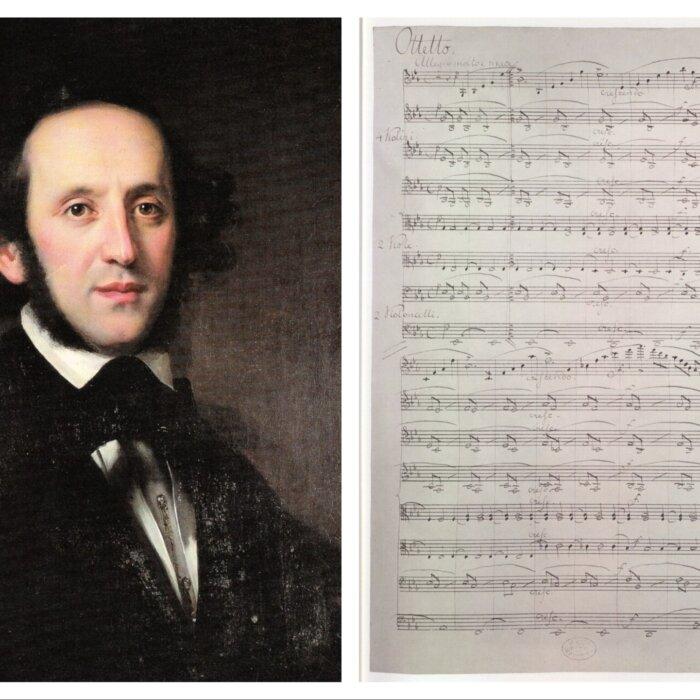

By the time Mendelssohn resumed major work on the symphony in the early 1840s, time had transformed the young composer. Mendelssohn’s years of experience deepened his musical language, allowing him to shape the youthful inspiration into a work marked by incredible maturity and depth. It was finally completed in January 1842 and premiered at the Gewandhaus in Leipzig on March 3 of the same year. Although it was the last of his symphonies to be finished, the work was published as Symphony No. 3, a title it retains today.
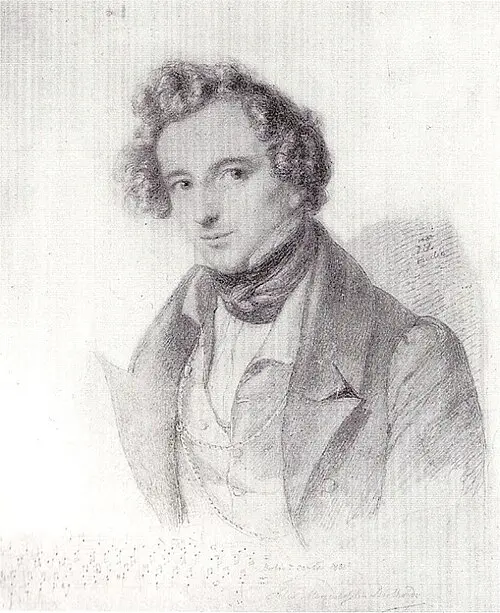
A portrait of Felix Mendelssohn, 1833, by Eduard Bendemann. Mendelssohn captured his impression of a twilight night in the roofless Holyrood Chapel and wove it into the opening of his "Scottish" Symphony. Public Domain
The ‘Scottish’ Symphony
Mendelssohn instructed the piece to be performed without breaks; the way each melody relates to the opening theme creates an intimate link between the movements. The “Scottish” Symphony received much praise for balancing Romantic emotion with Classical clarity, while subtly expanding traditional symphonic forms.Though Mendelssohn never explicitly described a scene for the work, one can imagine how the first movement’s expansive phrases in A minor seem to evoke lonely glens and brooding clouds. The clarinets and violas first introduce the somber theme that he attached to his letter home. A pulsating, lapping melody follows this; Mendelssohn evades the expected transition into a major key and instead chooses E minor. The now tumultuous mood develops and spirals into a thunderous intensity before returning to the opening figure. Only this time, the pizzicato plucking of the strings at the very end leaves the music questioning and uncertain, searching for a conclusion.
Take a listen to Edward Gardner’s recording of the first movement of Mendelssohn’s Symphony No. 3 with the City of Birmingham Symphony Orchestra—pay particular attention to the orchestra’s handling of textures and dynamics. (Listen)
Edward Gardner’s interpretation brings clarity to the music without disrupting its evocative imagery, and together with the orchestra’s expressive playing, one gets transported across the world to the solemn Scottish countryside.
What arts and culture topics would you like us to cover? Please email ideas or feedback to [email protected]


.jpg)