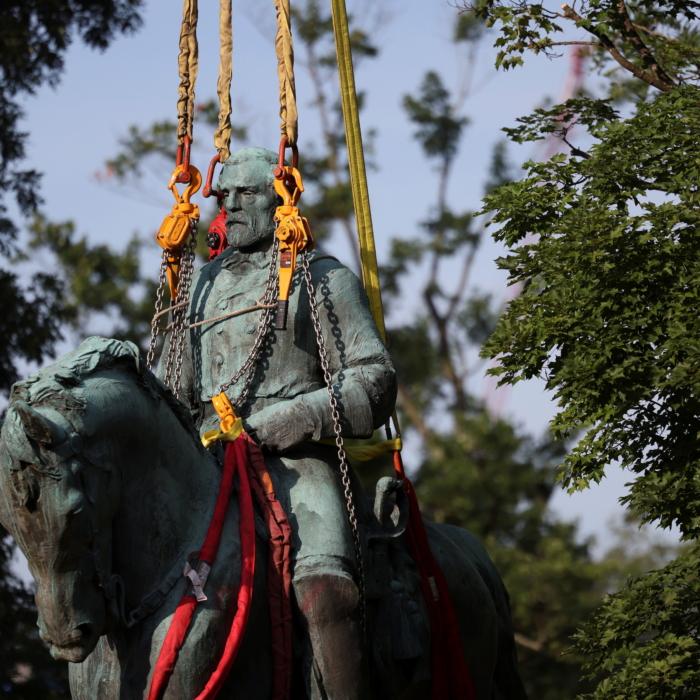
For the rest of his life, and down to our present time, Lee’s deeds brought both garlands and brickbats. As Mr. Thomas says, “Lee has been the patron saint of the American South,” yet historical figures outside of that region—Winston Churchill, Theodore Roosevelt, his cousin Franklin, and others—also lavished praise on Lee for his leadership skills and character.
Others condemned Lee. Northerners during the War considered him a traitor to the United States. More recently, as Mr. Emerson briefly mentions, late 20th-century revisionists assailed Lee’s stellar reputation. Here Mr. Emerson specifically mentions Tom Connelly’s “The Marble Man: Robert E. Lee and His Image in American Society,” writing that “Connelly argued that Lee’s image was contrived and that Lee himself endured a life replete with frustration, self doubt, and a feeling of failure. … He was actually a troubled man, convinced that he had failed as a prewar career officer, parent, and moral individual.’”

A Quest for Balance
“I am well aware,” wrote Mr. Thomas in his Lee biography, “that the portrait of Lee in these pages may offend equally those who revere and those who revile the man. I can plead only effort and honesty in defense of my understanding.”To paint that portrait, Mr. Thomas focuses more on Lee himself than on his military exploits during the War. We meet him as a boy struggling with the failures of his father, Light-Horse Harry Lee, a Revolutionary War hero who became a debtor and an outcast who rarely saw his son.



Mr. Thomas explains why Lee so often appears as a historical enigma. He was an Evangelical Christian and a stoic, with a fervent lifelong belief in the efficacy of duty and the practice of self-control. Unlike Ulysses Grant, he left no memoirs. He was a very private man, circumspect in his dealings with others and wary about sharing his innermost thoughts and emotions outside of his family circle.
The Conflicting Perspectives of Others

In Washington in 1866, Lee wrote to a friend, “I am considered now such a monster that I hesitate to darken with my shadow the doors of those I love lest I should bring upon them misfortune.”
Yet in October of 1865, Lee had signed his name to an Amnesty Oath, renewing his loyalty to the Constitution, and dispatched it to Washington. Secretary of State William Seward gave the signed oath to a friend as a souvenir, and the oath only reappeared in the national archives in 1970. As a result, unlike so many other Confederates who had received amnesty, Lee died without ever having been pardoned or regaining his rights as a citizen.
Mr. Thomas also makes clear that Lee held typical 19th-century views on freed slaves. On that 1866 trek to Washington, he appeared before a Congressional committee to testify about enslaved people’s conditions in Virginia. When asked what he thought of the new freedmen, Lee answered, “I do not think that he is as capable of acquiring knowledge as the white man is.”
However, as Mr. Thomas tells us, soon after returning to Richmond, Virginia from Appomattox, Lee was at a Sunday service at St. Paul’s Episcopalian Church when the pastor, Charles Minnegerode, invited parishioners to come forward and receive communion. “A tall, well-dressed black man” rose, went to the front of the church, and knelt at the rail, shocking the congregation. The congregation sat immobile and stunned until another man walked down the aisle and knelt at the rail near the black man.
Rare Qualities

Of all the figures in the American story, Robert E. Lee best embodies what happens when we are too ignorant or blind to recognize the nuances of history in which men and women in their own time have their own peculiar prejudices. Too many of us take a chainsaw to the past rather than a scalpel. When we read Mr. Thomas’s biography, we realize that Lee was neither a saint nor a sinner. He was a man of extreme self-discipline who was fair and merciful in his relationships and who judged himself much more harshly than he did others.

Eisenhower took time from his busy schedule to respond with a personal letter. He pointed out to Dr. Scott that the question of succession was very much in play in the first half of the 19th century, that Lee believed in the “Constitutional validity” of his cause, and that he was a magnificent leader who “remained selfless almost to a fault and unfailing in his faith in God.” Eisenhower concluded, “Indeed, to the degree that present-day American youth will strive to emulate his rare qualities, including his devotion to this land as revealed in his painstaking efforts to help heal the Nation’s wounds once the bitter struggle was over, we, in our own time of danger in a divided world, will be strengthened and our love of freedom sustained.”
Or as Mr. Thomas writes, “Lee was a great person, not so much because of what he did (although his accomplishments were extraordinary); he was great because of the way he lived, because of what he was.”