This copy is for your personal, non-commercial use only. Distribution and use of this material are governed by our Subscriber Agreement and by copyright law. For non-personal use or to order multiple copies, please contact The Epoch Times Reprints.
Illustrated portraits of sibling's Charles and Mary Lamb from "The Life and Works of Charles Lamb," 1899–1900, by Charles Lamb, Mary Lamb, and Alfred Ainger. Internet Archive. Public Domain
Most of us are shaped by the slow and steady accumulation of circumstances: the influences of parents and other family members, education or work, the tenor of the times. Sometimes the winds howl and the rain pours down, testing us to the hilt or driving our battered vessel into a safe harbor, but for the most part we sail along on the calm waters of routine, custom, and habit.
Others, however, find themselves so shaken and battered by a single cataclysmic storm that their lives are forever changed. The gale eventually passes, and though the survivors carry on as best they can, the scars and consequences of the tempest they’ve endured last a lifetime.
‘The Terrible Calamities’
A portrait of the celebrated essayist, poet, and novelist Charles Lamb, 18th century, by John Watson Gordon. Oil on canvas. Public Domain
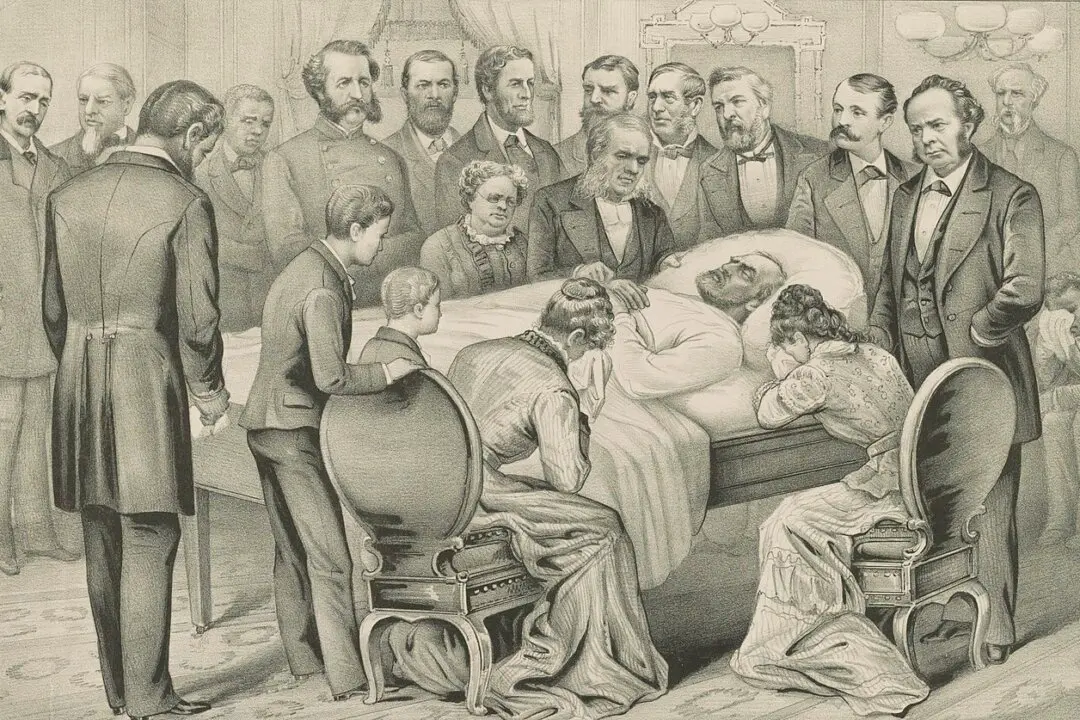
On Sept. 22, 1796, Charles Lamb (1775–1834) came home from his job as a clerk for the East India Company to a nightmare. His sister, Mary (1764–1847), who also earned money for the family as a seamstress, had suffered a manic breakdown, believed today to be caused by bipolar disorder. She seized a kitchen knife and chased her apprentice around the kitchen. When her infirm mother tried to interfere, she stabbed her through the heart and wounded her father in the head with the forks she was throwing around the room.
A few days later, Lamb described the scene and his emotions in a letter to Samuel Taylor Coleridge, a former classmate in school and a rising poet. After noting “the terrible calamities that have fallen on our family,” he added this brief description: “My poor dear dearest sister in a fit of insanity has been the death of her own mother. I was at hand only time enough to snatch the knife out of her grasp. She is at present in a mad house, from whence I fear she must be moved to an hospital.”
Justice for Mary was swift. On the following day, a coroner with a jury present determined that Mary was insane, a verdict that usually meant spending a lifetime in an asylum unless a relative stepped forward and agreed to care permanently for the afflicted person.
Twenty-one-year-old Charles took that step. For the rest of his life, between the bouts of madness that occurred every year or so and required outside assistance, he became his sister’s caretaker and best friend.
Charles had reasons for this devotion to his sister. In his infancy and toddler days, it was Mary who had watched over him and seen to his needs like a second mother, and she was his close companion during his adolescence. Moreover, he had witnessed her devotion and love for their mother, which often went unrequited. To Coleridge, he wrote that his mother “never could believe how much she loved her—but met her caresses, her protestations of filial affection, too frequently with coldness & repulse.”
Recognition and Fame
An 1828 engraving of Charles Lamb at the East India Company after the painting "Charles Lamb (1775–1834), Clerk in the East India House (1792–1825)," 1826, by Henry Hoppner Meyer. New York Public Library. Public Domain
Excluding certain getaways, Charles continued to work for the East India Company nine hours a day, six days a week—a post he held for 33 years. Despite this schedule and his safekeeping and care of Mary, he also gained a reputation for his writing, first as a poet who was a good friend of Coleridge and then of William Wordsworth and his sister, Dorothy. His best-known poem is “The Old Familiar Faces,” which he wrote in the wake of his sister’s madness and matricide. Interestingly, two versions of the poem exist. The first begins with these lines:
Where are they gone, the old familiar faces?
I had a mother, but she died, and left me,
Died prematurely in a day of horrors—
All, all are gone, the old familiar faces.
Later, probably wishing to avoid mention of this dark moment in the family’s history, he dropped these three lines, and they rarely appear now in anthologies or online.
A detail of Charles Lamb's edited poem "The Old Familiar Faces" as it appears in the publication of "The Oxford Book of English Verse, 1250–1900" by Arthur Thomas Quiller-Couch. The illustration of Charles Lamb, after the painting by Robert Hancock, was created in 1798, the same year Lamb wrote and published this poem. Public Domain
Unlike his poetry, which is little read today, Charles Lamb is remembered for his essays and letters. Many critics mark him as one of England’s finest writers in both genres. In a pocket-sized collection published by Doubleday & McClure Co. in 1899, editor Bliss Perry begins his introduction with this compliment: “The only editorial discomfort in selecting a couple of hundred of Lamb’s choicest pages has arisen from a sense of the excellence of those other pages that have not been taken.”
These works granted Lamb passage to Britain’s literary pantheon, but one other project won him popular fame.
Collaboration
Original 1907 publication of "Tales From Shakespeare" by Charles and Mary Lamb. Internet Archive. Public Domain
During their years together, the Lambs enjoyed attending and hosting gatherings of friends and writers. Both were known for their wit in conversation as well as for their kind and gentle spirits. These qualities shone as well in “Tales From Shakespeare,” their mutual production of a book narrating Shakespeare’s plays for children.
The Lambs divided the telling of these tales between them. Charles took up the tragedies, while Mary handled the comedies, or as E.V. Lucas observed in his 1907 “The Life of Charles Lamb”: “The pleasanter and more ordinarily human plays were safe with Mary Lamb, whose avoidance of adult complexities amount to genius.”
In their Preface, the Lambs conclude with the hope that their stories introducing Shakespeare to the young will be “enrichers of the fancy, strengtheners of virtue, a withdrawing from all selfish and mercenary thoughts, a lesson of all sweet and honorable thoughts [an]d actions, to teach courtesy, benignity, generosity, humanity: for of examples, teaching these virtues, his pages are full.”
An illustrated frontispiece from the circa 1922 publication of "Tales From Shakespeare" by Charles and Mary Lamb. Internet Archive. Public Domain
Initially released in 1807 under Charles Lamb’s name alone—Mary avoided publicity and public appearances, for the most part because of her past—“Tales From Shakespeare” became a bestseller for its publisher and a standard of Victorian children’s literature. It remains in print today, usually with the language modified and brought up to date.
The Lambs also produced a book of children’s poetry, which, though it sold well, never achieved the status of their Shakespeare book. And Mary wrote a series of collected and related stories, “Mrs. Leicester’s School,” which proved popular with the public.
The frontispiece for the original 1909 publication of "Mrs. Leicester's School," by Mary Lamb. New York Public Library. Public Domain
Steadfast to the Last
Because of his penchant for lighthearted humor—both in his books and in life—and his kindness, some friends referred to Lamb as “Gentle Charles,” an appellation he disliked because he associated the term with “poor-spirited.” Others viewed him as a tower of strength. Augustine Birrell, an essayist and admirer who promoted Lamb’s work, wrote: “Charles Lamb earned his own living, paid his own way, was the helper not the helped, a man beholden to no one, who always came with gifts in his hand, a shrewd man, capable of advice, strong in council.”
Frontispiece for E.V. Lucas's 1907 "The Life of Charles Lamb." Internet Archive. Public Domain
That Lamb kept the vow he’d made regarding his sister for the rest of his life reveals a man of tender devotion, but that love came wrapped in an iron glove. He had to be tough to bear such a responsibility for all those years.
And Mary recognized and returned that fraternal love. Lucas sums up this relationship by citing a friend of the Lambs, Robert Lloyd: “If we may use the expression, their Union of affection is what we conceive of marriage in Heaven. They are the world one to the other. They are writing a Book of Poetry for children together.”
In his poem “The Old Familiar Faces,” when Lamb was still suffering the fresh trauma of his household, he laments the losses of all familiar faces—childhood companions, a woman he loved, and a good friend—though he would continue down through the years to enjoy friends and good company. At the end of the poem are these lines:
How some they have died, and some they have left me,And some are taken from me; all are departed;All, all are gone, the old familiar faces.
One old familiar face, however, remained. “I could be nowhere happier than under the same roof with her,” he wrote to a friend of his sister in 1834, the year of his death.
Mary Lamb lived another 13 years, mostly under the care of nurses. Following her death, she was buried beside her brother in an English churchyard.
A memorial to Charles Lamb on the exterior of the Holy Sepulchre London. chrisdorney/Shutterstock
Jeff Minick has four children and a passel of grandkids. He has written two novels, “Amanda Bell” and “Dust on Their Wings,” as well as “Learning as I Go” and “Movies Make the Man.” You’ll find more of his writing at JeffMinick.substack.com.