Sisters in Montana
In the small town of Silver Bow, Montana, druggist Ned Elliott (Henry Travers), his wife, Rose (Beulah Bondi), and their three daughters, Louise (Davis), Helen (Anita Louise), and Grace (Jane Bryan) are preparing for the election ball that celebrates the 1904 presidential election.
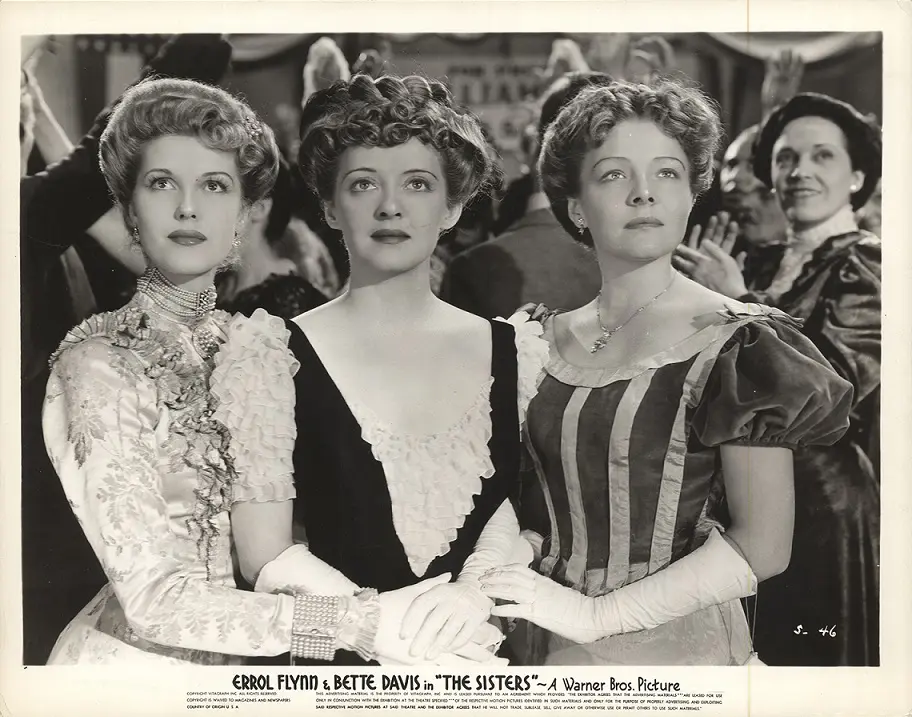
Louise’s dull but stable sweetheart, Tom Knivel (Dick Foran), whom Grace seems to like far more than her older sister does, arrives to take them in his motorcar. At the ball, Louise meets vagabond reporter Frank Medlin (Flynn), and they are instantly drawn to each other.
She invites him to dine with her family the following night, but he will only agree to come in a week’s time if she spends every evening in between with him.
A week later, at the family dinner, Louise’s parents plainly don’t approve of Frank. However, when he asks her to elope to San Francisco with him that night, she agrees.
Months pass as Frank and Louise struggle on his small salary in the big city. Back in Silver Bow, Tom proposes to Grace, and Helen marries her middle-aged but wealthy admirer, Sam Johnson (Alan Hale).
Frank and Louise
Errol Flynn is best known for playing swashbuckling heroes in adventure films, including “The Adventures of Robin Hood” (1938) and “The Sea Hawk” (1940). However, those who know about his personal life will recall that he was a functioning alcoholic most of his life, quite different from the strong, stalwart characters he so often portrayed.
Knowing this, it’s fascinating to see him in the role of Frank Medlin. Frank is a character you can’t help rooting for, even though he makes so many mistakes. His character arc avoids the predictable tropes.
He could easily have gone from the seemingly nice, charming young man to the stereotypical drunken, abusive husband, but he doesn’t. Although he plainly struggles with alcohol, he always loves Louise through all his difficulties and hates himself for making her suffer.
Louise, in contrast, is a very strong character. Her love for Frank is so deep and devoted that she believes everything will work out for them, even when it seems impossible. When he ultimately deserts her, thinking it’s for the best, she waits steadfastly for him to return.
Davis, one of the most acclaimed actresses in Hollywood history, plays the role to perfection. Subtle shifts in mood and facial expressions reveal a deep, complex, and well-studied character.

The Novel
“The Sisters” was based on Myron Brinig’s 1937 novel of the same name. As is often true of films’ source material, the book was more complex, focusing more equally on all three sisters’ lives and covering a longer timespan.
To make the plot more straightforward, the film focused on Louise and Frank’s love story, relegating her sisters and their stories to secondary positions. However, even Louise’s story was quite different in the novel. Rather than reuniting with her troubled reporter, Louise moves on after he leaves her. She marries the man for whom she works, who is played by Ian Hunter in the film.
In fact, the film was originally planned to have this ending, and it was even filmed that way. However, test audiences reacted negatively, so the movie was given a happy ending, with Frank returning to Louise at the very same event where they had first met four years earlier.
The Earthquake
One of the most dramatic points of the film comes a little after its halfway point. The very night that Frank leaves Louise, shipping out on a steamer, the infamous San Francisco earthquake of 1906 hits.Fans of classic cinema might be familiar with the longer, more famous earthquake sequence from MGM’s film “San Francisco” (1936). In fact, if you’ve seen that film, you’re sure to recognize some shots of the burning city in the aftermath of the quake. The two films did indeed share footage, but it originated in the 1927 silent film, “Old San Francisco.”
While this quake sequence isn’t as epic or prolonged as the one in “San Francisco,” it’s still harrowing and amazingly filmed. During the earthquake, Louise is caught in her apartment, screaming and stumbling in terror as the building collapses around her; this sequence is one that’s sure to stick with you. Plus, the potent symbolism of her world literally falling apart when her husband leaves her isn’t to be overlooked.
During the classic era of movies, Warner Bros. was considered the “realist” studio, as opposed to the fanciful grandeur of MGM. No other studio was as devoted to delving into complex human emotions and relationships, and this film is no exception.
Each character in the story is a deep, multilayered one, no matter how little screentime he is allotted. If you’re a fan of Davis, Flynn, 20th-century literature, or just someone looking for a deep, romantic, heartwarming film experience, you’re sure to love “The Sisters.”