All human beings have flaws and weaknesses. Abraham Lincoln was a human being. Therefore, Abraham Lincoln had flaws and weaknesses.
This simple categorical syllogism is valid, yet we often forget that the historical luminaries we consider heroes struggled with private difficulties and imperfections just like the rest of us. Many Americans regard Abraham Lincoln not only as a hero who rose head and shoulders above the men and women of his time—literally as well as figuratively—but also as a near mythological figure from the past. He appears on the U.S. penny, the $5 bill, and the Lincoln Memorial in Washington, which resembles a Greek temple. Historians and the public alike rightly regard him as one of the greatest of our presidents.
Yet when Lincoln entered the White House with the nation on the verge of civil war, we should remember that he carried his own troubles and defects.
Here are two pieces of this personal baggage.
Marriage
With some exceptions, like his choice of Andrew Johnson as his running mate in the 1864 presidential election, Lincoln was a good judge of character. He assembled a “Team of Rivals” for his cabinet made up of men with opinions at odds with his own and with each other. Lincoln had studied them and deemed each worthy of a place in the government.Regarding marriage, however, his discernment was lacking. Perhaps he was blinded by love, confusion, or fear of marriage itself. Precisely why he and Mary Todd married remains a question unsettled by historians. Passion and emotion don’t come with cut-and-dried explanations.
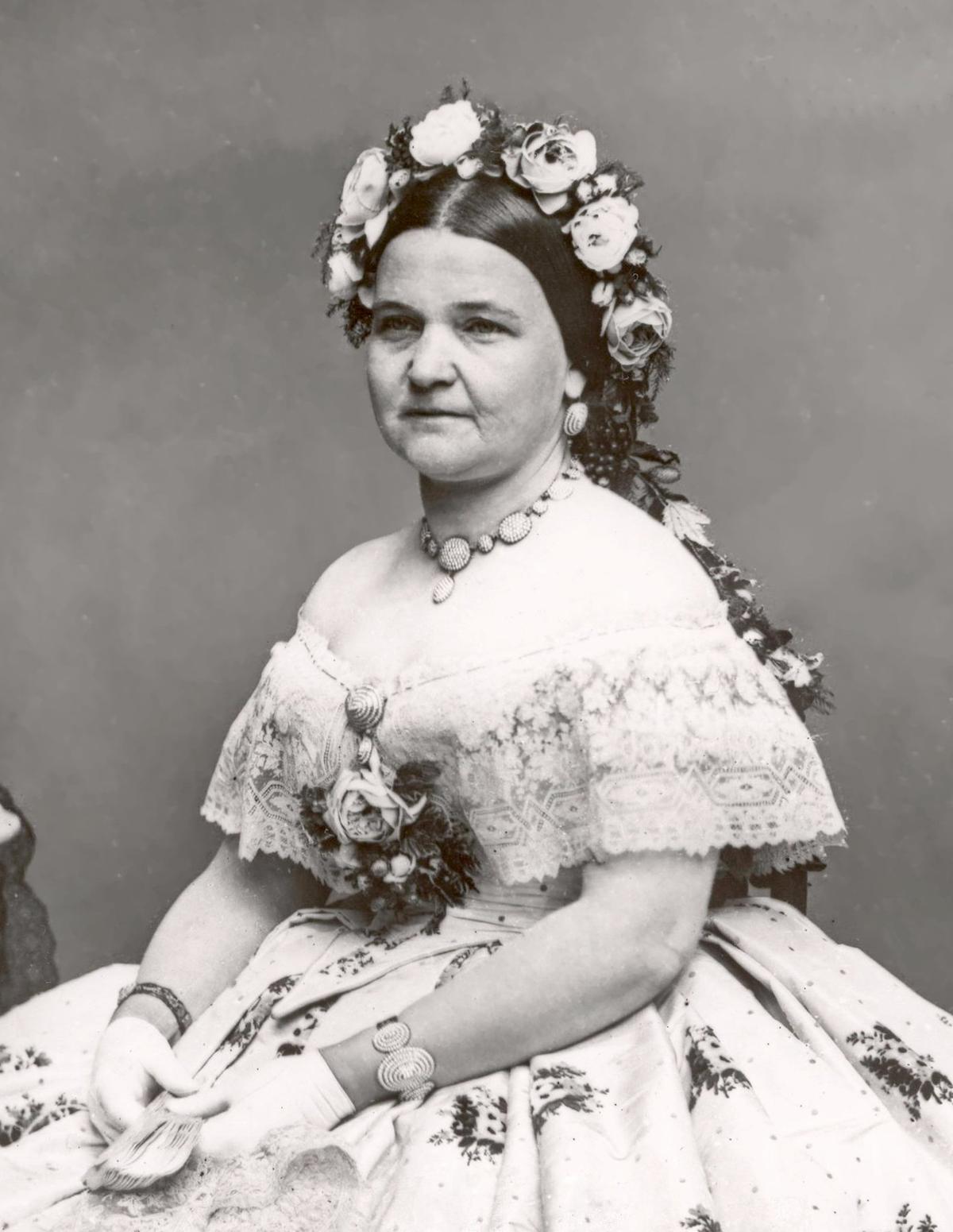
Mary Todd Lincoln, 1861, in a portrait photo by Matthew Brady. Public Domain
High strung, flirtatious, and easily given to anger and scorn, Mary Todd was born into wealth, was well-educated and bright, and enjoyed high society and spending money. The couple became engaged in 1840. But just before the wedding in January 1841, Lincoln broke off the engagement, probably because of his growing doubts about the marriage and the disapproval of her family. Nearly two years would pass before the couple, having patched up their differences, were married in November 1842.
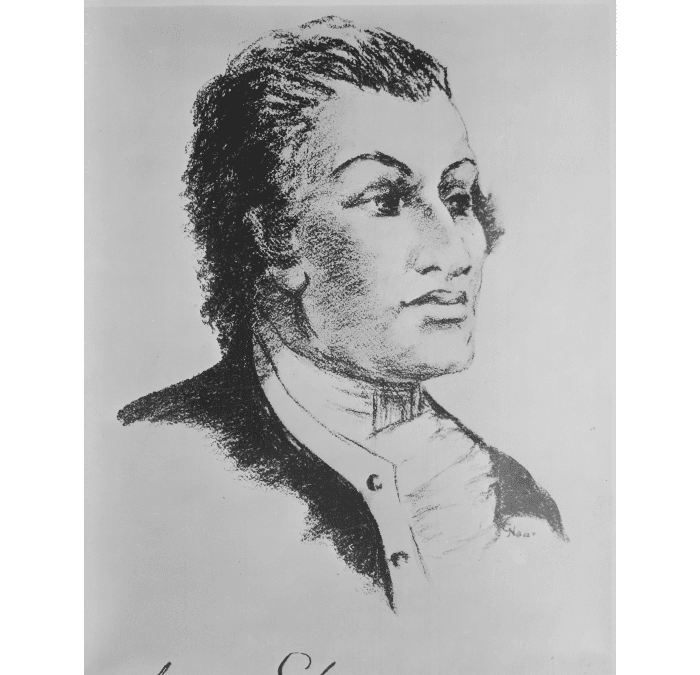
While Lincoln and Mary loved each other, it was a mismatch that brought both good and bad to his political life. His chief fault as husband was his frequent indifference to Mary’s troubles. Meanwhile, Mary was ambitious and pushed her husband to excel, but when he became president, she sometimes overstepped, demanding favors from other politicians and from members of the Lincoln cabinet. She was often lavish with money they didn’t have, spending it on expensive clothing and unnecessary accoutrements, and could become enraged when annoyed with Lincoln.
Col. Alexander McClure, who worked with Lincoln, later wrote of Mary: “In her figure and physical proportions, in education, bearing, temperament, history—in everything she was the exact reverse of Lincoln.”
Yet Lincoln had learned early on to play the diplomat with his wife. Michael Burlingame’s biographical book “The Inner World of Abraham Lincoln” records instances of his docility. Once, having granted her wishes “on a small matter in the White House, he told friends: ‘If you knew how little harm it does me and how much good it does her, you wouldn’t wonder that I am meek.’”
Deep Dark Depression
Closely associated with Lincoln’s broken engagement in January 1841 was a depression that rendered him so ill that he took to bed. From Jan. 13 to 19, he was absent from his seat in the Illinois legislature. He had experienced melancholia his entire life, but this time was different. His law partner William Herndon, who in his biography of Lincoln later described him as “crazy as a loon,” feared his friend was on the verge of suicide, though others consider that claim exaggerated.That Lincoln suffered, however, is beyond doubt. On Jan. 23, he wrote to former law partner John Stuart: “I am now the most miserable man living. If what I feel were equally distributed to the whole human family, there would not be one cheerful face on the earth. Whether I shall ever be better I can not tell; I awfully forebode I shall not. To remain as I am is impossible; I must die or be better, it appears to me.”
With the help of friends, Lincoln recovered from this bout of depression. He would continue wrestling for the rest of his life with “The hypo,” as he called it, short for hypochondria. Friends and visitors to the White House frequently commented on the sadness that marked him, yet he never again suffered so devastating a setback. He had learned a valuable lesson—he would “be better.”
He encouraged other sufferers of depression, telling them that even the blackest episode would pass. In late 1862, after learning of the dark sadness that had settled on a young acquaintance, Fanny McCullough, after the death of her father in the Civil War, he sent her words of advice that helped in her recovery:
“I am anxious to afford some alleviation of your present distress. Perfect relief is not possible, except with time. You can not now realize that you will ever feel better. Is not this so? And yet it is a mistake. You are sure to be happy again. To know this, which is certainly true, will make you some less miserable now. I have had experience enough to know what I say; and you need only to believe it, to feel better at once. The memory of your dear Father, instead of an agony, will yet be a sad sweet feeling in your heart, of a purer and holier sort than you have known before.”
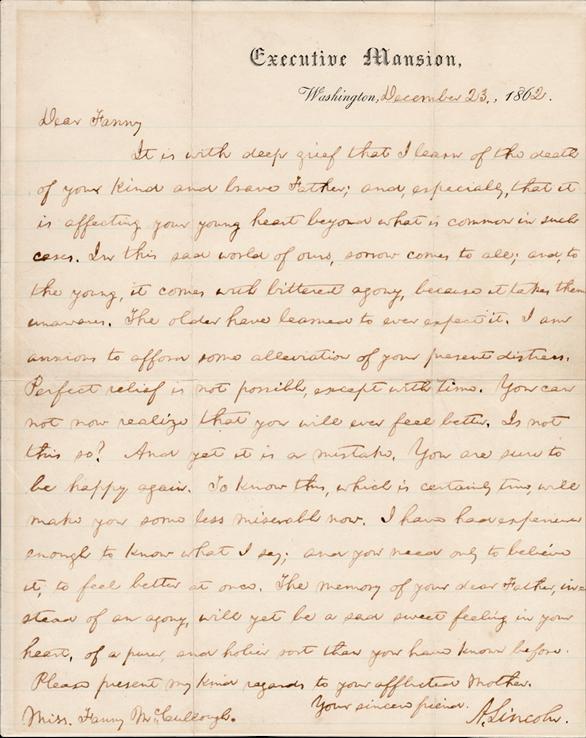
The letter of condolence from Abraham Lincoln to Fanny McCullough, 1862. Public Domain
A Lesson in Character
No matter how many accolades are heaped on men and women whom the world considers great, all of them are human, which means that all have troubles and interior difficulties. But the greatest of the great are the ones who, like Lincoln, fight against their shortcomings rather than tolerate or indulge them. He honored his imperfect marriage, keeping his equanimity when Mary railed against him or others. He fought off depression with the sword and shield of hope that the darkness would again become light.“Would you have a great empire? Rule over yourself,” is a quote attributed to Publilius Syrus, a Roman slave and writer of aphorisms.
Lincoln ruled over himself.
What arts and culture topics would you like us to cover? Please email ideas or feedback to [email protected]