Not like the brazen giant of Greek fame, With conquering limbs astride from land to land; Here at our sea-washed, sunset gates shall stand A mighty woman with a torch, whose flame Is the imprisoned lightning, and her name Mother of Exiles. From her beacon-hand Glows world-wide welcome; her mild eyes command The air-bridged harbor that twin cities frame. “Keep, ancient lands, your storied pomp!” cries she With silent lips. “Give me your tired, your poor, Your huddled masses yearning to breathe free, The wretched refuse of your teeming shore. Send these, the homeless, tempest-tost to me, I lift my lamp beside the golden door!”
When Edouard de Laboulaye had the idea for France to present a monumental gift to the United States in 1865, it required a massive fundraising effort from both countries. Laboulaye wanted to celebrate the close relationship between France and America, the centennial of the Declaration of Independence, and the recent abolition of slavery in the United States. The statue, originally known as “Liberty Enlightening the World,” had many ideas to encompass.Sculptor Frédéric-Auguste Bartholdi was commissioned to design the statue. With a crown evoking the sun’s rays extending into the world, a tablet inscribed with “JULY IV MDCCLXXVI” (July 4, 1776) to symbolize American independence, and a broken shackle and chains beneath the statue’s foot to symbolize the end of slavery, Lady Liberty would eventually stand holding her torch aloft as a beacon of welcome to immigrants who sailed past her on their way to America. In the meantime though, the United States was tasked with funding and building the pedestal while France was responsible for creating and funding the statue.

A portrait of Frédéric-Auguste Bartholdi, 1896, by Jean Benner. Public Domain
As one of the fundraising efforts in the United States, Emma Lazarus wrote a poem titled “The New Colossus” for an art and literary auction. Lazarus was born in 1849 in New York to a wealthy Jewish American family. By the 1860s, she was already publishing translations of German poems. She published her first book of poetry in 1866 when she was just 17. This poetic prodigy became friends with Ralph Waldo Emerson, who also served as her mentor. Yet despite these accomplishments, after her death in 1887, the body of her other work was largely eclipsed by “The New Colossus.”
In giving the Statue of Liberty a voice, Lazarus expanded the symbolism of the statue. Originally intended to represent republicanism and the friendship between two countries, it now came to represent compassion and a new hierarchy of values. The poem disdains “the pomp of ancient lands” and overturns the ancient conception of might, depicting the strength of America not as a conqueror but as the “Mother of Exiles” who embraces rather than destroys.

The statue of liberty is a quintessential American landmark. Aussieactive/Unsplash
The Old Colossus
The poem’s title indicates that a full understanding of the poem is impossible without knowledge of the old Colossus. The “brazen giant of Greek fame” was the Colossus of Rhodes, one of the seven wonders of the ancient world. Built between 292 B.C. and 280 B.C., the Colossus of Rhodes was a bronze statue of the god of the sun, Helios, and stood just over 98 feet tall. Helios was the patron deity of Rhodes, and the statue was constructed after the city withstood the Siege of Rhodes by Demetrius Poliorcetes of the Antigonid dynasty. It was toppled by an earthquake in 226 B.C., having stood for only 54 years.Though both the Statue of Liberty and the Colossus of Rhodes are symbols of freedom, Lazarus’s poem opens with the express intent to show how the Statue of Liberty is unlike its predecessor. While the old Colossus served as a reminder of how the Rhodians successfully repelled an attack on their city and rebuilt their defenses, the new Colossus is a symbol of welcome to those whom the world would consider defeated. Therefore, the poem subverts the ancient understandings of success and victory.
Related Stories
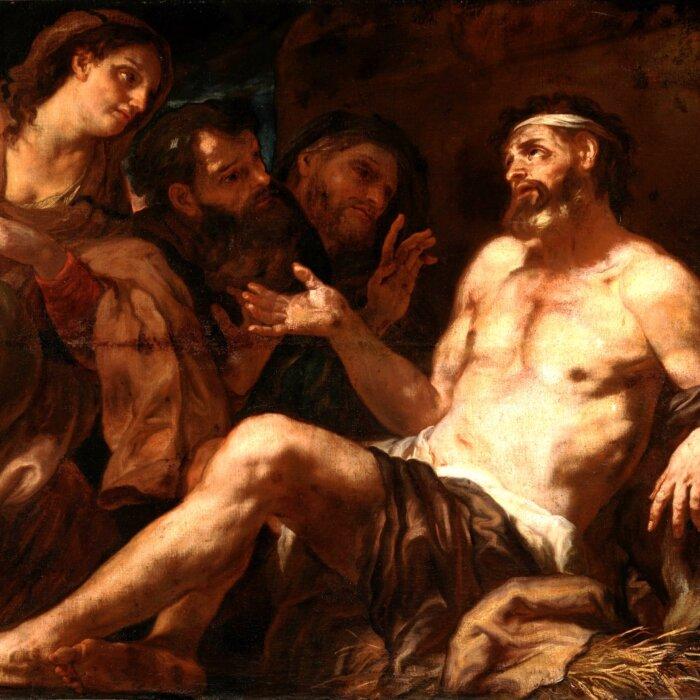
After defeating the Antigonids, the Rhodians collected the valuable equipment their attackers had left behind and sold it to fund the construction of their statue. By contrast, Lady Liberty’s treasure isn’t the spoils of war or exultation over enemies but the people who embody a lack of success in the world’s eyes. In alignment with the Judeo-Christian values on which the country was founded, it is the poor, the homeless, the humble, and the “wretched refuse” rejected by the world who are exalted and made desirable in the poem.
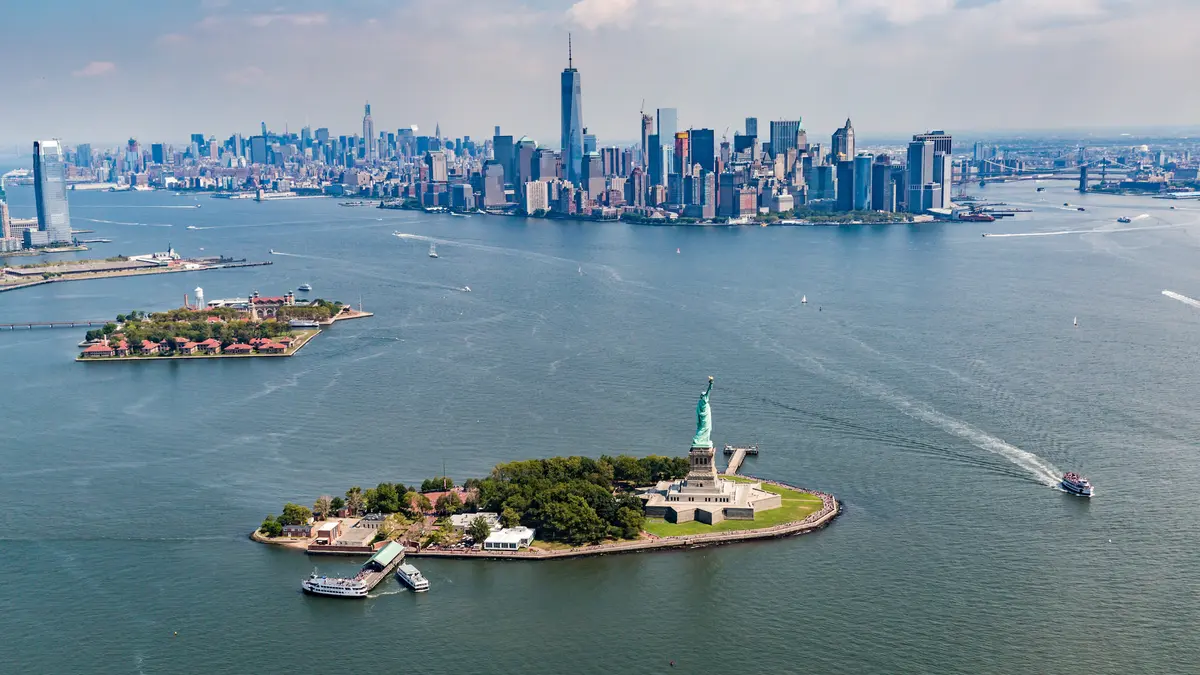
Ellis Island and Liberty Island. Shutterstock
A Light to the World
The poem paints a picture of a country that withstands and endures hardship. Its gates are “sea-washed” and the people welcomed there are “tempest-tost.” But, they are no longer outcasts but people who belong to the place. Unlike the old Colossus “with conquering limbs astride from land to land,” Lady Liberty encompasses the land in her gaze, including the “twin cities” of Brooklyn and New York, which at the time hadn’t yet been consolidated into the city of Greater New York. Lady Liberty’s eyes are mild but have the power to command; the flame of her torch is “imprisoned lightning.”These lines point not only to her power but to her restraint. Her torch is at once fire and lightning but also “world-wide welcome,” creating a sense of balance and strength exercised with justice and gentleness rather than cruelty.
Though Lazarus came from a wealthy family and her ancestors had been among the first Jewish settlers in the English colonies, she was deeply sympathetic to the cause of Jews escaping persecution in Russia. She worked as an aide for Jewish immigrants and was involved in charitable work for refugees. After traveling twice to Europe in 1883 and from 1885 to 1887 to participate in social reform, she died at the age of 38, shortly after returning from the second trip. Her words are engraved on a plaque on the pedestal of the Statue of Liberty, carrying on her work of urging the country to continue to be a beacon of liberty, hope, and compassion to the world.
What arts and culture topics would you like us to cover? Please email ideas or feedback to [email protected]