On Aug. 15, 1824, a great man arrived in New York at the start of a “Grand Tour” of America. Though his plan called for a four-month visit to the 13 states that comprised the original colonies, he ultimately stayed four times as long and met cheering throngs in all 24 states that comprised the Union at that time.
President James Monroe had extended the invitation to this beloved gentleman as part of the forthcoming celebration of America’s 50th birthday in 1826. It was the perfect choice. This man, the esteemed Marquis de Lafayette, came to America from his native France as a teenager to help the country secure its liberty and independence.
Lafayette laid his life on the line “for the cause” and never took a penny for his efforts. He joined the staff of Gen. George Washington (who came to love him as a son), endured a serious leg wound at the Battle of Brandywine, suffered with the troops in the awful winter at Valley Forge, helped Benjamin Franklin secure French support of the war effort, and played pivotal roles as a commander in battle after battle, including the deciding finale at Yorktown in 1781. In his 20s, he achieved the rank of major general in the Continental Army.
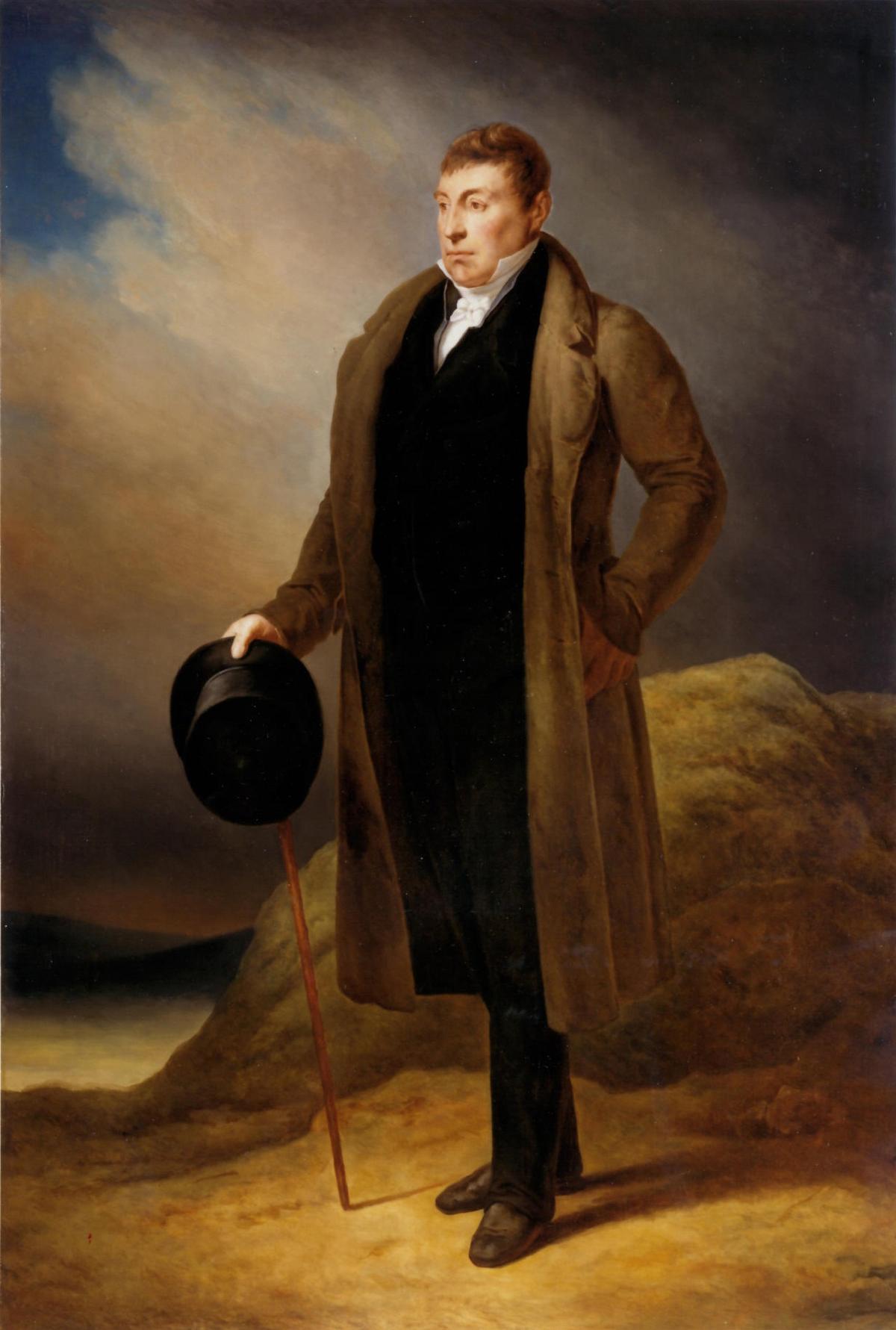
An 1823 portrait of Lafayette by Ary Scheffer. Collection of the U.S. House of Representatives. It was the most famous image of Lafayette during his U.S. tour in 1824. Public domain
That would be an impressive record if Lafayette had done nothing more, but it barely scratches the surface of the man’s greatness. It’s sufficient, however, to explain why his 16-month Grand Tour remains the biggest and longest celebration Americans have ever showered upon a foreigner.
Nearly 90 percent of the people of New York City turned out to welcome him as he disembarked from his ship. Massive, adoring crowds enveloped him in Boston, Philadelphia, Charleston, St. Louis—indeed, everywhere he went. He was 67 years old. Few Americans had seen or spoken to this living legend in half a century. Yet everyone not only knew who he was, but they loved him immensely. Historian Shannon Selin writes:
“Lafayette travelled over 6,000 miles, visiting all 24 states, some more than once. He was greeted with enthusiastic cheers, receptions, parades, processions, parties, banquets, concerts and balls. Locals decorated his route and erected ceremonial arches for him and his entourage to pass through. Church bells rang out in his honor. Cannons were fired in salutes. People praised him in toasts, speeches, poems and songs. He reviewed militias. He spoke with veterans and visited battlefields, including the site of the Battle of Brandywine, where he was wounded in the leg in 1777. He laid cornerstones and dedicated monuments. He toured mills, canals, farms and factories. He blessed children. He met Native Americans. A souvenir industry sprang up, producing dishes, ribbons, pins, badges, medallions, fans, quilts and clothing emblazoned with Lafayette’s name and/or image. Lithographs and paintings depicted scenes from the Revolution and his visit. New biographies of him were issued. Buildings, streets and towns were named for him, as were many children. His progress was breathlessly chronicled by the newspapers.”In a sense, Americans are still celebrating him today. No fewer than 36 American cities and towns are named for him, such as Fayetteville, North Carolina, and Lafayette, Louisiana.
Born Marie-Joseph Paul Yves Roch Gilbert du Motier in 1757, the Marquis de Lafayette deserves high ranking among the pantheon of liberty’s champions. Consider these additional facts from his remarkable life:
- We have Lafayette to thank for the preservation of Independence Hall in Philadelphia. The building was falling into disrepair when city officials decided to spruce it up for the visit of the Marquis. At age 19 in 1777, Lafayette had politely knocked on its door to ask Congress to let him join the fight against George III. When the war ended, he famously opined: “Humanity has won its battle. Liberty now has a country.”
- A lifelong abolitionist, he was ahead of his time on the matter of slavery. He enjoyed many close friendships with blacks in America and frequently urged “freedom for all mankind.”
- When the French Revolution broke out in 1789, it was Lafayette (as an elected member of the Estates General) who penned the initial draft of the Declaration of the Rights of Man and of the Citizen. Being thus a critical figure in the birth of both the American and French republics, he earned the lasting sobriquet, Hero of Two Worlds. His Declaration contained this superb, concise definition of his most cherished goal: “Liberty consists in the freedom to do everything which injures no one else; hence the exercise of the natural rights of each man has no limits except those which assure to the other members of the society the enjoyment of the same rights.”
- As the French Revolution took a tyrannical, anti-liberty turn, he fell out of favor with the radicals in power (such as the butcher Maximilien Robespierre). He was stripped of his French citizenship.
- When revolutionary France went to war with the rest of Europe, Lafayette was captured and imprisoned by the Austrians for two years. This might have saved him from the radicals and their bloody guillotine.
- Napoleon Bonaparte came to power in 1799, restored Lafayette’s citizenship, and offered to make him France’s ambassador to America. Lafayette declined because his affinity for America was so strong, he said, that he couldn’t imagine himself on the other side of a table from his friends. Though he was grateful for Napoleon’s treatment of him, he strongly opposed the French leader’s move to declare himself emperor-for-life. Lafayette even publicly turned down Napoleon’s repeated offers of political appointments, saying he would only consider such positions if they came from a government answerable to a free people.
- After Napoleon’s abdication and the restoration of France’s Bourbon monarchy in 1815, Lafayette refused to lend any moral authority to King Louis XVIII. As a result, he was shut out of the government. Only his international fame saved him from a worse fate. When President Monroe’s invitation to visit America arrived on his desk in 1824, Lafayette was more than ready for the warm welcome from the country whose independence he had fought for.
“I have always loved liberty with the enthusiasm which actuates the religious man with the passion of a lover, and with the conviction of a geometrician. On leaving college, where nothing had displeased me more than a state of dependance, I viewed the greatness and the littleness of the court with contempt, the frivolities of society with pity, the minute pedantry of the army with disgust, and oppression of every sort with indignation. The attraction of the American revolution transported me suddenly to my place. I felt myself tranquil only when sailing between the continent whose powers I had braved, and that where, although our arrival and our ultimate success were problematical, I could, at the age of nineteen, take refuge in the alternative of conquering or perishing in the cause to which I had devoted myself.”If you visit Paris, be sure to pay your respects at Picpus Cemetery, the largest private cemetery in the city. An American flag flies there above Lafayette’s body. He’s buried beneath American soil because the site was sprinkled with earth that he himself brought in a trunk when he visited Bunker Hill in Boston years before. During World War I, American troops frequently stopped at the great man’s grave, where they cried, “Lafayette, we are here!”
Never forget the Marquis de Lafayette. He remains one of the best friends liberty ever had. May his Grand Tour for Liberty never end.
For Additional Information
“Marquis de Lafayette: Hero of Two Worlds” (Simon Whistler Biographics video on YouTube)“Lafayette in the Somewhat United States” by Sarah Vowell
“Lafayette” by Harlow Giles Unger
“Lafayette: The Lost Hero” (video)
“Lafayette’s Visit to America in 1824–25” by Shannon Selin
This article was originally published by the Foundation for Economic Education on FEE.org.