Let’s hear it for ambitious kids!
A 12-year-old boy named Hussein was desperate to get a job on Englishman Howard Carter’s archaeological dig in Luxor, Egypt. It was 1922 and Carter was struggling. For years, he’d been searching unsuccessfully for the tomb of Pharaoh Tutankhamun, the “boy king,” who died as a teenager.
His patron, George Herbert, the fifth Earl of Carnarvon, and an avid collector of Egyptian antiquities, told Carter he was cutting off his funding after the season. (You may better recognize Lord Carnarvon because his family are the owners of Highclere Castle, the setting for “Downton Abbey”.)
Then Hussein’s donkey tripped on something—upon further examination it was an ancient step. The workers soon uncovered 14 ancient steps on that hot day in August 1922 that led to the tomb of the “Boy King” Tutankhamun, more than 3,300 years after his death at 18 or 19, likely from sepsis. The sensational find—the only near-intact royal tomb from ancient Egypt—generated tremendous excitement around the world.
Unlike previous tombs that had been found, King Tut’s hadn’t been badly plundered, likely because it was incredibly well concealed and hidden by debris.
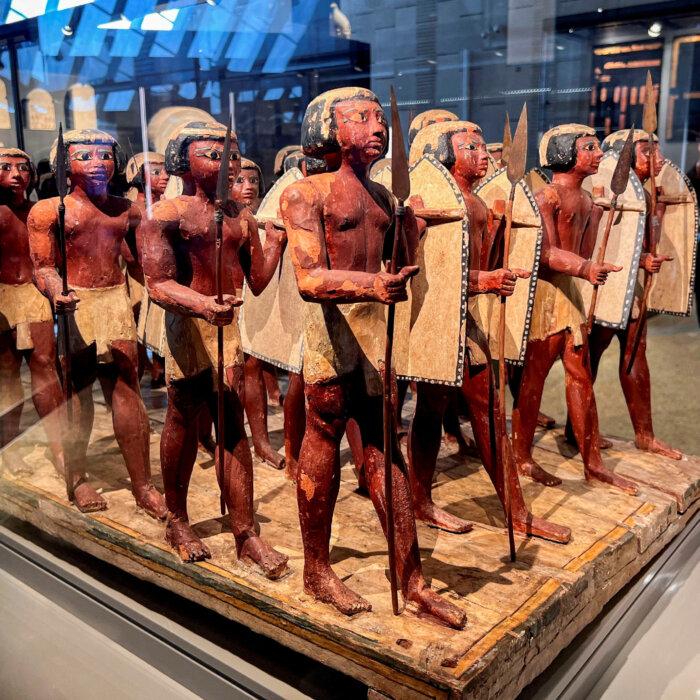
There were 5,664 masterpieces, including gold finger and toe sleeves that were placed over the Boy King’s fingers and toes, gold necklaces, and many amulets to help his voyage to the afterlife, as well as earrings he likely wore, even a lock of his grandmother’s hair in small nesting coffins. His inner-most coffin was made of gold and weighed more than 242 pounds. Perhaps the most famous artifact? The golden funeral mask. Zeid noted that when the new exhibit opens, there will be toys Tut would have played with as a boy.
All that is left in the tomb now is King Tut’s mummy, extensive hieroglyphs, and wall paintings that depict scenes and religious texts related to the young pharaoh’s life and afterlife. The colors on the wall paintings are remarkably still largely noticeable, including 12 baboons representing the 12 months of the year.
“They always see things with new eyes and that gives me the opportunity to see things I might have missed,” said their grandmother who was traveling with her son and his family. (Yes, we felt completely safe in both countries.)
There were mummies, huge statues, some placed up the central staircase, all varieties of jewelry and anything and everything ancient Egyptians believed they would need in the afterlife, including plates, jars of alabaster, chairs, ornate boxes that held organs after mummification, carvings of sacred falcons, cobras (said to protect the royals in the afterlife), and much, much more.
A fun fact: You will know you are looking at a king’s statue if you see a bee and a goose. Bees represented royalty while ancient Egyptians believed the goose was a messenger between heaven and Earth.
Then there are the different expressions on the statues’ faces. We learned that in the new kingdom (1400 BC) times were good, so the statues were shown smiling; in the middle kingdom (2000 BC) they were shown with sad faces because those were times of trouble for Egypt.
As you enter the museum, you can’t help but be wowed by the 36-foot-tall, 83-ton red granite statue of King Ramesses II who ruled for more than 60 years. The statue is so tall that the museum building was constructed around it.
The GEM is the largest archaeological museum complex in the world with more than 100,000 artifacts from prehistoric times through Egypt’s thousands of years of pharaonic civilization and through the ancient Greek and Roman periods of Egyptian history. Visitors can’t help but be impressed by the unusual building, shaped like a triangle. The building’s north and south walls line up directly with the Great Pyramid of Khufu and the Pyramid of Menkaure.
We first stayed at Mena House, now a Marriott Hotel, in sight of the pyramids that has been the site of key summits during World War II and before the famous Camp David Accords. The best part: You can see the reflection of the Great Pyramids in the pool outside. Some in our group ventured inside the pyramids, a tight squeeze!
There was little downtime, but no one minded on this bucket list trip. “Seeing pictures just can’t compare,” one in the group opined.
“Anytime you can go with the grandchildren, say yes!” the Pennsylvania grandmother added. “It has been the best trip.”