Some 15,000 years ago, tribes of Native Americans made their home in a wilderness area of what today is southern Florida. At that time, they lived in an arid landscape that was also inhabited by giant sloths, saber-toothed cats, and South American bears.
Later, climate change created a wetter environment that did not support those animals but did attract Spanish explorers and colonizers. A large tract of this former wasteland is now preserved as Everglades National Park, the largest tropical wilderness in the United States. In addition to a portion that is covered by razor-sharp sawgrass, it contains growths of mangrove trees and shrubs, tropical hardwood hammocks, pine and cypress forests, and freshwater prairie.
While many visitors enter the park to appreciate its natural beauty and recall its history, others come to enjoy a range of activities. These include guided sightseeing boat trips, exploration by canoe or kayak, hiking and biking, fishing, overnight camping, and shelling. Wildlife spotting is also a popular pastime. Alligators are the most sought-after prey for viewing, preferably at a distance. They’re often spotted in sloughs, which are channels connecting sawgrass prairies that are also favored by turtles, snakes, and fish.
The Everglades offers a hospitable habitat for some rare and endangered species. These include the large, cowlike manatee, the American crocodile, and the elusive Florida panther. Only about 200 of those panthers, which are members of the cougar family, are believed to remain in the wild. Somewhat surprisingly, they lack the ability to roar and instead make distinct sounds that include whistles, chirps, hisses, and purrs.
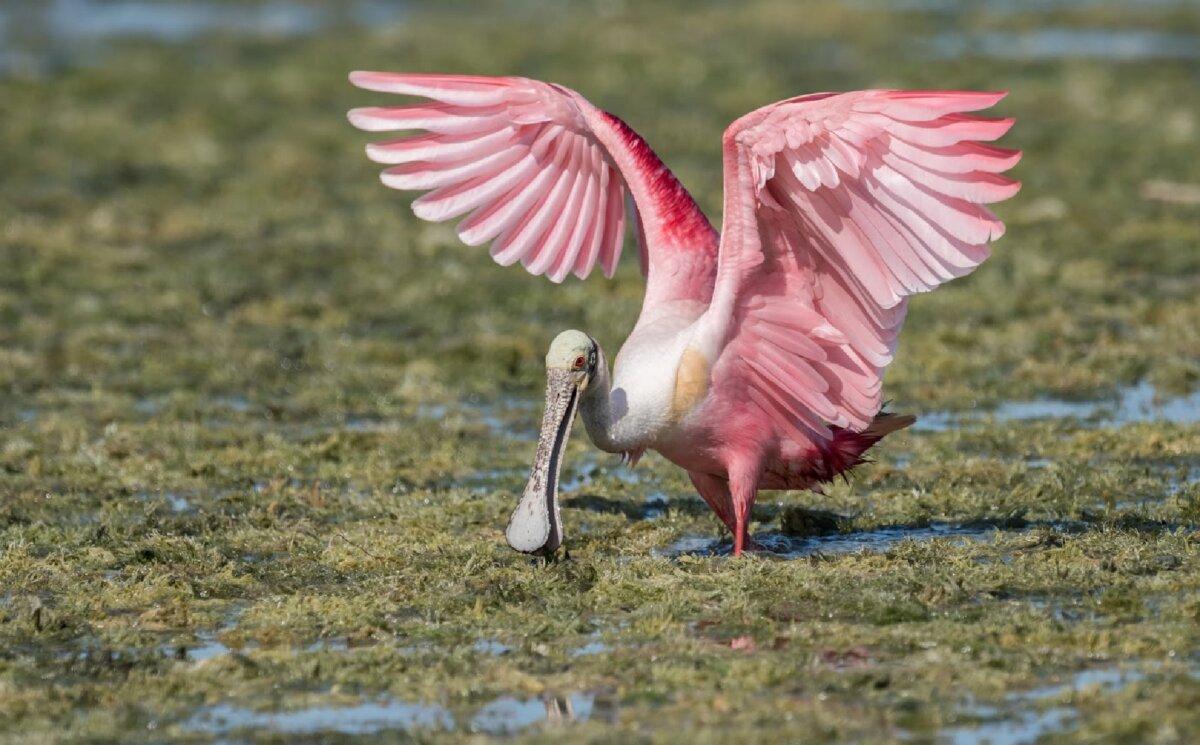
Much more prolific are the birds that make the Everglades their home or stop by on their annual migration flights. The warm, shallow waters have attracted countless types of birds for thousands of years, and more than 360 species have been identified in the park. Generally, they can be placed in one of three groups: wading birds, land birds, and birds of prey. Those with binoculars can enjoy looking for American bald eagles, roseate spoonbills, and dazzling painted buntings.
I experienced much that the Everglades has to offer during an excursion in an airboat. Those practical vessels are perfect for moving through marshy and shallow areas where a standard engine with a submerged propeller could not operate. The flat-bottomed airboat is driven by a large propeller mounted on the stern. It pushes the boat over the top of the water, usually at speeds approaching 35 mph. The operator typically sits in an elevated position, which provides a perfect perch for spotting wildlife. Alligators were the primary target of our outing, and we were rewarded with several sightings. They were augmented by a virtual aviary of birds with intriguing names such as snake bird and long-legged gallinule.

Native Americans who first inhabited the area got around in flat-bottom dugout canoes. They were made by hollowing out the center of cypress trees. Because the water was so shallow, they were propelled by push poles rather than paddles.
Evidence of human habitation also awaits discovery at some sites in Everglades National Park. Shell mounds serve as reminders that Native Americans who resided there long ago disposed of the outer casings of edible mollusks and mollusks used as tools in heaps. Archaeologists theorize that these formations were used to identify sacred places and separate them from living quarters and other public areas.
A visit to the Miccosukee Indian Village on the edge of the Everglades provides an introduction to that tribe’s history and culture, along with the inevitable touches of commercialism. Included are alligator demonstrations, a resort, casino, and golf club. Tribal members demonstrate beadwork, basket weaving, and other traditional skills, and exhibits at a museum include artifacts, photographs, and a documentary film.

Like many of Mother Nature’s magnificent handiworks, Everglades National Park faces a number of challenges. Climate change is causing the sea level to rise, which results in intrusion by saltwater and increased evaporation. Pollution, in part from phosphorous-based fertilizers, is a growing concern. The influx of people moving to Florida is adding to the need to find land for housing developments.