Then when he was 16, his father sent him to the Amherst Academy in Massachusetts to study navigation after noticing his high aptitude. While attending school, he continued to experiment heavily with explosives.
Samuel Colt never claimed to have invented the revolver, but his ingenuity forever changed the way they were designed and manufactured. Throughout his life, Colt proved his ability to overcome failure. He also reinvented how firearms were made, marketed, and sold. Although he died before he could enjoy his fortune, the company he built continues to be a pioneer in the firearm industry today.
Colt was born on July 19, 1814 in Hartford, Connecticut to Sarah Caldwell Colt and Christopher Colt. His father owned a textile business. But all wasn’t easy. Colt experienced a troubled childhood. Of his eight siblings, at least three passed away young. Of his eight siblings, at least three passed away young. One of his sisters died of tuberculosis when she was 19 and another committed suicide. His mother died from tuberculosis when he was just 6 years old. Two years later, his father remarried.
At age 11, Colt was sent to Glastonbury, Connecticut where he was indentured to a friend who was a farmer. He became fascinated with guns after his grandfather, who served in Gen. George Washington’s Continental Army, gave colt his old flintlock pistol.
During his time working and attending school in Glastonbury, Colt soon began reading a scientific encyclopedia called the “Compendium of Knowledge.” He grew fascinated with gunpowder and explosives. When he was 15, he moved to Ware, Massachusetts to work at his father’s mill. He learned machining techniques from the skilled workers and had access to tools and materials to make his ideas reality. One time, he advertised an event where he would blow up a raft in a local lake. The explosion missed the raft, but put on quite a show.

The young Samuel Colt pored over an early encyclopedia, much like this one, when he was a teenager. Public Domain
Later on July 4, 1830, Colt detonated an explosion that set a school building on fire. He was expelled.
A Change in Life’s Path
Presumably angry, Colt’s father sent him to India on the brig Corvo. Colt learned the sea trade firsthand on his way to Calcutta. While acting as apprentice seaman, he became fascinated with the ship’s wheel. It spun freely, but then clicked into place with a ratchet. He got an idea that he could do the same with a pistol so that it could fire multiple times successively. Most guns during the era could only fire one shot at a time and took a decent time to reload.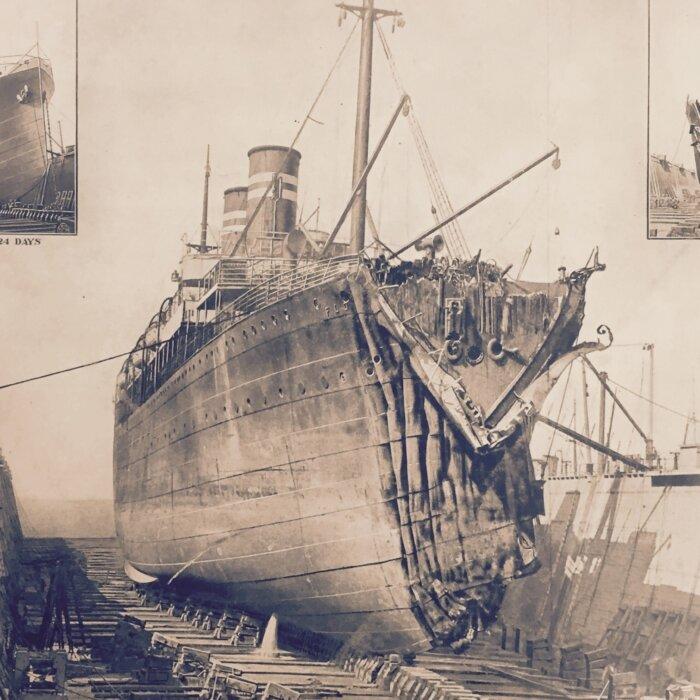
When Colt returned home two years later, he put his idea for a new revolver to work. His father paid for him to design a rifle and a pistol. But when the pistol exploded when first fired, his father stopped funding Colt’s inventions.
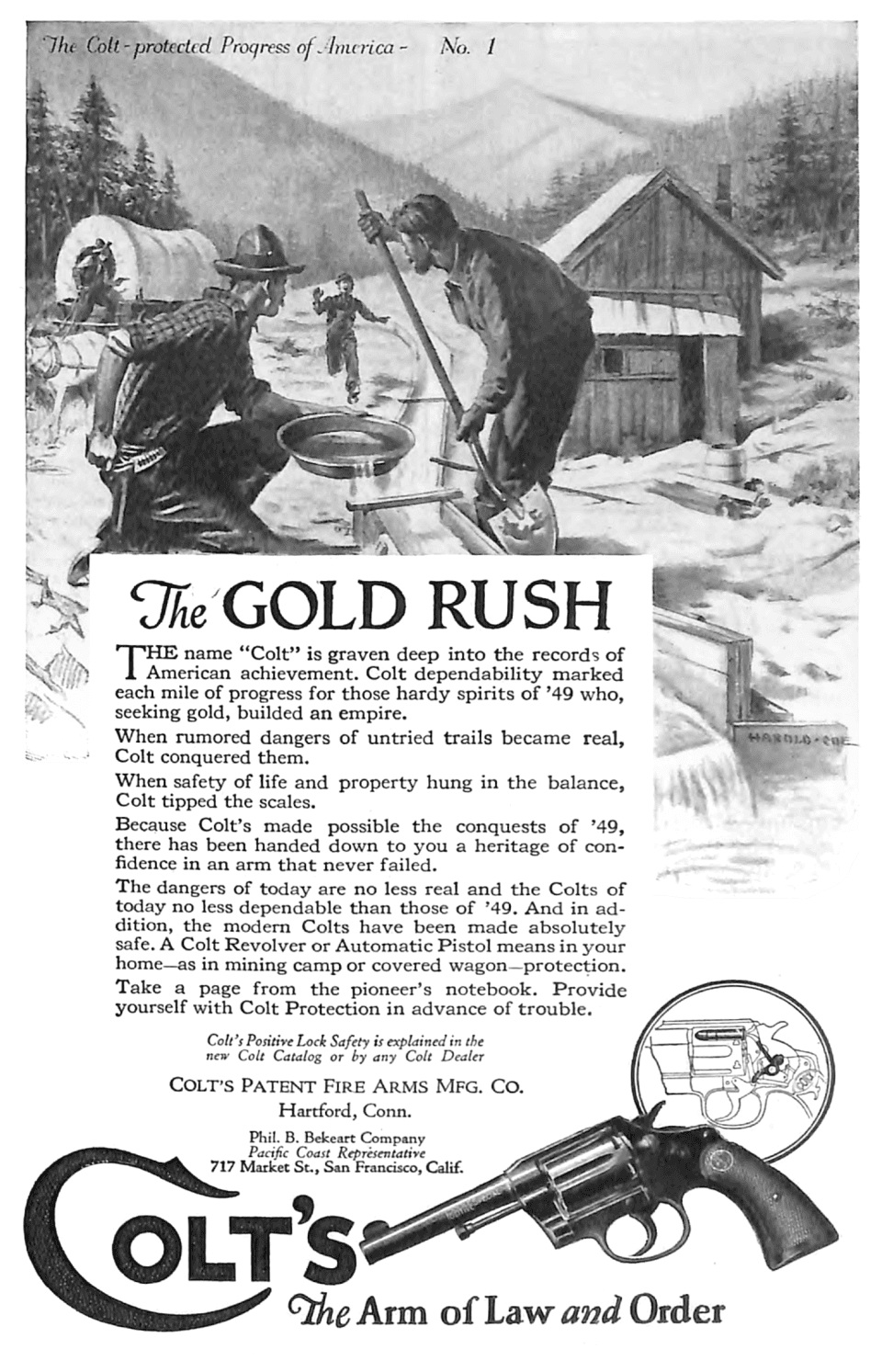
Advertisements for the Colt revolver were ahead of their time; Samuel Colt turned out to be masterful at marketing his product. Public Domain
Not to be defeated, Colt decided to go on tour the United States. Calling himself a doctor, he gave dramatic public demonstrations of laughing gas, a new medical development for two years. After he saved some money, he went to a gunsmith in Baltimore, Maryland, and they improved the design over the next few years. In 1835, Colt was awarded a patent in England and France before getting his “revolving gun” patented in the United States on Feb. 25, 1836.
By the end of 1837, Colt’s company had made over 1,000 guns, but they weren’t selling well. A new law that stated that state militias could only buy weapons that were being used by the U.S. military. By 1842, Colt had to shut down his factory.
But Colt’s ingenuity didn’t end there. He worked with Samuel Morse—the inventor of Morse code—to design a waterproof telegraph cable that could be laid underwater. He planned to use it as a fuse to set off mines in case of a British invasion. He demonstrated that an underwater explosive system could destroy a moving ship. His invention impressed the U.S. Navy and President John Tyler, but a politician named John Quincy Adams, later the sixth U.S. president, put a stop to the project, saying the invention was an “unchristian contraption,” according to Robert Longley’s online biography of Colt.

"Mrs. Elizabeth Hart Jarvis Colt and son Caldwell," 1865, by Charles Loring Elliott. Elizabeth Colt helped manage her husband's manufacturing company after his early death. Public Domain
Long-Awaited Success
Colt would soon get his big break after Capt. Samuel Walker noticed Colt’s revolver when it was used in the Seminole Wars. Walker saw how a 15-man unit defeated 70 Comanche warriors in Texas. In 1847, Walker set out to New York City to find Colt and order his weapons.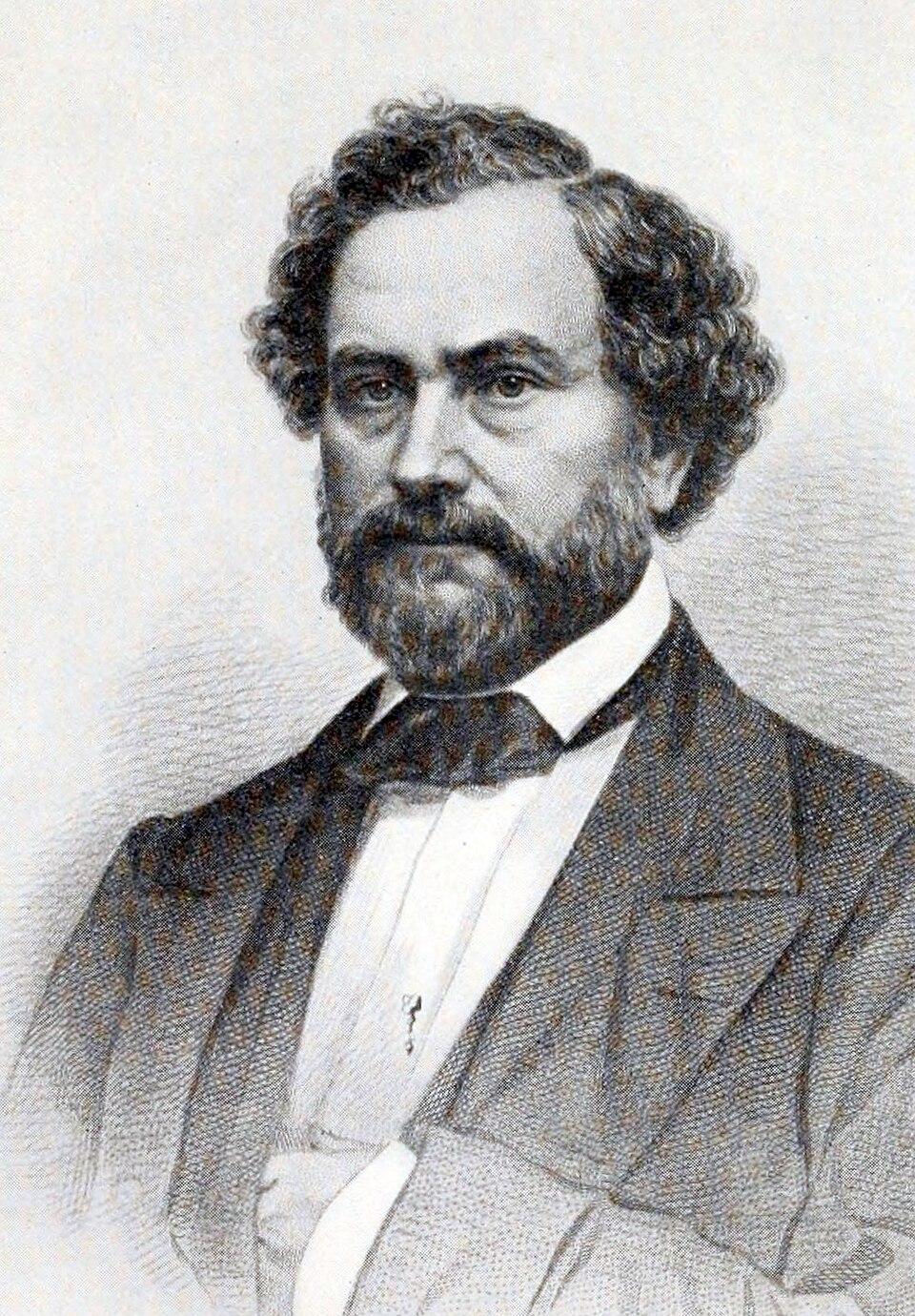
An 1857 engraving of Samuel Colt. Public Domain
Walker found Colt at a New York gunsmith shop, but he told Colt a few changes had to be made before he purchased the revolvers. Walker wanted them to fire six rounds instead of five, and he wanted it to be easier to reload. He also told Colt he wanted the firearm to be able to kill a human or a horse with a single shot.
Colt originally produced 1,000 models of the Colt Walker pistol. He then sold 1,000 more to the same militia company. Colt used his proceeds of $10 per pistol to build his first factory in Hartford, Connecticut and then opened a factory in London in 1853.
As his product’s popularity surged, Colt found new ways to sell and market his weapons. Since some foreign leaders wouldn’t meet him because he was a private citizen, Colt convinced the governor of Connecticut to make him a lieutenant colonel in the state militia. Colt gifted engraved pistols to military leaders and famous people. He even hired Western artist George Catlin (1796–1872) to paint pictures with people using Colt pistols to protect themselves.
Over the years, Colt’s weapons became famous as people began to settle in the western part of the country. Soon, Colt’s weapons were sold around the world using the slogan, “God created men, Col. Colt made them equal.”

An unidentified Union soldier holds a Colt revolver across his chest, circa 1861–1865. Library of Congress. Public Domain
Shortly after the Civil War started, Colt died from gout on Jan. 10, 1862. He never shot a gun he made at another human. Over the years, Colt Manufacturing has produced over 30 million pistols, revolvers, and rifles. Today, the company is most known for the government-contract production of the M16 assault rifle and the AR15 semiautomatic rifle.
What arts and culture topics would you like us to cover? Please email ideas or feedback to [email protected]