This copy is for your personal, non-commercial use only. Distribution and use of this material are governed by our Subscriber Agreement and by copyright law. For non-personal use or to order multiple copies, please contact The Epoch Times Reprints.
Built for an audience of 2,000, the Concert Hall is the largest and most elaborate part of the palace. Extensive windows—covering most of the walls and much of the ceiling—make it the only European concert hall fully illuminable by natural lighting. The yellow center of the skylight resembles a chandelier from the sides and the sun from underneath. Other decorative elements include a massive marble arch, mosaiced columns, and hundreds of sculpted flowers. Dave Z/Shutterstock
Built between 1905 and 1908, the Palace of Catalan Music in Barcelona, Spain, is a masterpiece of Catalan art nouveau. The concert hall was the crowning achievement of architect Lluís Domènech i Montaner (1849–1923). It is the most exemplary architectural work inspired by the Catalan Renaissance, which aimed to restore Catalan language, literature, and national identity.
Just 100 years earlier, the distinctive culture of Spain’s region of Catalonia was decaying. If Spain’s unification under King Ferdinand and Queen Isabella initially created conditions for cultural flourishing, it slowly led to the artificial dominance of the Castilian region. King Philip V’s early 18th-century political centralization accelerated the process.
Linguistic differences between Catalonia and Castile provided the initial spark for the Catalan Renaissance, which began as a literary movement in the 1830s. The following decades saw it spread into the other arts. Vocal music—to which Catalan linguistic tradition is also central—became particularly important.
A choral society at the forefront of Catalan Renaissance music, the Orfeó Català, commissioned the Palace of Catalan Music and chose Montaner—an established Catalan art nouveau architect. The architectural style emphasizes organic forms, undulating lines, and the integration of sculpture, stained glass, and wrought iron.
Stylistically, art nouveau was influenced by naturalist and medievalist movements such as the Gothic Revival. But it was more eclectic, also drawing from classical and baroque styles. The palace exemplifies that eclecticism and mixes architectural elements found throughout Catalonia’s long history with its classical columns and Moorish mosaics. Modern materials such as steel allowed for rooms to be constructed on a larger scale with fewer supports than would have been historically possible.
In 1997, the Palace of Catalan Music was declared a UNESCO World Heritage Site. Today, more than half a million visitors annually attend live concerts or tour the concert hall. Guided tours explore the palace’s main concert hall, the Lluís Millet Hall, the vestibule, and the Petit Palau—an underground auditorium that was added in 2004.
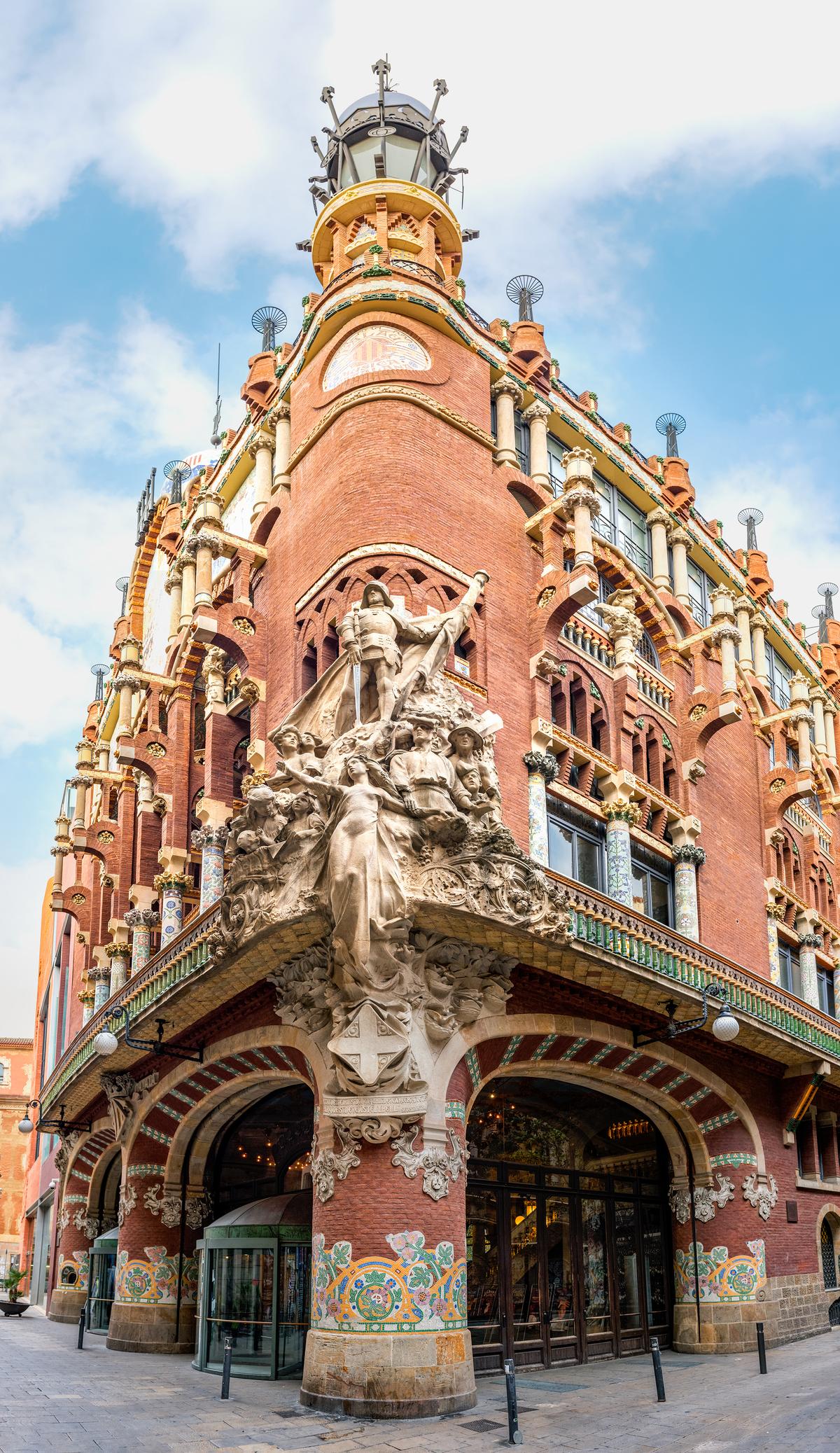
The palace’s southeast corner, located at a significant intersection, is the centerpiece of its facade. A cluster of classical sculptures called "The Catalan Folk Song" by Miguel Blay stand out against the most sober part of the facade background. Most of the figures represent Catalans in traditional garb. Above them stands St. George—Catalonia’s popular patron saint—in a full suit of armor. Valerie2000/Shutterstock
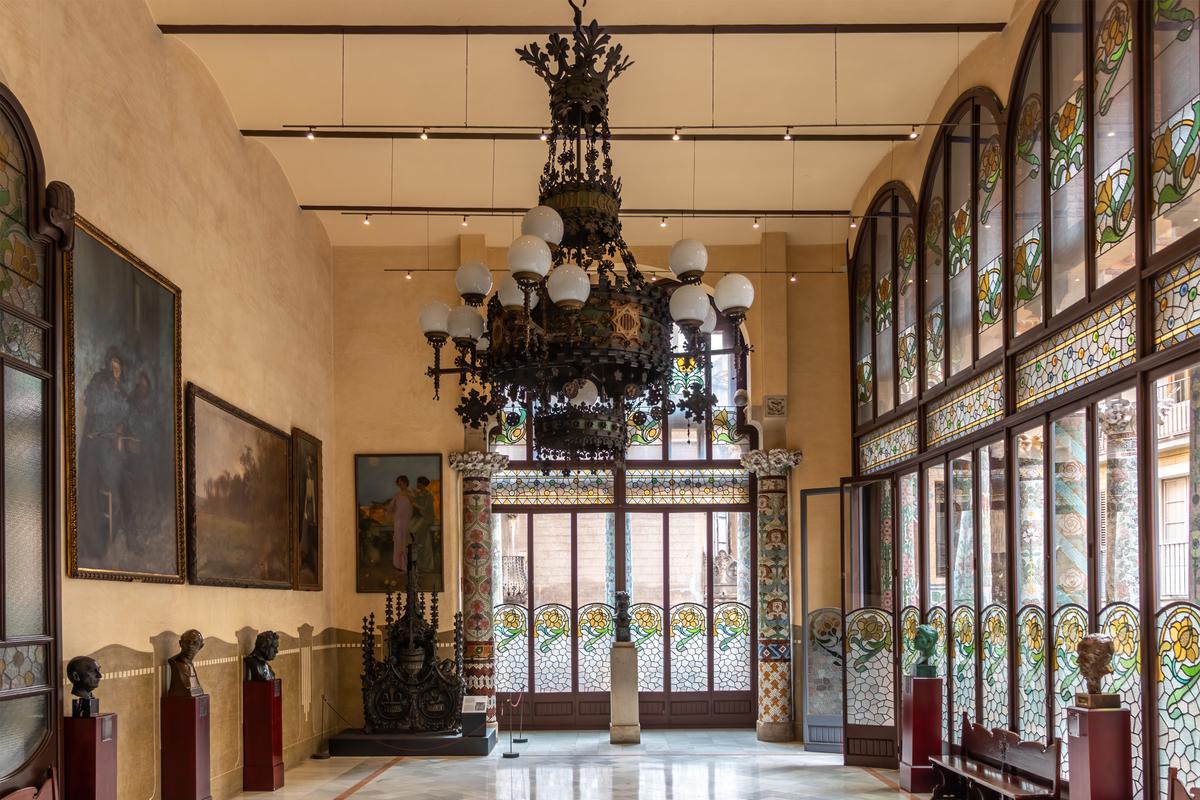
Named for one of the Orfeó Català’s founders, the Lluís Millet Hall features three walls of glass with ornately wrought flowers, mosaiced columns, and a 650-pound wrought-iron arts and craft-style chandelier. Busts of figures associated with the palace or the Orfeó Català—including Millet and his co-founder, Amadeu Vives—line the walls. agsaz/Shutterstock
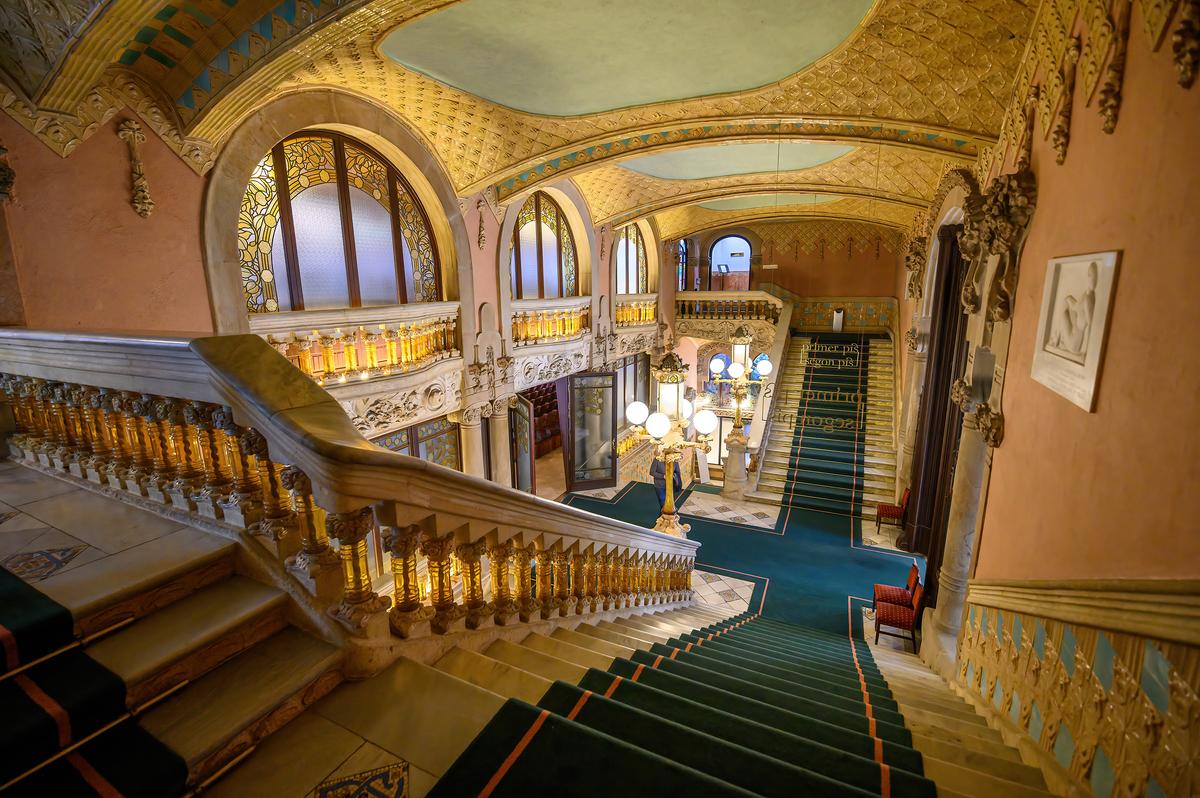
Flanked by crowned lamps on columns, the grand marble staircase features a marble balustrade supported by transparent yellow glass balusters. The foyer and staircase exemplify elements of Catalan art nouveau with the fluid and curved lines, floral motifs, stained-glass windows, and organic green and gold coloration. Mitzo/Shutterstock
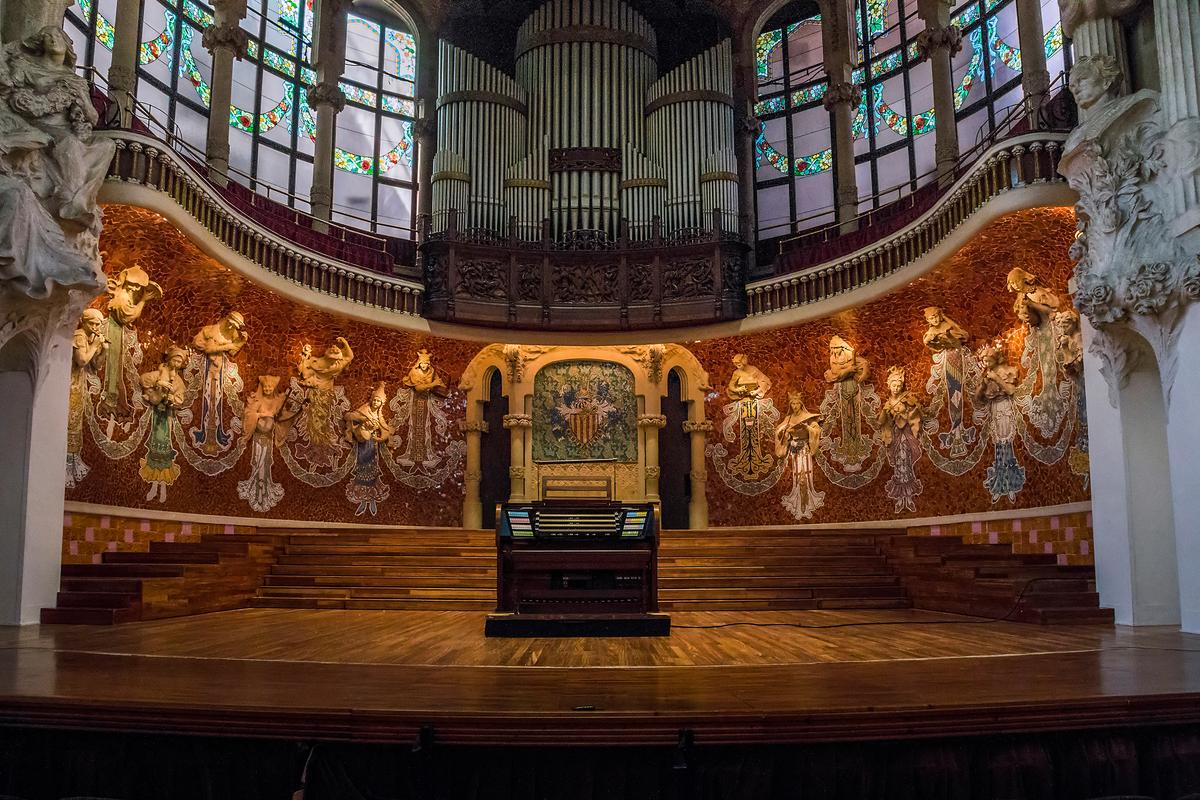
Gothic sculptures of the muses with musical instruments form a semicircle behind the stage and are separated into two groups by the Catalan coat of arms at the center. The sculptures’ upper bodies emerge from a mosaic wall behind them, which features prominently red and orange tiles. Above the stage is a gallery reminiscent of a church choir loft that contains a pipe organ with more than 3,000 tubes. goga18128/Shutterstock
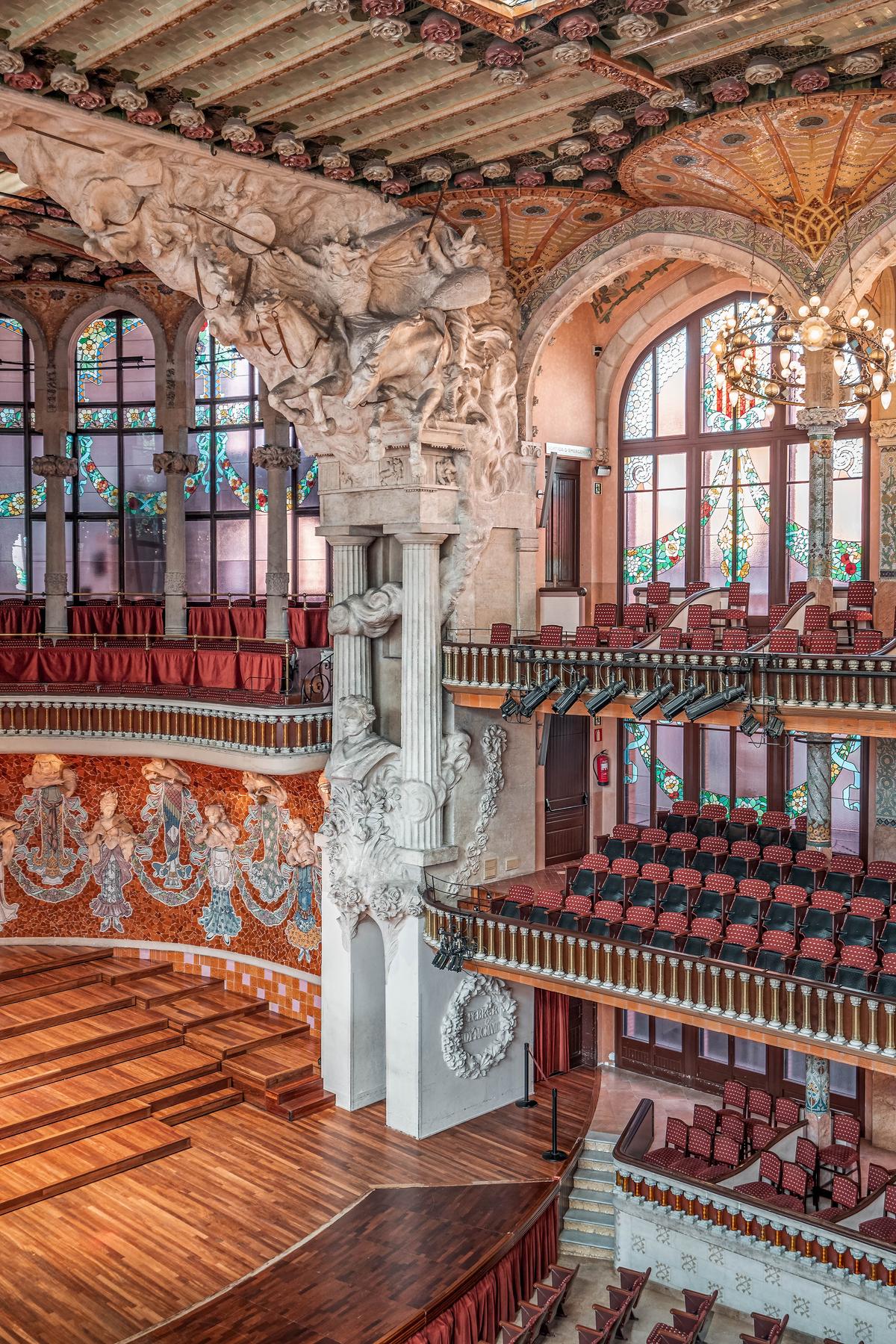
Pablo Gargallo and Dídac Masana’s sculpted marble arch frames the Concert Hall’s stage. A bust of Ludwig van Beethoven is featured between the Doric columns on the right side, topped by the sculptural group “Ride of the Valkyries” from Richard Wagner's opera “Die Walküre.” Dave Z/Shutterstock
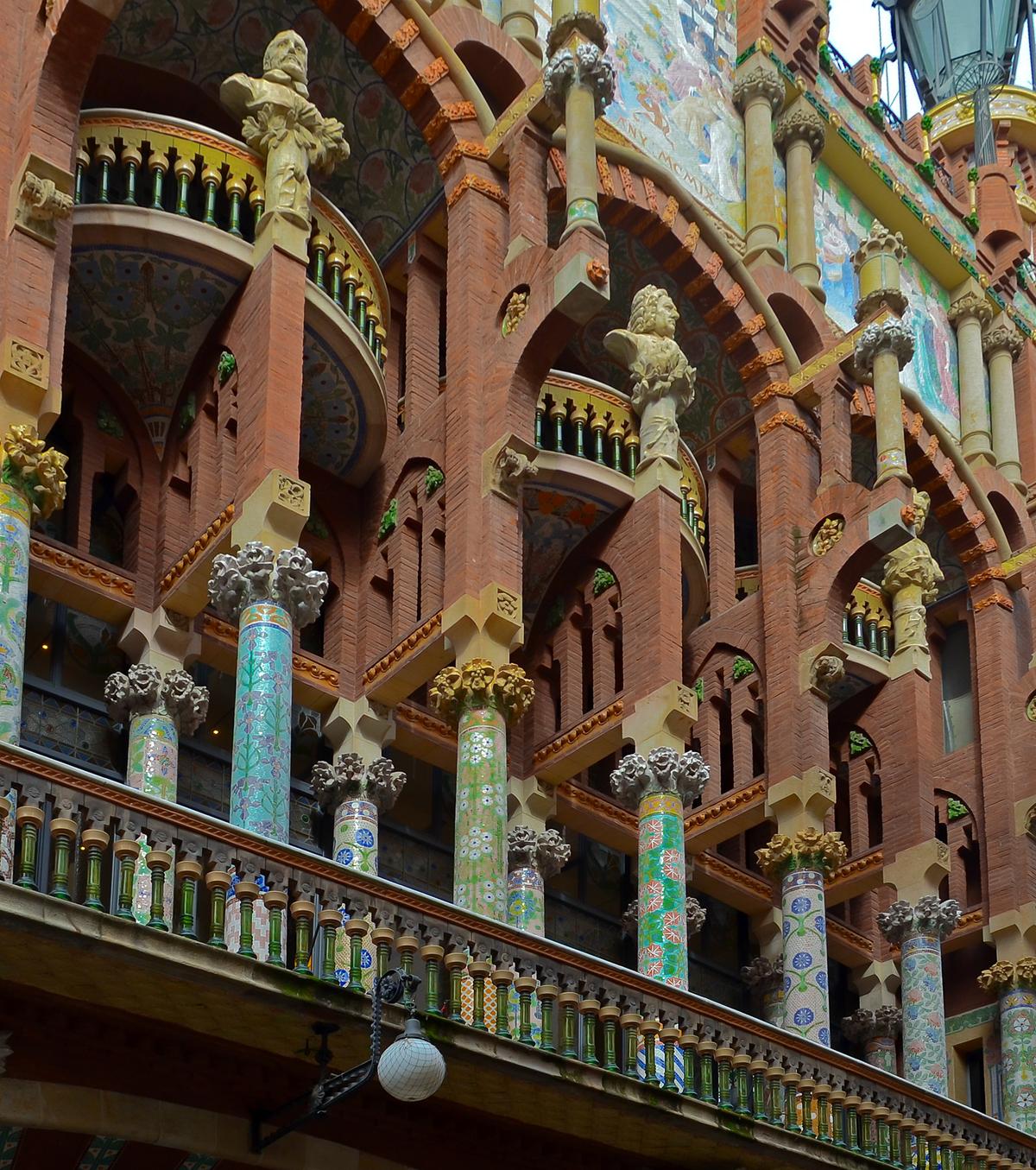
Moorish aesthetics are prominent in the palace’s facade, most notably in the colorful floral mosaics of the balcony columns. The multiplicity of small- and medium-sized columns is a characteristic of Moorish architecture later adopted by Spanish Gothic, while the red brick is common to both styles. Classical busts of Italian composer Giovanni Pierluigi da Palestrina and German composers J.S. Bach and Ludwig van Beethoven are in keeping with the palace’s eclecticism. Emily Goodwin/Shutterstock
What arts and culture topics would you like us to cover? Please email ideas or feedback to [email protected].
James Baresel is a freelance writer who has contributed to periodicals as varied as Fine Art Connoisseur, Military History, Claremont Review of Books, and New Eastern Europe.