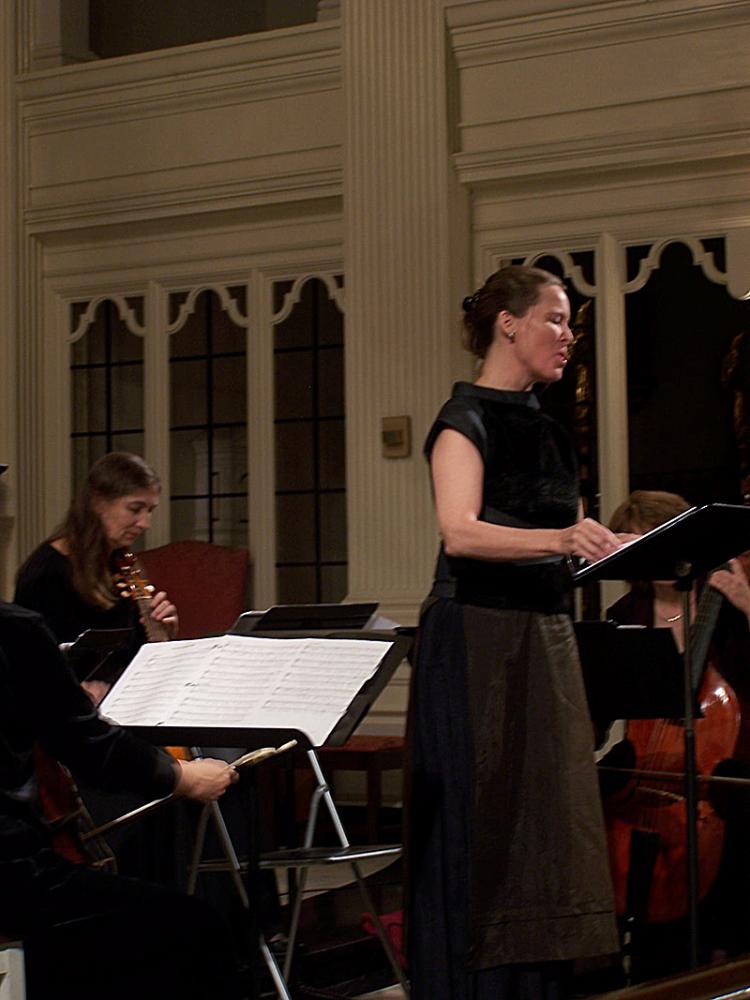
Performing at the Corpus Christi Church in Manhattan, the Parthenia ensemble (Beverly Au, Lawrence Lipnik, Rosamund Morley, and Lisa Terry) performed on the viola da gamba in different sizes and ranges.
After opening with original Elizabethan viol music and songs, Parthenia played the world premiere of Kristin Norderval’s “Nothing Proved,” a composition for voice, viols, and audio processing, based on poems and quotes of Elizabeth I.
Together with singer and composer Kristin Norderval and supported by the charismatic actors Roberta Maxwell and Paul Hecht, the viol ensemble created a program like a string of pearls—reviewing the life of the famous queen in music, songs, spoken poems, and speeches. A melancholic yet fascinating atmosphere colored the whole evening.
Reigning as the Virgin Queen of England for over 40 years, Elizabeth I (1533-1603) lived in a male-dominated time and survived countless political and personal intrigues. When just 3 years old, Elizabeth had seen her own mother executed by her father, the notorious Henry VIII, and understood that she should stay the only authority in state.
Once she had obtained the throne, Elizabeth shrewdly rejected the House of Commons’ petition that she marry. She argued that, as queen, she was married to the state and would be loving mother to her children, the people of England.
Lilting, soft tones in strict forms prevailed in the first part of the concert, which mostly featured composer William Byrd and unknown masters of the Elizabethan Age. With songs, poems, and speeches, the Parthenia production introduced Elizabeth within the context of her time.
The young Elizabeth experienced both imprisonment in the Tower of London and years of house arrest. On her window in Woodstock, where she was kept, she scratched with a diamond: “Much suspected by me / Nothing proved can be / Quoth Elizabeth prisoner.”
Her poems and quotes show a strong and sagacious personality, in which she regarded herself as a character on the stage of history. Despite the danger to her life, she was able to reflect on her situation from a higher perspective. Her strong belief in God carried her through her troubles, and her outspokenness helped her to deal with the obligations of the throne.
Also part of the program (a fiery delivery by Roberta Maxwell) was her famous speech to the troops before England’s victory over the Spanish Armada (1588). The victory made England the dominating naval power on the world’s seas for centuries.
The second part of the program, featured Kristin Norderval’s composition “Nothing Proved,” with modern music on old instruments. Reminiscent of Renaissance forms, the piece used electronic sound effects and improvisation that emphasized Elizabeth’s emotional struggles.
Norderval’s soprano voice, perfectly suited to the simplicity and grace of the old songs, was crystal clear and reaching flute-like heights in the first part. Intense and dramatic in the modern part, she modulated between bel canto and spoken word.
While singing, the multi-talented musician both conducted the performance and processed the sound simultaneously, first using live sound and later recordings of the ensemble.
Improvisation played an important role in last piece, which was structured by timing. The excellent acoustics of the Corpus Christi Church, the home of Parthenia, supported the purity of the sound.
After the performance, violist Beverly Au explained that Parthenia proposed the idea and arranged the texts for the performance: “Elizabeth was an amazing and wonderful writer. We wanted to have a new piece written for us and have a woman composer interpret her words. We were even happier to have Kristin Norderval perform, which was the perfect match. Elizabeth was very edgy, and the electronic sounds in Norderval’s composition helped to give a sense of the edginess of her words.”
Information of upcoming concerts of the ensemble can be found on www.parthenia.org.