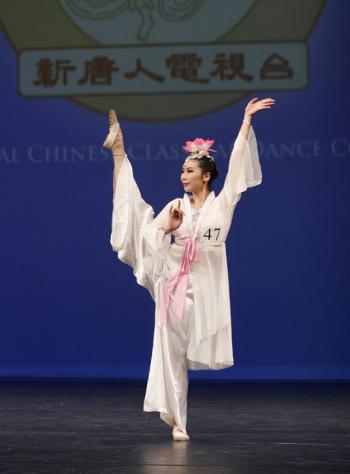
Michelle Ren began training in artistic gymnastics in China at the age of 6 and has won several awards, including the first prize in the Adult Female Division of New Tang Dynasty Television’s International Chinese Classical Dance Competition in 2007.
Ms. Ren currently serves as a choreographer and principal dancer with DPA. She spoke of the inner meaning and outer form of Chinese classical dance, which has moved and exhilarated audiences at DPA shows around the world.
Chinese classical dance, a comprehensive system featured by Divine Performing Arts, has been passed down through Chinese history by common people and by members of the imperial court. It has three components: technique, bearing, and form. Michelle Ren says the dance not only displays high artistry, but also contains deep resonances of traditional Chinese culture—a divinely inspired heritage.
“When people really have respect toward and have faith in divine beings, they will then let people know how to conduct themselves. And the performers can manifest to the audience the different inner meanings of the art.”
Chinese Classical Dance Transforms the Heart
Ms. Ren said the profundity of Chinese classical dance mirrors that of China’s 5,000-year-old culture, and its movements have influenced martial arts, Chinese opera, and more.
“Many difficult techniques such as aerial movements and spins in artistic gymnastics and martial arts are actually derived from Chinese classical dance.”
There are endless techniques and bearing that explore inner meaning and style. Form, gestures, and movements can delineate different scenarios in stories and depict a wide range of characters.
Ms. Ren said that after a Western dance critic watched the show, he noted that Chinese classical dance has a lot of round movements with the arms and steps, and it is true. Many movements in Chinese classical dance emphasize circles: horizontal circles, vertical circles, and more.