Two Men were traveling in company through a forest, when, all at once, a huge Bear crashed out of the brush near them.
One of the Men, thinking of his own safety, climbed a tree.
The other, unable to fight the savage beast alone, threw himself on the ground and lay still, as if he were dead. He had heard that a Bear will not touch a dead body.
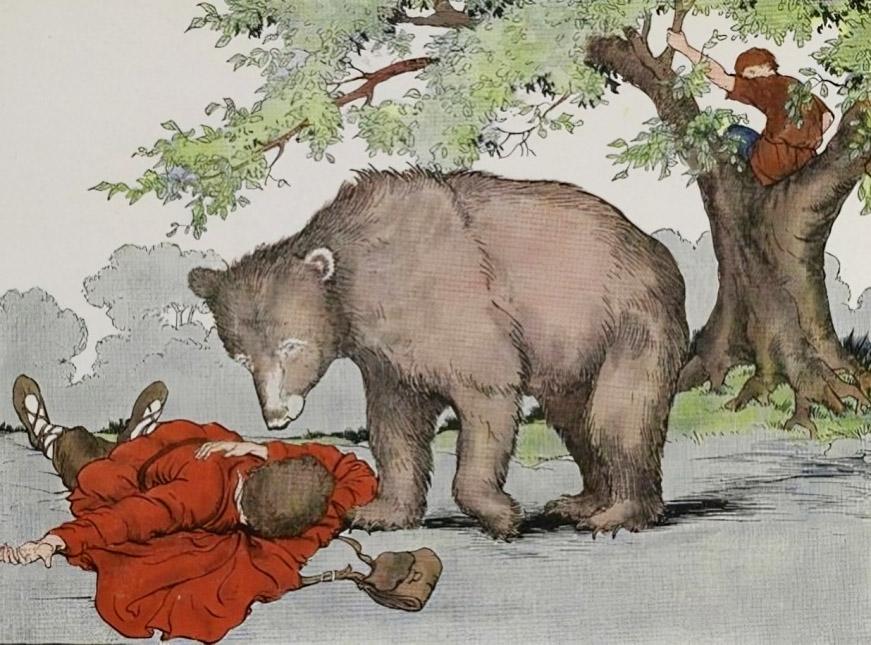
"Two Travelers and a Bear," illustrated by Milo Winter, from “The Aesop for Children,” 1919. PD-US
It must have been true, for the Bear snuffed at the Man’s head awhile, and then, seeming to be satisfied that he was dead, walked away.
The Man in the tree climbed down.
“It looked just as if that Bear whispered in your ear,” he said. “What did he tell you?”


“He said,” answered the other, “that it was not at all wise to keep company with a fellow who would desert his friend in a moment of danger.”
Misfortune is the test of true friendship.
This fable is reproduced from “The Aesop for Children” (1919).
Aesop (c. 620–564 B.C.) was a Greek storyteller credited with a number of fables now collectively known as “Aesop’s Fables.” His tales, with their moral value, have long influenced our culture and civilization, contributing not only to the education and moral character building of children, but also, with their universal appeal, to the self-reflection of adults alike who have chosen to embrace the virtues or heed the warnings within.
Share your stories with us at [email protected], and continue to get your daily dose of inspiration by signing up for the Inspired newsletter at TheEpochTimes.com/newsletter