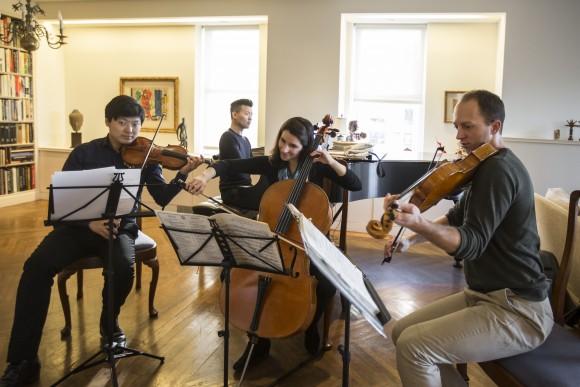
NEW YORK—The French Romantic composer Gabriel Urbain Fauré (1845–1924), though he achieved fame late in his career, was highly influential on French music thereafter. His music is known for its refinement, sensitivity, and intimacy.
Fauré bridged the Romantic and modern periods; atonality and serialism (in which sets of fixed notes are used to create a structure rather than the chromatic scale) arose near the end of his career, though Fauré did not compose in these styles. Instead, he expanded tonality without breaking from the traditional structure of classical music.
He studied under Camille Saint-Saëns and later taught Maurice Ravel, Georges Enesco, and Nadia Boulanger, among others.
About a hundred of Fauré’s works are frequently performed in France, and outside the country some of his most popular works are his well-known works Requiem (Op. 48), Pavane (Op. 50), “Claire de Lune” (“Moonlight”, Op. 46, No. 2), and his first sonata for violin and piano.
Many of his best-known pieces were composed, at least partially, during 1877, a whirlwind of a year for Fauré both personally and professionally.
“During that year he fell in love, he got engaged to this girl, and within the same period of time, inexplicably—she didn’t make her reasons clear to him—she broke off the engagement with him, and he was heartbroken,” said Luke Fleming, artistic director of Manhattan Chamber Players.