This copy is for your personal, non-commercial use only. Distribution and use of this material are governed by our Subscriber Agreement and by copyright law. For non-personal use or to order multiple copies, please contact The Epoch Times Reprints.
At dawn on April 6, 1862, Confederate forces commanded by Albert Sydney Johnston sprang from the woods near Tennessee’s Pittsburg Landing and smashed into the Union army of Maj. Gen. Ulysses S. Grant (1822–1885). With surprise as their ally, and despite fierce resistance, the Confederates pushed back Grant’s men toward the Tennessee River. By day’s end, victory at Shiloh seemed to belong to the attackers.
One of Grant’s generals who would soon become his friend and admirer, William Tecumseh Sherman, was downhearted over the losses of the day. Gen. Carlos Buell counseled immediate retreat. But Grant rejected both the defeatist mood and any idea of withdrawal. That night, when Sherman encountered his commander in the rain, he said, “Well, Grant, we’ve had the devil’s own day, haven’t we?” to which a calm and collected Grant replied, “Yes. Lick ‘em tomorrow though.”
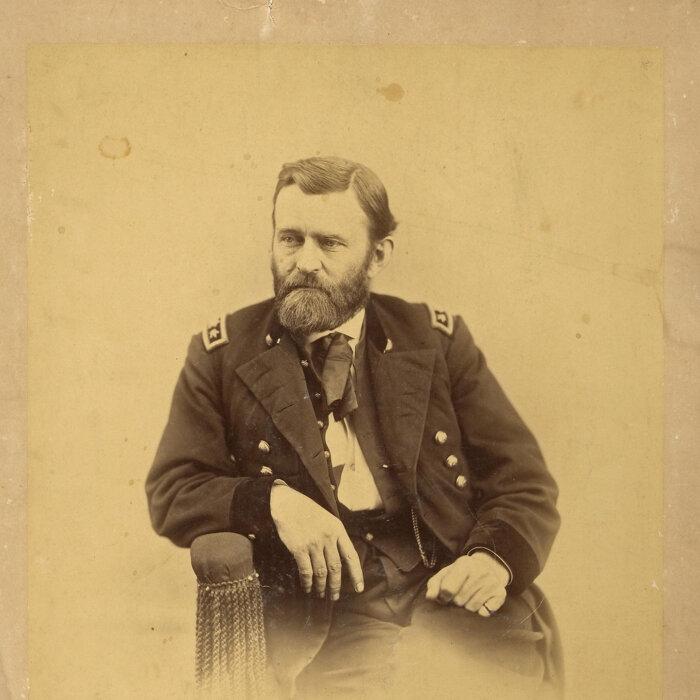
Ulysses Grant in 1861. Public Domain
And so they did. On April 7 the Union army pushed the Confederates from the field. To paraphrase a comment from Abraham Lincoln, Grant was clearly a general who would fight.
An Inauspicious Resume
Grant’s boyhood was unremarkable except for his talent for training horses. His performance out of the saddle was mediocre at West Point. He served with distinction in the Mexican-American War. Then, in 1854, he left the Army, his career tainted from an incident involving drunkenness. He was working as a clerk in his family’s leather business in Galena, Illinois, when war broke out.
Stack Grant’s humility, his quiet ways, and his often unkempt appearance alongside his mish-mash military career, and he would be among the least likely of candidates to command all the armies of the North by war’s end.
A case can be made that Grant’s character brought him to that mountaintop of honor and responsibility.
Never Sound Retreat
Just as he had at Shiloh, Grant believed in taking the war to the enemy. After fighting to a stalemate at the Battle of the Wilderness in 1864, his first encounter with Robert E. Lee and the Army of Northern Virginia, Grant shocked and delighted his troops by refusing to retreat, as previous commanders would have done.
During the battle, when Grant learned that correspondent Henry Wing of the New York Tribune was heading for Washington, he sent a message with Wing for the president. Meeting with Lincoln, Wing delivered Grant’s short, succinct dispatch: “Whatever happens, there will be no turning back.” These words so pleased Lincoln, whose previous generals always kept retreat as an option, that he leaned over and kissed Wing on the forehead.
Sherman later noted: “When Grant cried ‘Forward!’ after the battle of the Wilderness, I said: ‘This is the grandest act of his life; now I feel that the rebellion will be crushed.’”
Persistence, in the face of adversity, won the day.
Gen. Grant cheered by his men after the Battle of the Wilderness. Library of Congress. Public Domain
Face the Enemy
Both in the Mexican-American War and the Civil War, Grant demonstrated courage when under fire. At Shiloh, a courier was killed by a cannon ball, his blood spraying the general, but Grant showed no signs of fear or defeat, muttering only “Not beaten yet by a damn sight.”
More importantly, for both the army and the Union, Grant displayed daring and fearlessness in his command of battles and campaigns. At one point, during the Wilderness battle, an aide raced to the general, and claiming that he knew well Lee’s style of fighting, declared that the army was in grave danger. For once, Grant lost his temper. “I am heartily tired of hearing about what Lee is going to do,” he replied in disgust.
“Some of you always seem to think he is suddenly going to turn a double somersault, and land in our rear and on both of our flanks at the same time. Go back to your command, and try to think what we are going to do ourselves, instead of what Lee is going to do.”
Success as a commander, whether in the military or elsewhere, requires the ability to act fearlessly in a crisis. Again and again, Grant showed himself capable of making such decisions.
Keep Calm and Carry On
“The Peacemakers,” 1868, by George Peter Alexander Healy, depicting (L–R) Maj. Gen. William Sherman, Gen. Ulysses Grant, President Abraham Lincoln, and Rear Adm. David Porter. Public Domain
In maintaining an appearance of equanimity in the face of duress, Grant was head and shoulders above many other commanders. He displayed a mental calmness accompanied by an evenness of temper that amazed and inspired the soldiers serving under him. During battle, he calmed his nerves by smoking cigars and whittling, practices that also steadied the men around him. He disliked casual profanity and avoided emotional outbursts.
Once, when asked after meeting the general what sort of man Grant was, Lincoln replied, “I hardly know what to think of him. … He’s the quietest little fellow you ever saw. Why, he makes the least fuss of any man you ever knew. … The only evidence you have that he’s in any place is that he makes things git! Wherever he is, things move!”
Grant did make things move, but always with a cool precision of mind and manner that steadied those around him. In this regard, he joins other great commanders from America’s military past like George Washington, Robert E. Lee, and Dwight Eisenhower.
In a letter home to his wife, Col. Theodore Lyman wrote of Grant, “He habitually wears an expression as if he had determined to drive his head through a brick wall, and was about to do it. I have much confidence in him.”
Astute gamblers of that time would have put their money on Grant’s head and not on the wall.
What arts and culture topics would you like us to cover? Please email ideas or feedback to [email protected]
Jeff Minick has four children and a passel of grandkids. He has written two novels, “Amanda Bell” and “Dust on Their Wings,” as well as “Learning as I Go” and “Movies Make the Man.” You’ll find more of his writing at JeffMinick.substack.com.