This copy is for your personal, non-commercial use only. Distribution and use of this material are governed by our Subscriber Agreement and by copyright law. For non-personal use or to order multiple copies, please contact The Epoch Times Reprints.
After decades of being lucky enough to travel the world, I’ve collected more than my fair share of souvenirs. My favorite is a small chunk of the Berlin Wall.
I didn’t buy it in a museum gift shop or snag it on eBay. I got it straight from the source back in 1989. That’s when the notorious concrete barrier—the ultimate symbol of the Cold War, pitting the communist East against the capitalist West—effectively came crashing down.
When the border opened on that game-changer of a day Nov. 9, I happened to be a college student spending my junior year abroad in England. I hightailed it to Berlin not long after the momentous event, eager to be an eyewitness to what political science majors like me would be studying in the classroom for decades to come.
Tall metal poles along the former border between East and West are part of the Berlin Wall Memorial. Lori Rackl/TNS
I arrived by train to a surreal scene. Going from one side of the wall to the other felt like stepping out of a technicolor film into a black-and-white movie. Parts of East Berlin seemed abandoned, almost post-apocalyptic. (Many of the vacant buildings would go on to be filled by young artists, musicians and other creative types who helped cement Berlin’s enduring reputation as a capital of cool.)
Along the wall, entrepreneurial folks wearing stonewashed jeans and leather bomber jackets were selling hammers and pickaxes. I bought a couple of tools for a few deutsche marks and started chipping away at the Iron Curtain partition, adding to the chorus of clink-clink-clinks coming from fellow “wall peckers.”
The writer, Lori Rackl, in front of the Berlin Wall shortly after it fell in 1989. Lori Rackl/TNS
It would be 37 years before I returned to Berlin, a trip I made this past spring. I can’t blame Berlin being boring as a reason for the nearly four-decade gap between my first and second visit.
Alexanderplatz today is a bustling public square in Berlin. Shortly before the wall fell in 1989, East German protestors packed Alexanderplatz to demand democratic reforms. Lori Rackl/TNS
This sprawling metropolis—its footprint measures nine times the size of Paris—has plenty to see and do. The nightlife is legendary, even if I’ve aged out of it. The culinary scene is as wide ranging and diverse as you’d expect in such an international city. Tasty street food like homegrown currywurst and Turkish-influenced doner kebab sandwiches happily coexist with 22 Michelin-starred restaurants. Culture vultures won’t go hungry between the offerings on Museum Island and a robust performing arts scene in this hip capital that’s celebrating 20 years as a UNESCO City of Design.
But on my long overdue return, I found myself most drawn to what brought me here in the first place: the wall. Most of it is long gone, thanks partly to wall peckers like me. Yet its presence still looms large, from the family-friendly, interactive DDR Museum detailing what it was like to live in East Germany to original sections of the foreboding partition. One segment that’s still standing is at the Topography of Terror, a somber tourist attraction about the atrocities of the Nazi regime.
An original stretch of the Berlin Wall is now East Side Gallery, the longest open-air art gallery in the world. Lori Rackl/TNS
On a much lighter note, another original expanse of wall has been reborn as the longest open-air art gallery in the world. It stretches for nearly a mile along the banks of the Spree River in what used to be East Berlin. Shortly after the wall fell, 118 painters from 21 countries turned this once-barren strip of concrete into a linear canvas of artistic expression known as the East Side Gallery.
An original stretch of the Berlin Wall is now East Side Gallery, the longest open-air art gallery in the world. Lori Rackl/TNS
Another example of regained freedom has taken shape as Mauerpark, or wall park in German. This outdoor living room in the pretty Prenzlauer Berg neighborhood used to fall within the “death strip,” a heavily guarded area between the parallel walls that separated East and West Berlin. The former no-man’s-land has morphed into a popular gathering spot, especially on Sundays when there’s a massive flea market and spirited karaoke sessions.
An original stretch of the Berlin Wall is now East Side Gallery, the longest open-air art gallery in the world. Lori Rackl/TNS
The Berlin Wall Memorial is the best site for understanding the infamous barrier, “that hideous, 28-mile-long scar through the heart of a once proud European capital,” as Time magazine described it back then. The memorial spans almost a mile along the road Bernauer Strasse. You can watch an English-language film about the wall at the visitor center. And you can easily spend a couple hours wandering the memorial’s outdoor area. It includes a preserved section of the death strip zone and photos of more than 100 people who died at the border, most of them trying to escape East Germany.
The memorial will be especially busy on Aug. 13. It’s the main site for ceremonies marking the 65th anniversary of the wall’s construction. On that summer day in 1961, the Soviet-controlled East German government hastily began building a barrier to stem the exodus of residents fleeing to the West.
A marking on the ground shows where the Berlin Wall once cut through the heart of the city, dividing East and West Berlin. Lori Rackl/TNS
The Cold War heated up fast a couple months later when American and Soviet tanks faced off at Checkpoint Charlie, the famous border crossing point between the U.S.-occupied sector of West Berlin and the Soviet’s East Berlin.
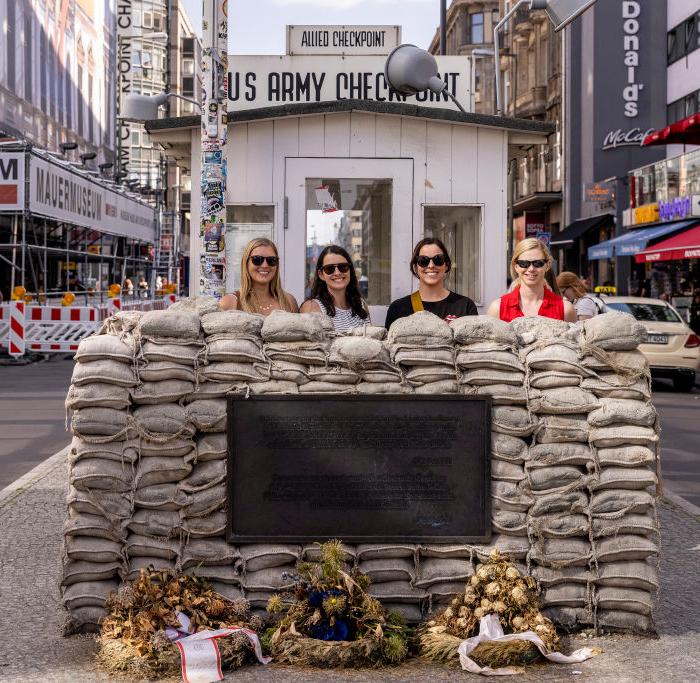
Fast-forward 65 years, and tourists flock here to take selfies in front of a replica of the Checkpoint Charlie guardhouse and to pop into the nearby Mauermuseum, or wall museum.
Tourists take photos in front a guardhouse replica at Checkpoint Charlie, the famous border crossing point between the U.S.-occupied sector of West Berlin and the Soviet’s East Berlin. Lori Rackl/TNS
Like most museum gift shops, this one is stocked with souvenirs, including pieces of the wall. I perused shelves full of these concrete nuggets, many of them bigger than mine and in better condition. But my cherished keepsake has something money can’t buy. It comes with memories that grow more valuable over time.
Pieces of the Berlin Wall for sale at the Mauermuseum, or wall museum, near Checkpoint Charlie. Lori Rackl/TNS