In the 1880s, when skyscrapers starting popping up in cities all over America, fire safety quickly became an issue. There were previous fire escape designs, but many of them involved ropes and ladders and were quite dangerous themselves. It wasn’t until 1887, when Anna Connelly received a patent for her fire escape, that the world received a safer standard. Her basic design still in use today.
When the American Civil War ended in 1865, millions of people started moving from the rural areas of the country into the cities. In fact, between 1880 and 1900, American cities grew by 15 million people.
With greater populations, fires started breaking out in every major metropolitan area in the United States. By the 1860s, New York City passed laws requiring buildings to have at least two stairways, one of which had to be fireproof. However, many landlords resisted this law, because adding another staircase would be costly and make the buildings unattractive.
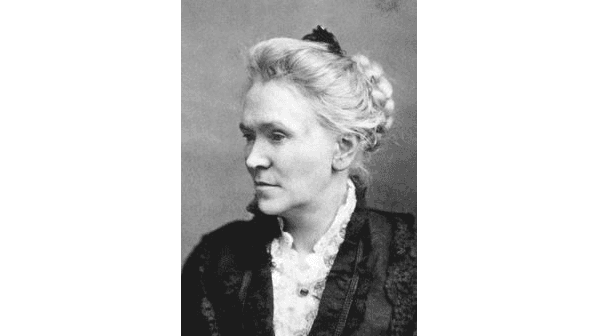
Connelly was born on Sept. 23, 1868 in Philadelphia, Pennsylvania to English parents. Little is known about her personal life, but many historians noted that she was widowed and worked as a homemaker. She was quite inventive, as she had filed several patents starting in 1877, but none of them came to fruition.
In the 1880s, she realized that there needed to be a better way to get people living or working in a high-rise building to safely escape in the event of a fire. One patented fire escape that included a rope, pulley and wicker basket was invented by Daniel Maseres in 1784. Connelly felt there had to be a better way.
Iron Bridge
Connelly’s first fire escape system consisted of an iron bridge that was attached to two roofs on tall buildings. The bridge consisted of a railing and an open bottom. In the event of a fire, residents could climb to the roof and use the bridge to walk from the rooftop of a burning building to one that wasn’t on fire.

Later, she revamped her invention after realizing that not everyone could get to the roof of a building in the case of a fire. She later changed her fire escape to include platforms (with hand railings for safety) on each floor. Iron ladders connected each platform.
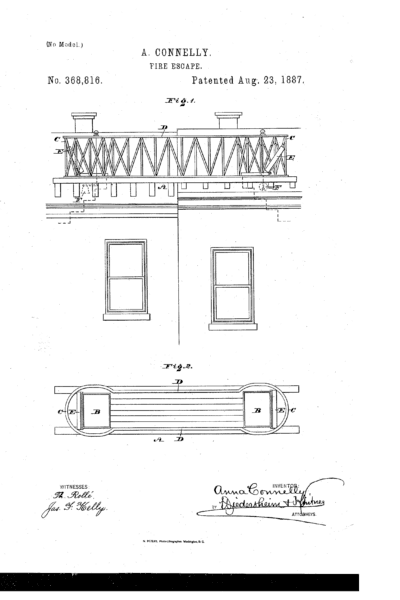
The new fire escape not only allowed people on any floor to escape on a fire-resistant ladder with handrails, but also helped firefighters more easily get water to each burning floor.
Landlords seemed to like the new fire escapes because they could be added to existing buildings. Connelly’s fire escapes didn’t require major remodeling of the buildings. Her creation eventually morphed into the zigzagged exterior fire escapes that are still seen on buildings today.
Connelly’s invention eventually led New York City to develop its first building codes that required a way for people to egress in the case of a fire in the late 1800s.
For the last 150 years, Connelly’s invention has helped save numerous lives by creating a safe way to evacuate a burning building. According to most accounts, Connelly lived to be 100 years old and passed away some time in 1969.