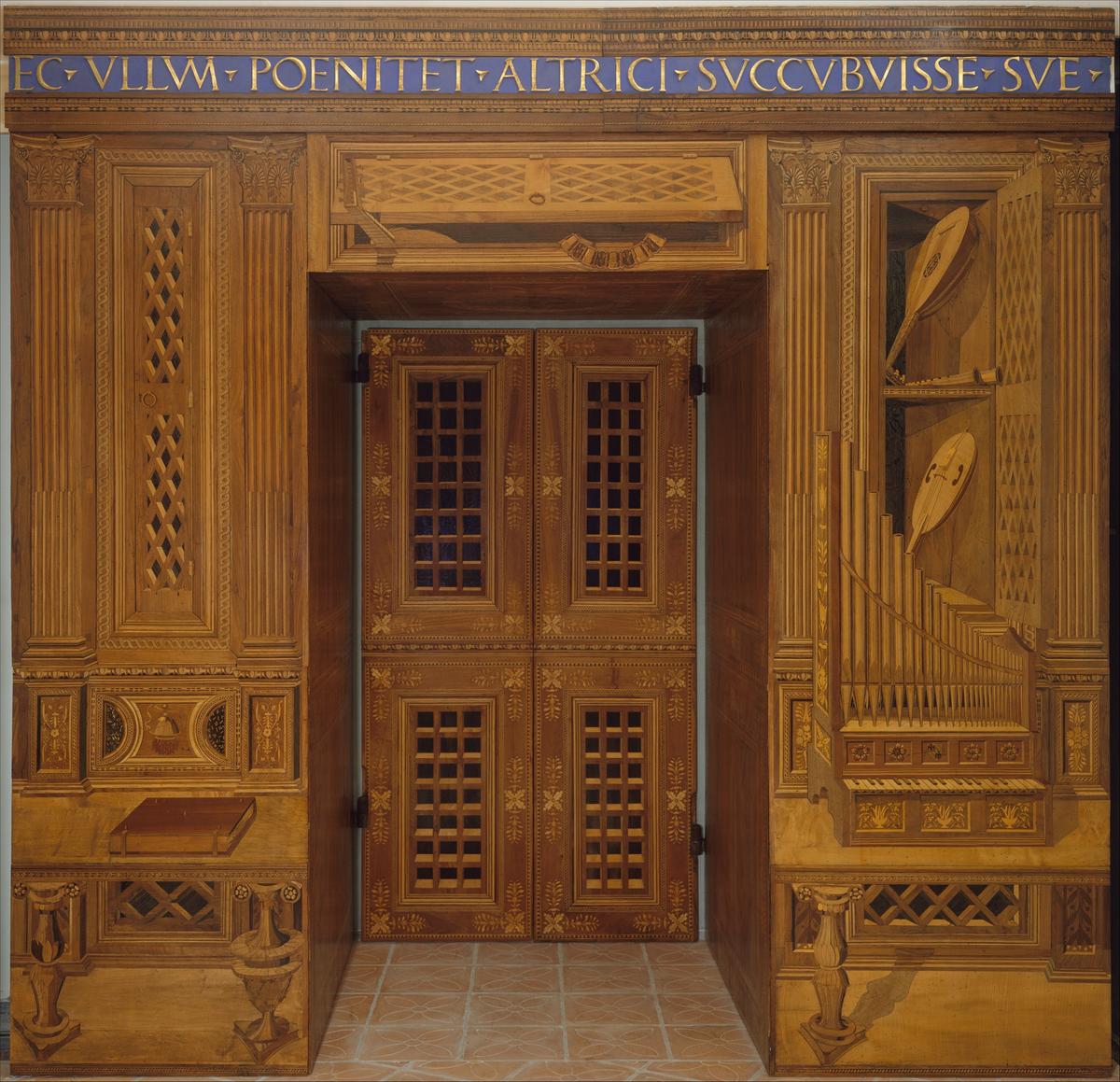
One of the most incredible interiors of the Italian Renaissance was designed and built for the Ducal Palace in the Umbrian town of Gubbio. A “studiolo,” or small study, was an important room in palaces of the era, serving as an intimate sanctum for its owner to engage in scholarship and meditation. The space was used to entertain visitors as well as store treasured possessions. This circa 1478 to 1482 “Studiolo” was created in a wood-inlay technique called intarsia, and its detailed images of architecture and still lifes are rendered as a trompe l’oeil (trick of the eye) effect. No longer in Italy, it was shipped to New York City in 1939 and is on display at the Metropolitan Museum of Art.
The tour-de-force Gubbio “Studiolo” was commissioned by Duke Federico III da Montefeltro (1422–1482), a famous ruler of the Duchy of Urbino and parts of Umbria. He was renowned as a military leader, intellectual humanist, and patron of the arts. Federico was described by a contemporary as “ever careful to learn some new thing every day.” One of the world’s most notable Renaissance portraits is a circa 1465 to 1472 image of him by painter Piero della Francesca that is part of the Uffizi collection in Florence.

A Marvelous Wooden Illusion
Intarsia is a difficult, elaborate, and expensive technique of using different colored woods to create pictures. Grained woods are cut into thin pieces, known as veneers, shaped as desired, and laid into a matrix. Intarsia’s Italian origins date to about 1250, but it was not used to create illusionistic still lifes until the 1430s in Florence. Naturalism that fooled the eye was popular across the arts in 15th- and 16th-century Italy.
Intarsia used for this type of composition mandated lighter woods inlaid into a darker wood background. After about 1540, the technique lost favor as the woods would lose their original colors over time and were susceptible to woodworm infestation. The Met’s “Studiolo” has undergone extensive conservation treatment.
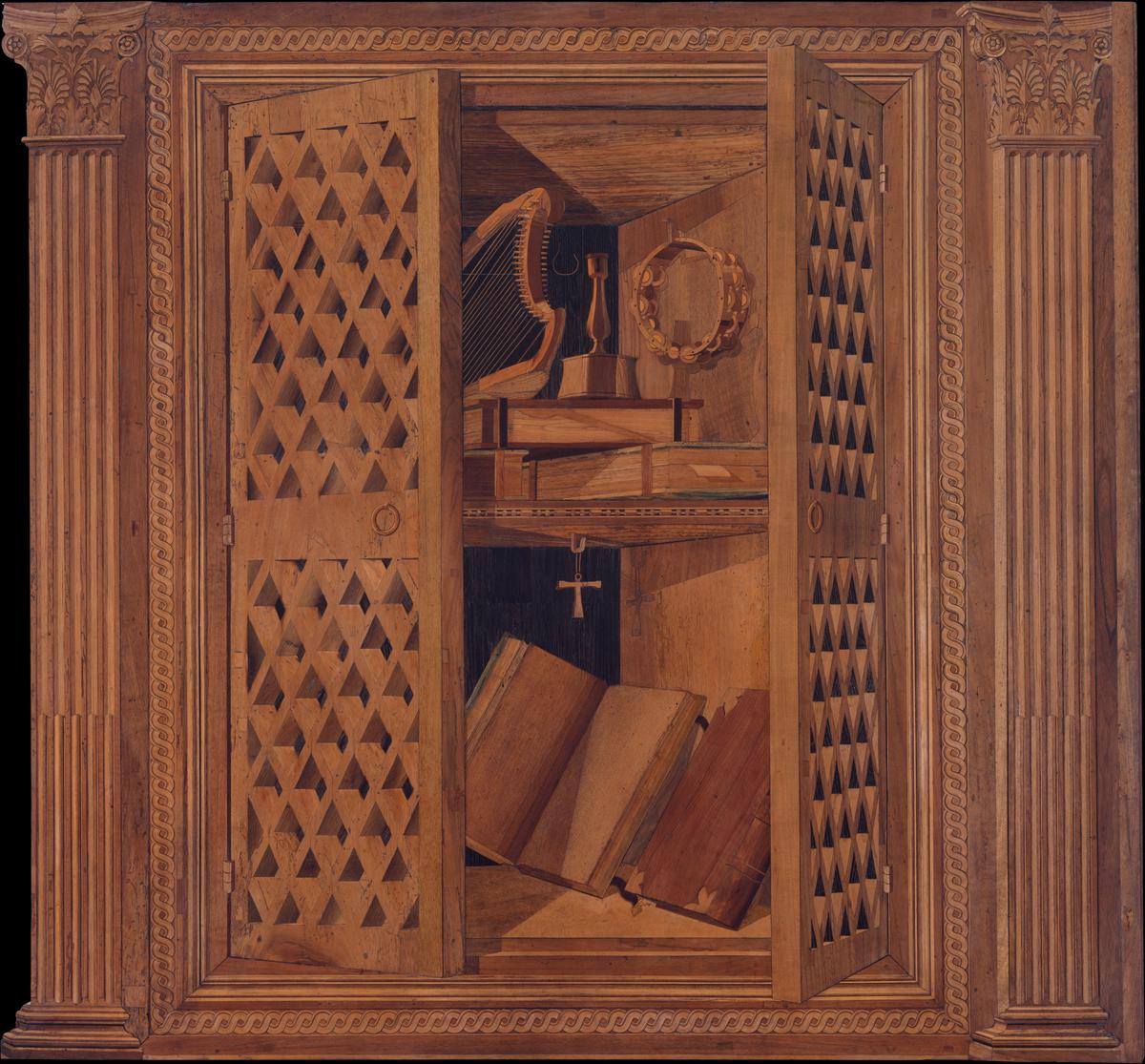
The Gubbio “Studiolo” may be a small room, at about 16 feet wide by 12 feet long, but it is mesmerizing. At first glance, it looks like a fully furnished and decorated interior. There are benches against lower walls and shelf-laden cabinets with latticework doors, some of which are ajar. Shadows give the objects an illusion of realistic volume, but in fact, everything is flat. All visual effects are made only of wood, not even paint. This virtuosic ensemble features thousands of pieces and slivers of different wood varieties—walnut, beech, rosewood, oak, and fruitwoods in a walnut base—fitted together.

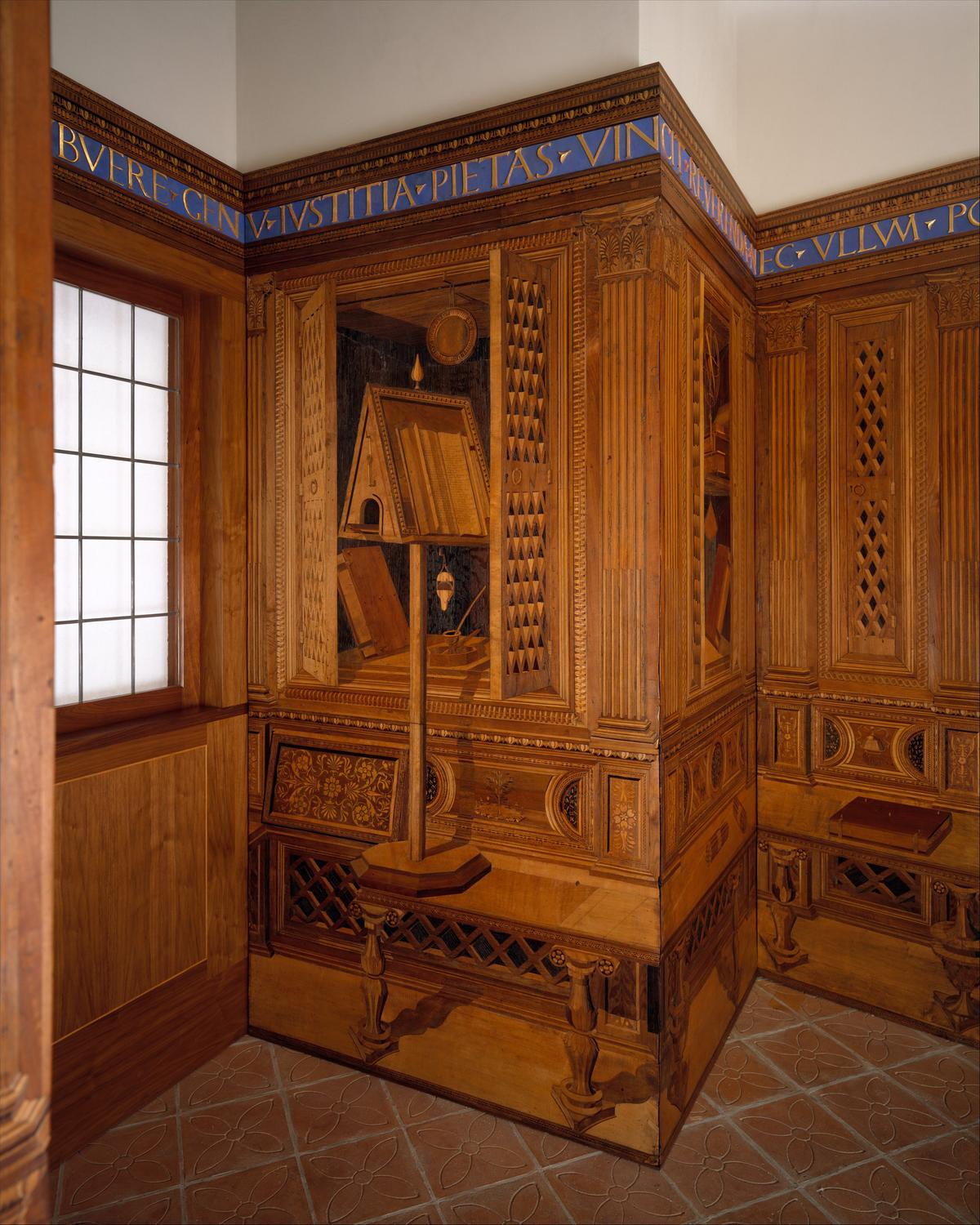
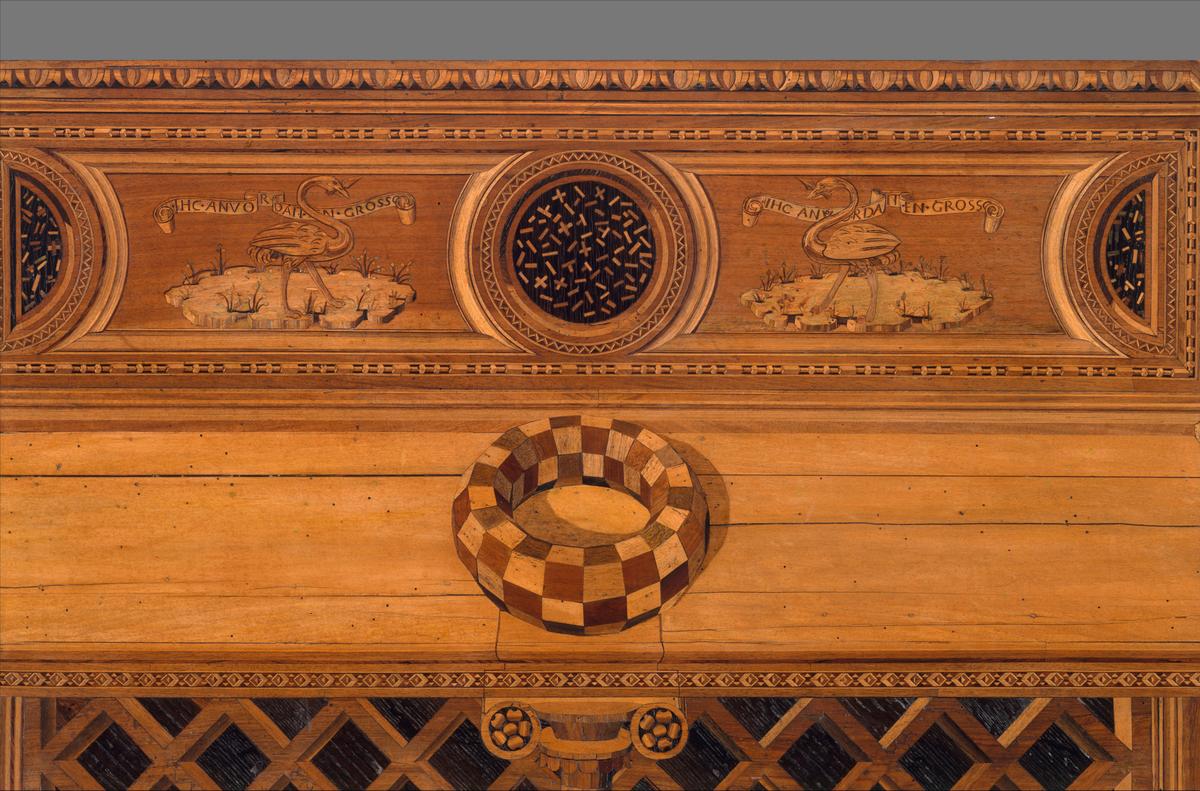
This room is believed to have been designed by Francesco di Giorgio (1439–1501) and executed by Giuliano da Maiano (1432–1490) and his brother Benedetto da Maiano (1442–1497). It abounds with accessories and motifs that reflect Federico’s accomplishments and interests. His military glory is evoked by a helmet crowned with an eagle, situated in the back corner on the right. The duke’s emblems of an ostrich with a spearhead in its beak, signifying victory despite adversity, and the ermine, symbolizing purity, are included in the decorative scheme.
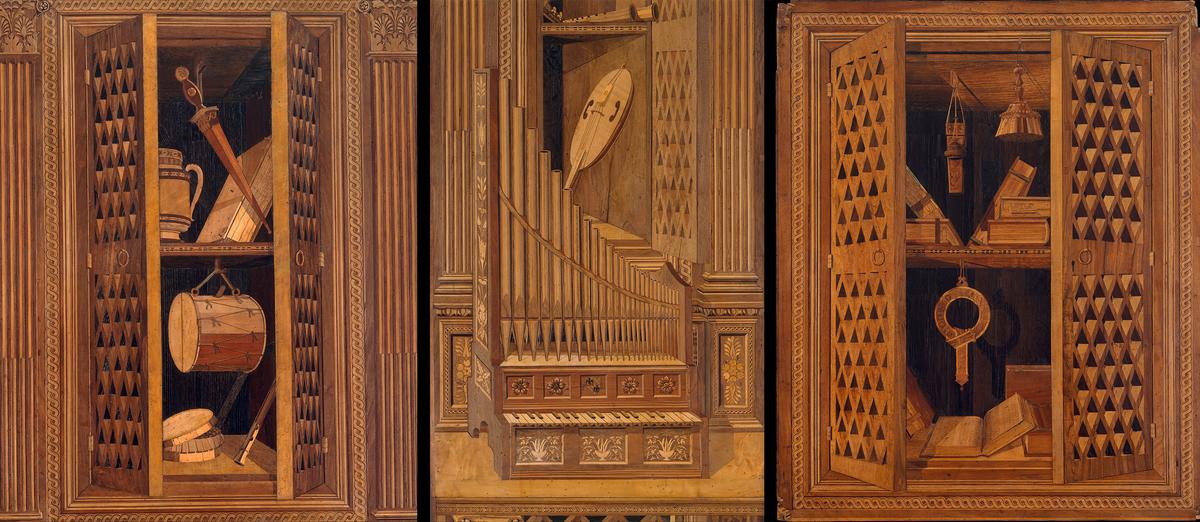
Trumping the number of warfare accoutrements, which include a dagger, are representations of his comprehensive interests that included mathematics, science, and literature. Portrayals of books harken to his famously extensive library. Musical instruments (portative organ and fiddle), measuring devices, and scientific equipment can be found throughout the panels. There is also a bird in a cage, candied fruits, quill case with lead inkwell, jeweled whisk broom, and Federico’s Order of the Garter bestowed by King Edward IV of England.
This exquisite masterpiece is presented at The Met as a multi-paneled room visitors can enter. Once inside the enthralling “Studiolo,” visitors are transported to a ruler’s retreat in a 15th-century Italian palace. With its beautiful aesthetic and mastery of perspectival inlay, it embodies the union of art and science.