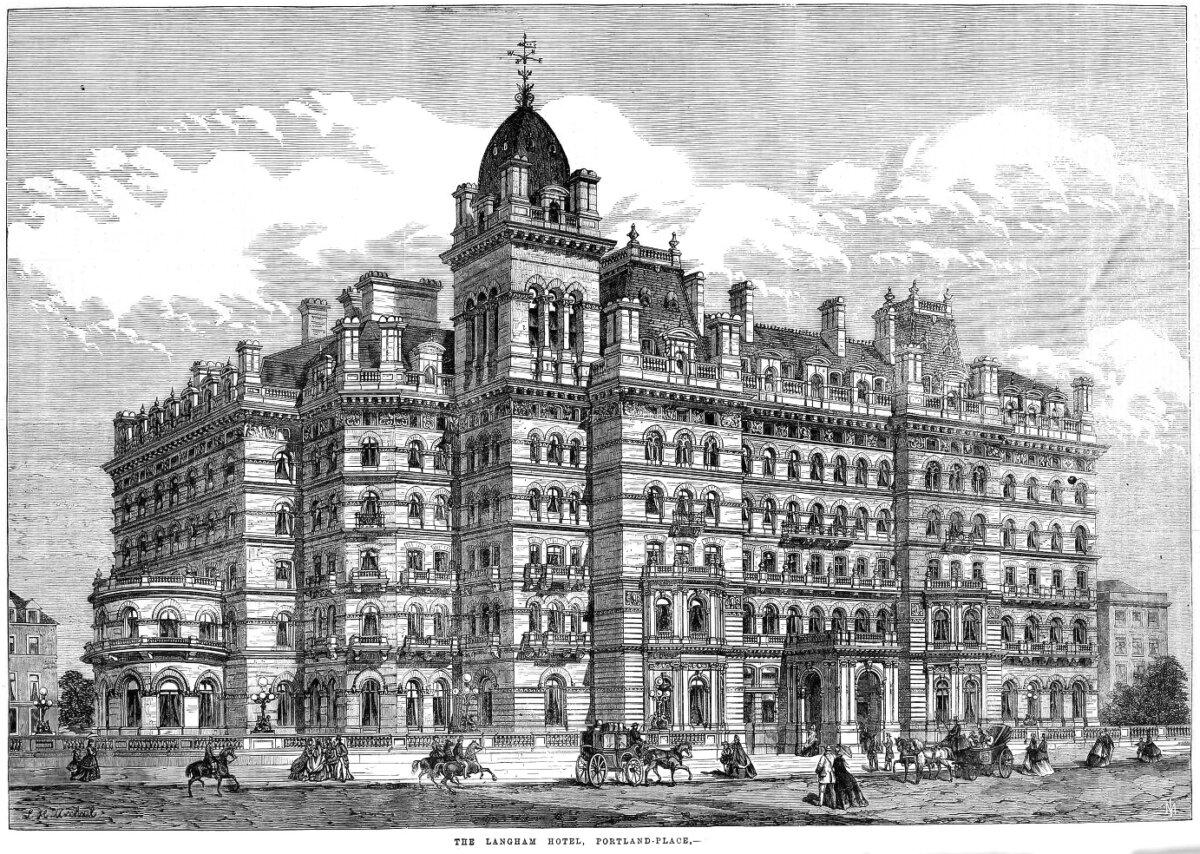
As the American Civil War entered its third year, construction of the Langham Hotel in England began. This 10-floor hotel with its nearly 600 rooms, rose 156 feet into the London sky. It was completed shortly after the conclusion of the Civil War on June 10, 1865. The hotel was Europe’s most modern, with hot and cold running water, water closets, and an early form of elevators, not to mention its elegant design both on the interior and exterior.
The hotel’s design was a collaboration of several architects and designers, including interior designers, James Murray and Owen Jones; contractors, Lucas Brothers, which had recently built the London Bridge Railway Terminus Hotel; Jackson & Graham, a high-society furniture firm; and John Giles, who had actually won the design competition in 1862. It was architecturally designed in an Italian style, and, internally, boasted hand-printed wallpaper, 15,000 yards of Persian tapestries, and marble and silk decorations.
An Editor’s Sway
The Philadelphia-based publishing house, J.B. Lippincott Company, was founded in 1836 by Joshua Ballinger Lippincott. It originally began as a publisher of the Bible and other religious texts. By the end of the 1840s, it was one of the nation’s largest publishers, having expanded into other genres. In 1861, it expanded its publishing efforts to include book importing, manufacturing, and retail. Ten years later, it opened its New York City office, and four years after that, in 1875, it opened an office in London. Among its numerous business endeavors was Lippincott’s Monthly Magazine, which published its first edition in January 1868.The monthly magazine specialized in “literature, science and education.” In 1886, Joseph Marshall Stoddart became the magazine’s managing editor, and it was during his tenure, which lasted until 1894, that the magazine began publishing novelettes and serializing novels.
Doyle and Wilde
While Stoddart was getting acquainted with his new position as managing editor in 1886, on the other side of the Atlantic, a young doctor was completing his third novel—the first two hadn’t been published. When Arthur Conan Doyle finally completed his book, it appeared it would receive the same response as his previous two. The London publisher, Ward, Lock, and Company, reluctantly purchased Doyle’s novel for a one-time-payment of 25 pounds, though they viewed it as not much more than a “penny dreadful.” The publisher promised to publish it in due time, perhaps for a holiday publication.
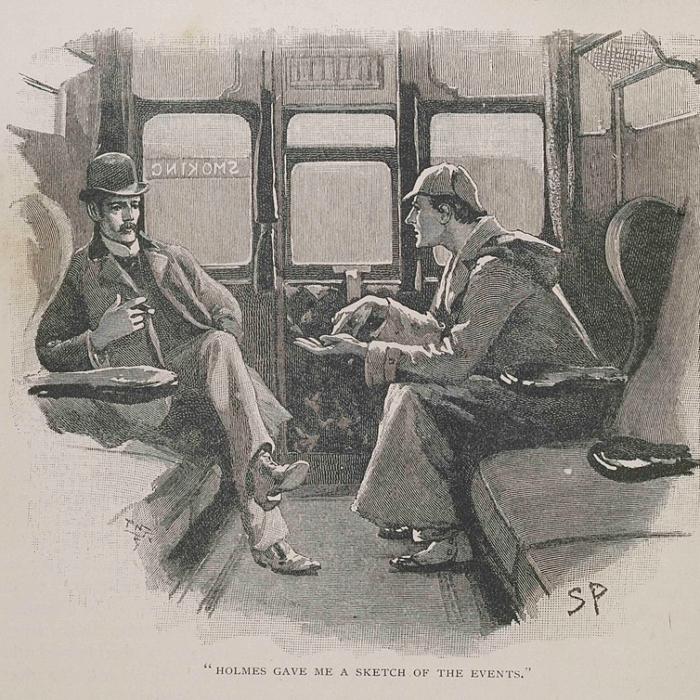
“A Study in Scarlet” was finally published in the 1887 Beeton’s Christmas Annual. The mystery novel with a direct American connection, as much of the story takes place in America, would introduce the world to the consulting detective Sherlock Holmes.
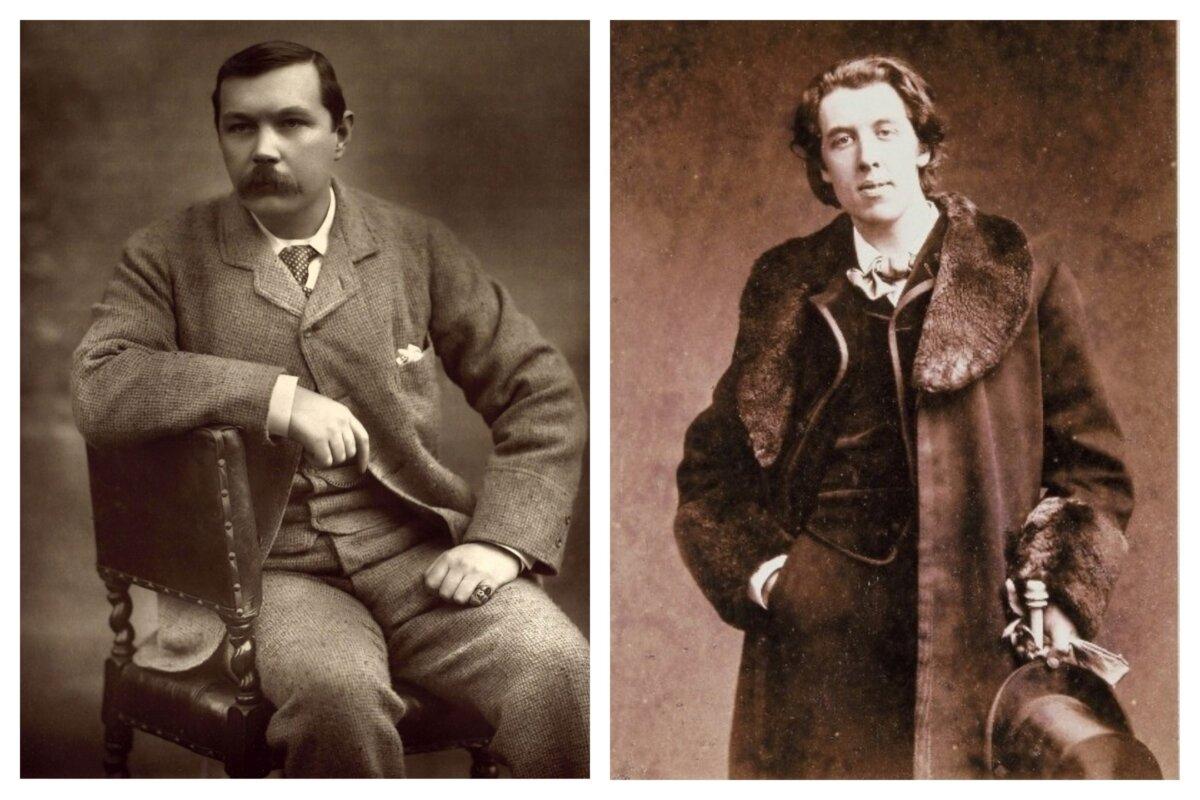
In 1888, “A Study in Scarlet” was reprinted in volume form, though Doyle received no money for it. Doyle, however, seemed to have moved on from writing about his consulting detective and pursued a historical fiction adventure novel in the same vein as Sir Walter Scott’s work. The result was “Micah Clarke,” published by Longmans, Green, and Company in February 1889.
Oscar Wilde had never written a novel. The same year Doyle’s novel was reprinted, the brilliant Oxford-educated poet had published a collection of children’s short stories. Concerning America, Wilde had a more personal relationship. In 1882, he conducted 140 lectures in 260 days on the subject of aesthetics. During his time in the United States, he met three famous American poets: Henry Wadsworth Longfellow, Oliver Wendell Holmes, and Walt Whitman.
‘A Golden Evening’
Stoddart left Philadelphia and set sail for England in July 1889, intent on shoring up writers for the new British version of Lippincott’s Monthly Magazine, scheduled to begin publication at the start of the following year. When he arrived in London, Stoddart knew precisely where he would schedule his meetings with prospective writers: the Langham Hotel.It was during this week in history, on Aug. 30, 1889, that Stoddart met with Doyle and Wilde, along with Thomas Gill, an Irish member of Parliament, at the Langham Hotel for dinner to discuss writing for the new magazine. By the end of the night, Stoddart had obtained verbal agreements from both Doyle and Wilde: Each would write a story in time for the January 1890 edition.
One Down, One to Go
A few days after the dinner, on Sept. 3, Doyle sent Stoddart a letter accepting the terms of their agreement. Unfortunately for Stoddart and the new magazine venture, Doyle and Wilde were the only British authors he could secure.In that Sept. 3 letter, Doyle indicated that Sherlock Holmes would be, as initially agreed, the story’s main character. He also had an idea for a working title: “The Sign of the Six.”
On Oct. 1, Stoddart received another letter informing him that Doyle had completed the manuscript and had sent it to Lippincott’s London agents. Doyle requested that Stoddart choose between two titles: “The Sign of the Four” or “The Problem of the Sholtos.”
There was certainly some relief that one of the two stories had arrived in plenty of time for the January publication. The editors, however, believed that Doyle’s story wasn’t strong enough to be the centerpiece for the inaugural edition. Stoddart was hoping against hope that Wilde would have his story completed in time.
One Magazine, Two Literary Classics
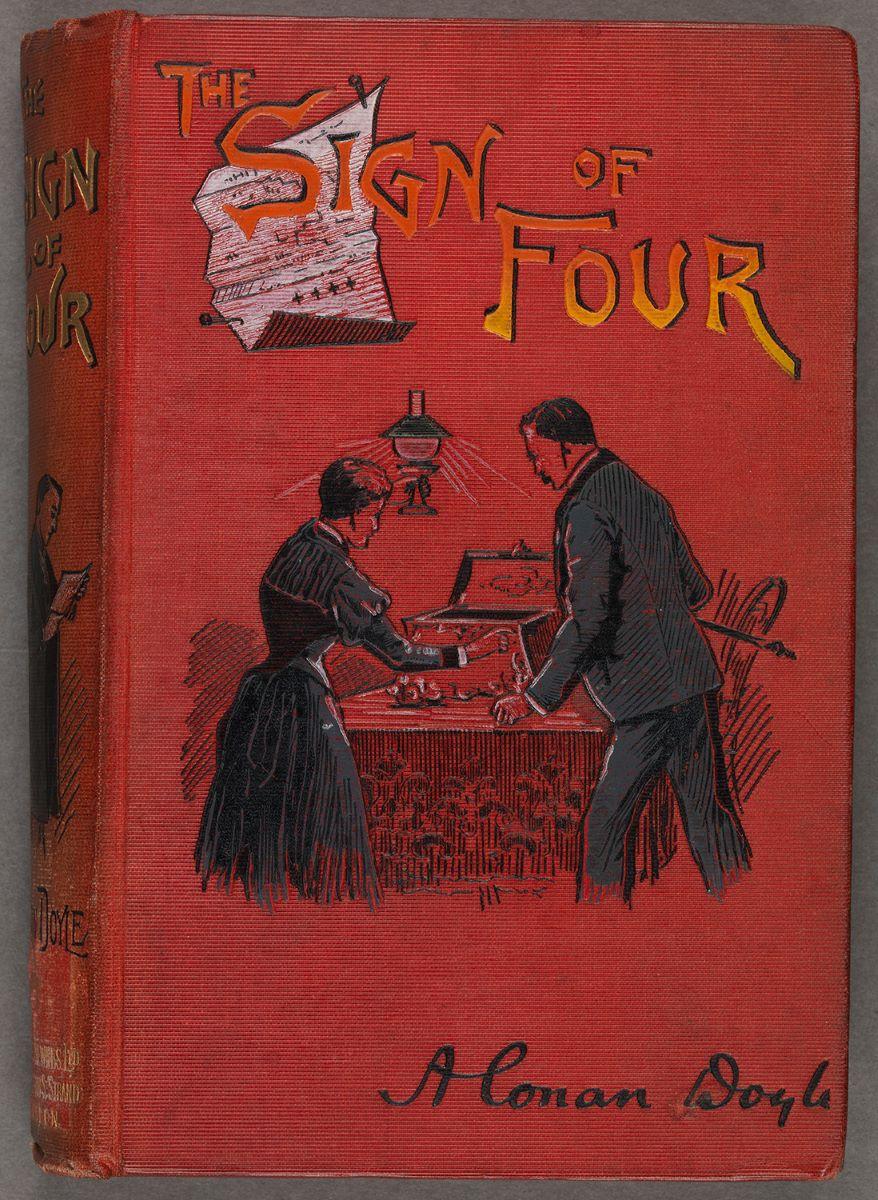
The English edition of Lippincott’s Monthly Magazine was nonetheless published in January without either Doyle’s or Wilde’s story. The following month, though, Doyle’s “The Sign of the Four” was the centerpiece of the magazine (interestingly, the English editions were published in London by Ward, Lock and Company, which had published “A Study in Scarlet”).
Wilde’s manuscript did not arrive until April 1890, but in so many ways it was worth the wait. His story, entitled “The Picture of Dorian Gray,” was the centerpiece of the July edition and is arguably his greatest and most enduring work.
On Dec. 4, 1996, more than a century after the publication of these two works, the autographed manuscript Doyle sent to Stoddart’s London agents on Oct. 1, 1890, was being auctioned by Sotheby’s. It was expected to bring $250,000 to $350,000. It sold for $519,500.
“It was really ‘The Sign of Four’ that started the legend of Holmes going, which is what led to the further series of stories which made Holmes world famous. It sets up the powerful contrast between the very gruff and hearty Dr. Watson and the brilliant, prickly Sherlock Holmes. … There was nothing like them before. They are unique in literature.”
On June 26, 2024, the manuscript was auctioned again, bringing in $960,000—a record for any Doyle manuscript sold at auction.
A Subtle Nod?
Of the three—Stoddart, Doyle, and Wilde—Stoddart is understandably the least well known. Indeed it would have been out of place to mention Stoddart in either of these works. Nonetheless, in “The Sign of the Four” (often shortened to “The Sign of Four”), Doyle does seem to hint at the American editor, though it was been a hint that only he, Stoddart, and Wilde (and perhaps Gill) would have caught. In the early pages of the novel, Miss Mary Morstan, who has come to Sherlock Holmes for help, tells the consulting detective that her father is missing.“He telegraphed to me from London that he had arrived all safe,” Doyle wrote for his character, “and directed me to come down at once, giving the Langham Hotel as his address.”
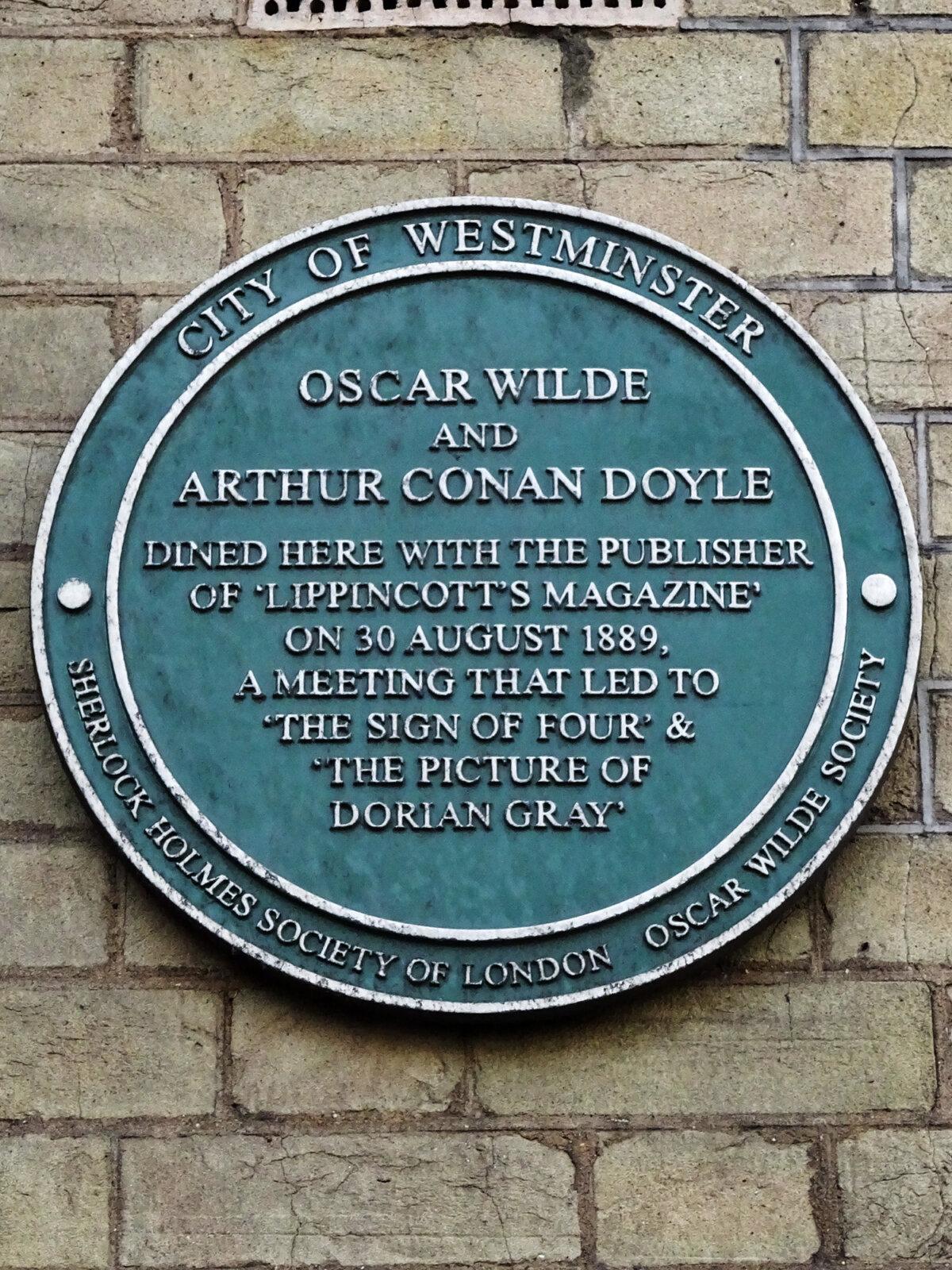
It was not the only time Doyle used the Langham Hotel as a setting. The grand hotel was also mentioned in “A Scandal in Bohemia” and “The Disappearance of Lady Frances Carfax.” In 2010, the Sherlock Holmes Society of London and the Oscar Wilde Society collaborated with the City of Westminster and the Langham Hotel to commemorate that fateful dinner. On the outside wall of Langham’s restaurant is a plaque that reads: “Oscar Wilde and Arthur Conan Doyle dined here with the publisher of ‘Lippincott’s Magazine’ on 30 August 1889, a meeting that led to ‘The Sign of Four’ & ‘The Picture of Dorian Gray.'”