This copy is for your personal, non-commercial use only. Distribution and use of this material are governed by our Subscriber Agreement and by copyright law. For non-personal use or to order multiple copies, please contact The Epoch Times Reprints.
Energy and Natural Resources Minister Tim Hodgson speaks at the Inter Pipeline natural gas extraction plant in Cochrane, Alta., on July 4, 2025. The Canadian Press/Lauren Krugel
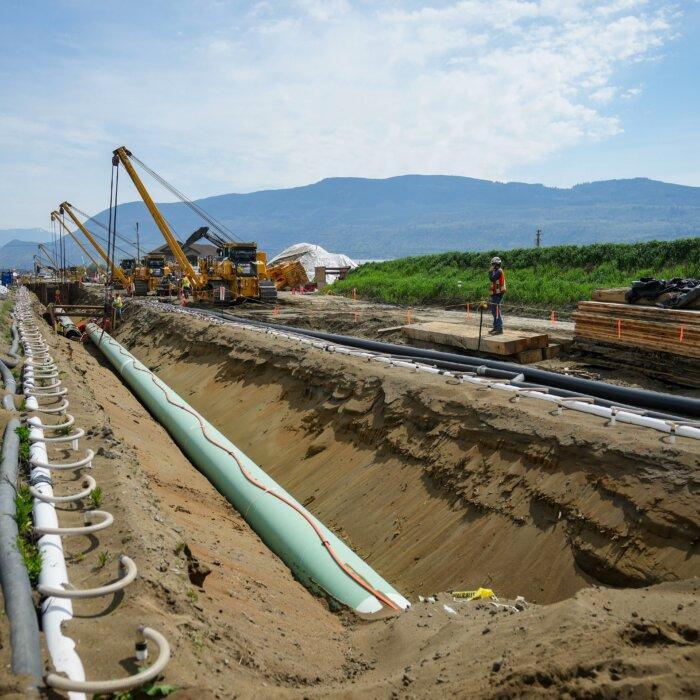
Ottawa has not received any private sector proposals to build a new pipeline linking Alberta to British Columbia, says federal Natural Resources Minister Tim Hodgson.
Hodgson was in Calgary on July 4 announcing funding for five Alberta carbon capture projects when he was asked how receptive he would be if a proponent were to emerge in the coming weeks for a new crude pipeline from Alberta to northern B.C.
The minister responded that Ottawa has begun conversations with the private sector on projects that could get the green light under the One Canadian Economy Act, also known as Bill C-5, which was passed into law on June 26. The bill seeks to speed up approval for infrastructure projects that align with Canada’s national interest.
“We’re very early on in that process. If a project comes forward, and I’ve not seen one yet, but if a project comes forward, it will be evaluated against those five criteria,” Hodgson said, referring to the evaluation process used to determine what qualifies as national interest projects.
“One of the five key criteria is high probability of execution. That means private sector leadership and private sector capital,” the minister said, adding that the evaluation would be done alongside consultations with relevant jurisdictions and indigenous groups. He noted that discussions with the private sector have included these stakeholders.
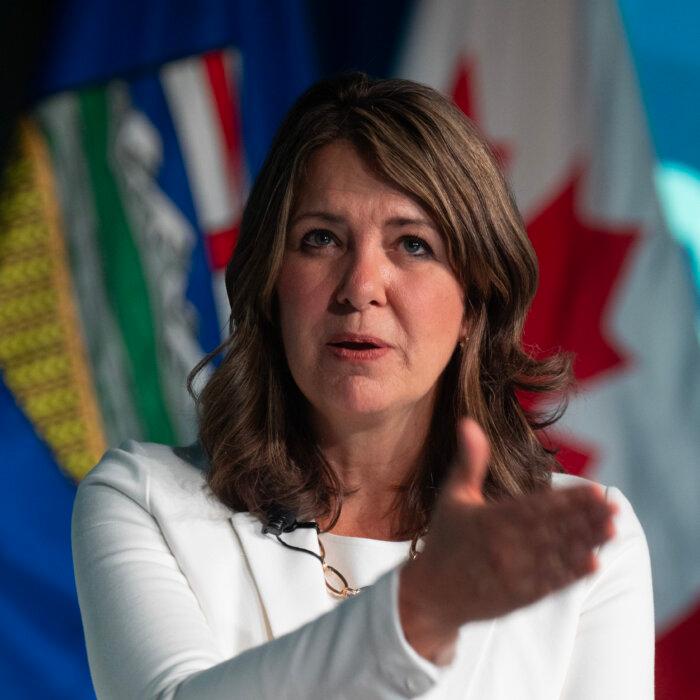
The expectation for a pipeline proposal to emerge within weeks was first suggested by Alberta Premier Danielle Smith in late June, when she said in an interview with Bloomberg published on June 24 that there had been ongoing discussions with major energy companies. However, she declined to provide details on which firms were involved.
At the time, Smith said a pipeline from her province to northwest B.C. would be “the most credible and the most economic of all of the pipeline proposals the private sector would consider.” On June 8, the premier said the pipeline could be paired with carbon capture and storage projects, such as the Pathway Alliance initiative, to offset carbon emissions.
Meanwhile, B.C. Premier David Eby has expressed skepticism about the need for a new pipeline in his province, suggesting that an energy company would have already signed up for the project if it was economically feasible.
‘Up to the Proponent’
At the July 4 press conference, Hodgson declined to share details on how talks are progressing with the six partners involved in the Pathways Alliance project, which are six of Canada’s largest oilsands companies: Canadian Natural, Cenovus Energy, ConocoPhillips Canada, Imperial, MEG Energy, and Suncor.
“Those conversations are going on. They’re going to happen in private,” Hodgson told reporters. “When there’s a transaction, we'll let everybody know. But you should assume that everyone is focused on trying to figure out how to make that happen.”
The consortium of the six oilsands companies has proposed a carbon capture and storage network and pipeline that, once operational, would transport captured emissions from oilsands facilities to a hub in the Cold Lake area of Alberta for permanent underground storage.
Asked how “quickly” the federal government would act on building a new pipeline if a proposal were to emerge, Hodgson said it would depend on the interested energy companies.
“How quickly a proponent comes is up to the proponent,” the minister said, adding that once a proposal is designated as a national interest project, his government would aim to approve it within two years—in line with the Liberals’ “one project, one review” commitment to cut approval timeline from five to two years.
Regulations
Pipeline projects in Canada have faced regulatory challenges for years. A previous analysis by The Epoch Times showed that between 2015 and 2020, $175 billion in energy projects were cancelled in the country, with a significant number of projects citing uncertainty around the regulatory process, and environmental policies, as well as the complexities of indigenous consultation.
The federal government under Prime Minister Mark Carney has shown signs of flexibility toward the oil and gas sector. In the May 27 throne speech delivered by King Charles III, the government outlined its interest in becoming an “energy superpower” by including “conventional energy” as part of its plan—a notable shift from former Prime Minister Justin Trudeau’s last throne speech in November 2021.
Calgary-based Enbridge Inc., Canada’s largest pipeline company, said in late June of this year that it would only pitch the new Alberta-B.C. pipeline when there is a “real provincial and federal legislative change.”
Enbridge, the backer of the scrapped Northern Gateway oilsands pipeline to Kitimat, B.C., said in February that the company and its investors lost hundreds of millions of dollars when the Trudeau government cancelled the project in 2016 as they were nearing the finish line.
Hodgson did not comment directly when asked whether he and the oil and gas sector had found a “consensus” to address Trudeau-era climate policies, such as the Impact Assessment Act, also known as Bill C-69, and the Oil Tanker Moratorium Act, also known as Bill C-48.
Bill C-69 enables the federal government to conduct environmental assessments on resource and infrastructure projects, including pipelines and mine development, while Bill C-48 bans oil tankers off the coast of northern B.C. to protect marine life.
Hodgson said the newly adopted Bill C-5 would allow Ottawa to take a centralized approach to “do all the things we needed to do,” under a single set of timelines, and “to take those learnings to go back and deal with the other acts over time.”
Bill C-5 allows projects deemed to be of “national interest” to circumvent Bill C-69.
A few days before Hodgson’s press conference, the environment ministers of Alberta and Ontario sent a letter to Ottawa calling for the repeal of several Trudeau-era federal climate policies, including Bill C-69.
On July 2, Saskatchewan joined Alberta’s legal challenge against Bill C-69, opposing the legislation in court.
Jennifer Cowan, Matthew Horwood, Paul Rowan Brian, and The Canadian Press contributed to this report.