This copy is for your personal, non-commercial use only. Distribution and use of this material are governed by our Subscriber Agreement and by copyright law. For non-personal use or to order multiple copies, please contact The Epoch Times Reprints.
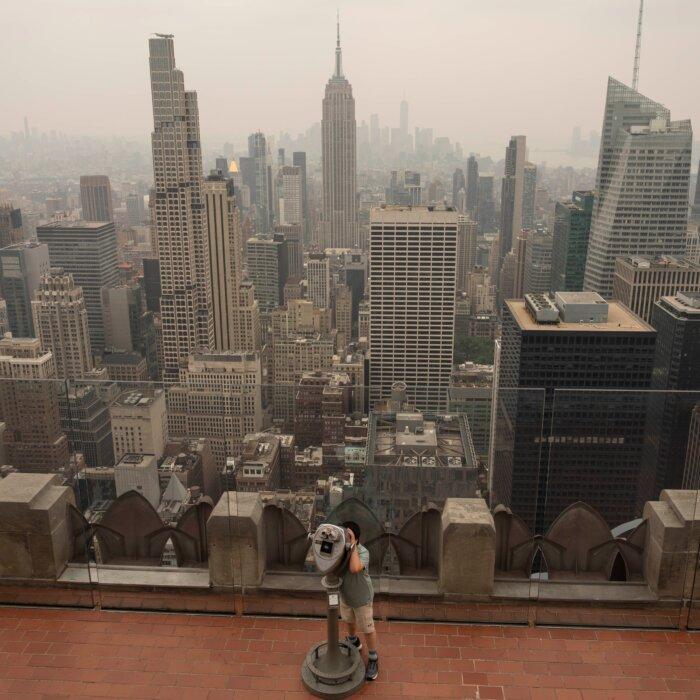
The Lincoln Memorial, the Washington Monument, and the U.S. Capitol are barely visible from a lookout in Arlington, Va., as heavy smoke from wildfires shrouds the landscape in Washington, D.C., on July 17, 2026. AP Photo/J. Scott Applewhite
U.S. President Donald Trump has shared an AI-generated image depicting a giant filtration barrier along the U.S.-Canada border, in apparent reference to his recent criticism of Canadian wildfire smoke drifting across the border into the United States.
The image, posted on his Truth Social platform on July 25, shows a large air filter stretching miles along the shared border, with a label on one end of the structure that reads “MERV 16 High Efficiency Particulate Air Filter.” On the U.S. side, at the base of the imaginary barrier, is a sign that reads “North America Air Filter Barrier” above the slogan, “Clean Air, Clear Borders.”
Trump has been critical of the Canadian government’s response to wildfires of late. His latest post came a day after he remarked in the Oval Office that he would impose tariffs on Canada in retaliation for smoke from wildfires that has blanketed multiple U.S. states in recent days.
“We’re going to put a big tariff on Canada because of the smoke,” the president told reporters following his announcement on the Americans’ recent advancement in nuclear energy.
“I’ve told Canada they have to do something about it. You know, we’ve never had this problem. All of a sudden, we have this problem with Canada.”
Trump did not elaborate on how the tariff would be implemented during the press conference.
He first threatened the additional tariff over wildfire smoke in a Truth Social post on July 17, in which he criticized Canada’s forest management and said the country should be held accountable for the poor air quality.
“We are holding Canada responsible for the fact that they are not properly maintaining their Forests, and Brush therein, and the United States is being unnecessarily invaded by filthy, polluted, and unhealthy air,” Trump wrote.
He added that the “yearly occurrence” of wildfire smoke from Canada had cost the U.S. billions of dollars, and the “cost of this pollution must of necessity be added” to the tariffs its northern neighbour is currently paying.
‘Made Very Clear’
There were a total of 858 active wildfires across Canada as of July 16, with 750 being classified as “out of control,” according to the Canadian Interagency Forest Fire Centre (CIFFC) at the time. Smoke from the wildfires had drifted eastwards and southwards into the United States, prompting air quality warnings in cities such as Toronto, Ottawa, Chicago, Detroit and Minneapolis then.
A July 25 update by CIFFC as of publication time indicated 928 active wildfires occurring countrywide, with “out of control” fires seeing a slight increase to 752.
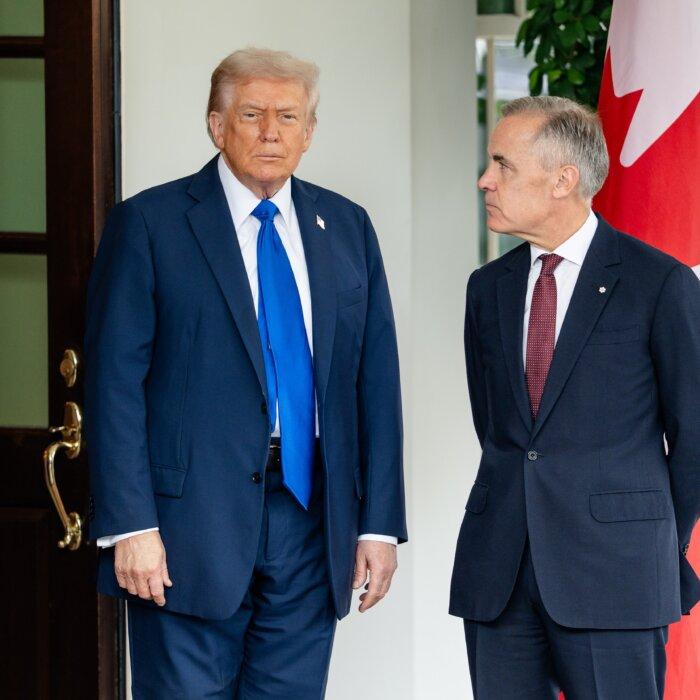
Speaking to reporters on July 19 at Joint Base Andrews in Maryland, Trump said he told Prime Minister Mark Carney during the FIFA World Cup final, which they both attended earlier that day, that the wildfire smoke is “poisoning” U.S. air, and that maybe Canada should pay the damages, or the United States should impose tariffs.
The president said that he has a “good relationship” with the prime minister but that the fires have got to stop.
Carney confirmed July 20 that he discussed the matter with Trump over that weekend, saying he “made very clear” to the U.S. president the magnitude of the wildfire situation Canada is facing.
“[I] made very clear both the scale of the issue, the scale of the forests that Canada is blessed with—eight times the size of Texas—[and] the fact that we have effectively a drought, conditions that extend from the equivalent of Texas all the way to Minnesota, to put it in American terms,” Carney told media outlets.
‘Knows No Borders’
Several Republican lawmakers have also criticized Canada over the wildfire smoke that has drifted to their states.
On July 15, four Michigan members of the U.S. House of Representatives wrote Carney a letter demanding “immediate action” from Ottawa, saying that it has failed to make progress in conducting adequate forest maintenance to mitigate wildfire risks “after repeated conversations sharing concerns.”
“This is the third consecutive year we have had to write to Canadian officials about a crisis that Canada has the tools to prevent and has chosen not to,” wrote Michigan Republicans John James, Jack Bergman, John Moolenaar, and Lisa McClain.
Two days later, on July 17, Republican Senator Bernie Moreno’s office issued a news release saying the Ohio senator has introduced a bill to “sanction Canada and Canadian officials for their failure to contain the wildfires polluting American skies throughout Ohio and the greater United States.”
As well, Republican Senator John Hoeven, representing North Dakota, recently introduced a resolution calling on Ottawa to take responsibility for the impacts caused by the wildfires and to increase efforts to put out the fires and prevent their recurrence with immediate effect.
Democratic Senator Patty Murray, who objected to Hoeven’s resolution, spoke on the Senate floor on July 22, saying Canadian firefighters cross the border to assist the United States fight its wildfires “all the time.” The Washington senator added that a B.C. helicopter pilot who was in Colorado helping battle a wildfire was killed 10 days ago after his chopper crashed into a reservoir.
Her comment echoed what Ontario Premier Doug Ford said during a July 17 press conference that Canada had helped California during its recent wildfire and helped Georgia and North Carolina during Hurricane Helene.
“I truly believe the Americans are good neighbours. If there are some politicians out there chirping away, well, maybe what you should do—rather than complain—is send support, send help, because we have done the exact same thing for our American friends,” he said.
U.S. Ambassador to Canada Pete Hoekstra said in a July 15 statement that the challenge of wildfires “knows no borders” and requires a shared response between the two neighbours.
“I commend the outstanding co-operation between the United States and Canada as we confront these fires together. Our two governments are monitoring and sharing information in real time — coordination that reflects our partnership at its best,” he wrote.
Matthew Horwood and The Canadian Press contributed to this report.