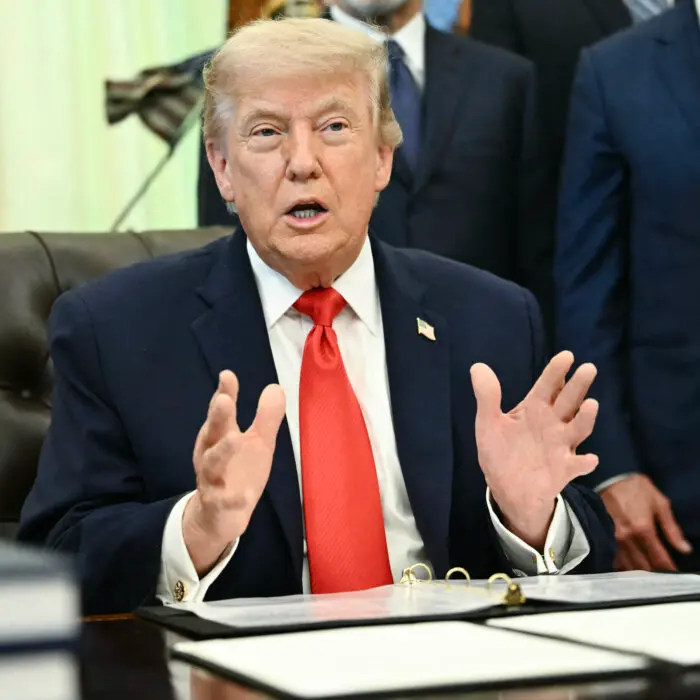
WASHINGTON—Nuclear energy innovations are progressing faster than expected with the advancement of small, modular reactors, President Donald Trump, accompanied by industry leaders, announced on July 24 in the White House.
“Today we’re celebrating an historic milestone for civilian nuclear energy and the renaissance of nuclear power in America,” Trump said during the Oval Office ceremony.
The president set a goal—by the nation’s 250th anniversary on July 4—of three reactors reaching criticality, the point where enough atomic energy is produced to create a self-sustaining nuclear reaction.
Four companies met the challenge, exceeding Trump’s target.
“What we’ve done is pretty much a miracle. Most believed the goal was impossible,” Trump said.
“Making sure that these groundbreaking designs were safe to build, and so quickly, it was a challenge that required an historic partnership between these innovative companies.”
Executives from Aalo Atomics, Antares Nuclear Inc., Deployable Energy, and Valar Atomics joined the president to celebrate their companies’ milestones.
Antares Nuclear was the first to achieve the goal on June 4, with plans for energy production as early as 2027 and use for military purposes in 2028.
Valar Atomics reached criticality around mid-June with its Ward 250 reactor, with future commercial deployments set to serve industrial applications and data centers to bolster grid-independent development.
Deployable Energy’s Unity nuclear achieved the goal on June 30, five months after launching the project. The company aims for rapid deployment by 2028.
“The American spirit is unlocked through your vision and through the department of energy and the secretary and the team. We couldn’t be more proud to be part of this moment,” Bobby Gallagher, the company’s co-founder and CEO, told the president during the event. “I do think this is going to be the start, people are going to look back and believe this is when the tide turned in nuclear.”
Aalo Atomic’s Aalo-X reached criticality on the Fourth of July, with data center integration and power production slated for 2027.
The new reactors are the first privately funded in the country since 1974, officials said.
The United States, once the leading innovator in nuclear technology, has fallen behind in recent years, with Russia and China focusing on nuclear infrastructure development while American energy funding was divested to wind, solar, and other sources.
“Now, America is building again, America is dreaming again, and we’re leading the world pioneering the next generation of nuclear power,” Trump said. “There’s nobody even close.”
Administration officials highlighted the growing demand for energy in the United States and the potential for nuclear to supply clean power.
“If you want to invest in green energy, invest in nuclear,” Jarrod Agen, executive director of the Energy Dominance Council, said during the event. “That’s going to solve the energy demand out there, and that’s base load energy that’s going to solve our solutions, and that’s the energy of the future.”
Michael Kratsios, director of the Office of Science and Technology Policy, said during the event that Trump set “one of the most ambitious goals in civil nuclear history.”
“America is going to be back as the leader in large reactors and next-generation small reactors.”
Trump signed four executive orders in May 2025, with guidelines meant to “reignite a wave of progress” and propel nuclear energy development in the United States.
The Energy Department outlined progress made by the administration in an update issued a year after the orders were signed, including reducing regulatory burdens for licensing new reactors with the creation of a Reactor Pilot Program.
“Next-generation reactor designs are moving toward key tests with impressive speed,” a May 2026 statement from the department reads. “Our nuclear fuel supply is being reinforced to meet our future energy demands. Retired nuclear plants are on target to restart, and utilities are gearing up to boost the power output of existing plants.”
Trump aims to increase nuclear energy production in the nation from 100 gigawatts to 400 gigawatts, with each unit able to power approximately 750,000 homes per year.
A Fuel Line Pilot Program, established in July 2025 by the Department of Energy, allows companies to expand production of nuclear fuel to boost domestic supply chains. Officials signed $2.7 billion in contracts with American companies, announced in January, to increase enrichment.