This copy is for your personal, non-commercial use only. Distribution and use of this material are governed by our Subscriber Agreement and by copyright law. For non-personal use or to order multiple copies, please contact The Epoch Times Reprints.
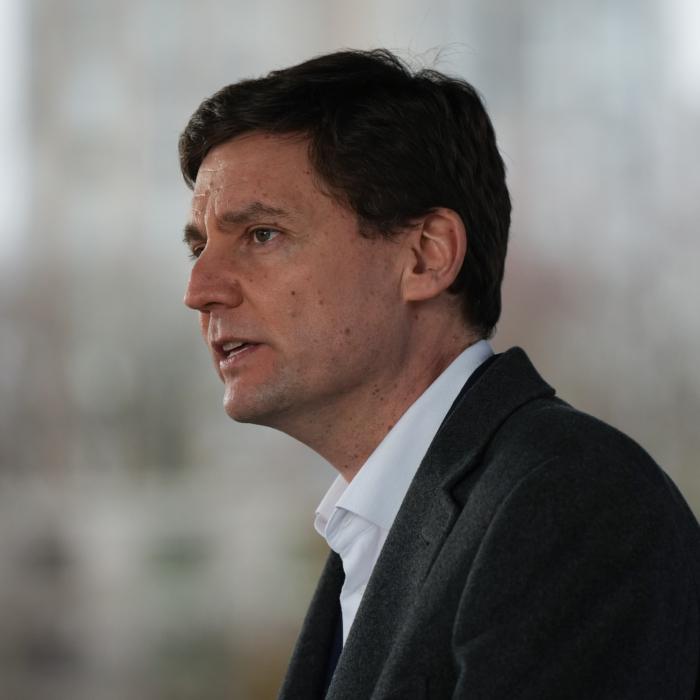
B.C. Premier David Eby listens to a speaker at a closing news conference of a meeting of western Canadian premiers in Kananaskis, Alta., on May 26, 2026. The Canadian Press/Jeff McIntosh
B.C. Premier David Eby set off on his trade mission to China on Saturday, saying before his departure that one of the main goals of this trip is to reduce reliance on the United States.
Speaking to reporters at the Vancouver International Airport ahead of his flight on June 27, Eby reiterated the message that his province is looking to double exports to non-U.S. markets over the coming decade.
“British Columbians have asked the government very clearly to do the work to diversify our trade relationships around the world,” the premier said. “The U.S. has been historically a very good trading partner for us, but we’ve been too dependent on the United States.”
Eby said the mission seeks to strengthen commercial ties with China, which he said is B.C.’s second-largest trading partner, with a focus on forestry, energy, tourism, and agriculture.
The trade delegation will be in China from June 27 to July 3, with B.C.’s Transportation and Transit Minister Mike Farnworth joining the premier for visits to key cities such as Beijing, Shanghai, and Guangzhou.
Eby said he will discuss the lumber trade in China to counterbalance U.S. tariffs that have hurt his province’s forestry sector. He noted that many jobs in British Columbia also rely on the relationship with China and said he hopes to see Chinese tariffs currently affecting the province lifted, including those on the seafood sector.
Eby’s trip to China will mark the first time a B.C. premier has visited the country since 2018, when former Premier John Horgan sought closer trade relations as part of a 10-day tour that included stops in South Korea and Japan.
It will also be Eby’s first-ever trade trip to China, he said. The itinerary released by his office left scant details on the specifics, including whom he will be meeting, beyond a commitment to “meet with government and business leaders” in the mentioned cities and sectors.
The premier told reporters that the full itinerary was not released so as to avoid giving competitors in other provinces and countries a potential unfair advantage, as the mission seeks to drum up customers and deals for B.C. companies.
Eby, however, specifically said he will meet with PetroChina to discuss the second phase of LNG Canada’s large-scale liquefied natural gas (LNG) facility in Kitimat, B.C. PetroChina is a state-owned subsidiary of China’s China National Petroleum Corporation and holds a 15 percent stake in the LNG facility.
The premier said a final investment decision on the project is expected later this year, adding that it is the “really big fish” he seeks to land during the trip. He said the project is worth around $28 billion in terms of provincial revenue “to pay for public services.”
In terms of security, the premier said the RCMP and the Canadian Security Intelligence Service (CSIS) had briefed him to ensure “our team is fully aware of how to minimize risk and to maximize opportunities while visiting.”
A day before his departure to China, Eby said at a press conference that he would cut his trip “a bit short” in order to be back on July 2, at Ottawa’s request, for a potential announcement of a memorandum of understanding around major projects between British Columbia and Ottawa.
Chinese Interference in Canada
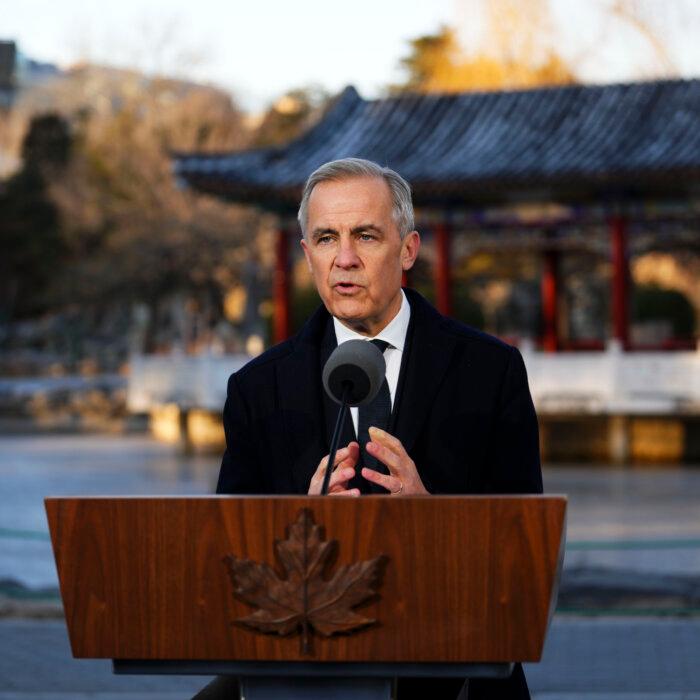
Eby’s China trip comes after Prime Minister Mark Carney visited the country this past January. During that visit, Carney announced a “new strategic partnership” with China. The prime minister also signed a deal to allow 49,000 Chinese electric vehicles into Canada at a reduced tariff rate of 6.1 percent from the previous 100 percent rate, in exchange for China removing or reducing its tariffs on some Canadian agricultural and seafood products for the rest of the year.
The move was a pivot away from what Carney said during the April 2025 election campaign, when he said China was the “biggest security threat” facing Canada. Ottawa has justified the push to increase ties with China as an effort to diversify trade away from the United States amid tariffs imposed by the Trump administration.
In its final report published in January 2025, the Foreign Interference Commission concluded that China is the “most active perpetrator of foreign interference targeting Canada’s democratic institutions.” It added that foreign interference activities target all levels of government and civil society groups in Canada.
The report notably identified B.C. as one of the places where there were allegations of interference by the Chinese Communist Party (CCP) in some of the electoral ridings.
One example is former Conservative MP Kenny Chiu, who represented the Richmond East-Steveston riding, who was targeted in 2021 by false narratives on his stance on a foreign influence registry, the report noted. “Canadian intelligence holdings identified the media spreading these false narratives as having close links to the PRC [People’s Republic of China] government or PRC state media,” the report said regarding Chiu, who lost his seat in the 2021 federal election.
Incumbent NDP MP Jenny Kwan of the Vancouver East riding was also targeted for taking positions critical of the CCP. “Intelligence holdings indicate that the PRC worked to exclude particular political candidates from public events in 2019, and that this strategy continued in 2021,” said the report regarding Kwan.
At the municipal level, a January 2022 leaked report by CSIS said that then-consul general Tong Xiaoling orchestrated some in the local Chinese community to help elect a mayor and a city councillor favoured by the CCP, as reported by The Globe and Mail in March 2023.
The CCP’s latest attempt to interfere in Canada was reported in a May 4 Global News article, which revealed that Chinese Consulate officials met with a City of Vancouver employee in an effort to stop Shen Yun, a New York-based dance company that performs under the tagline “China Before Communism,” from performing at the city-owned Queen Elizabeth Theatre from April 8 to 12. The meeting with consulate officials in early April was previously confirmed to The Epoch Times by a city spokesperson.
Eby told reporters on June 26 that Carney has offered him an invitation to join the prime minister in China in November as part of the Asia-Pacific Economic Cooperation (APEC) gathering.
News of Carney being invited to attend the APEC summit was announced by China’s Foreign Affairs Minister Wang Yi when he visited Canada in late May. A visit to China in November would be Carney’s second in 2026, after his trip to Beijing in January.
Noé Chartier, Omid Ghoreishi, and The Canadian Press contributed to this report.