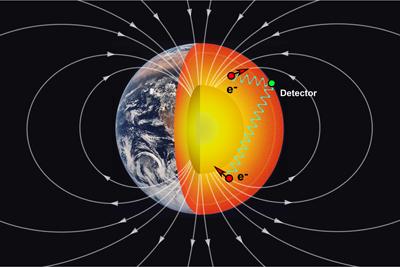
The four known forces in physics—gravity, electromagnetism, and the strong and weak nuclear forces—might soon be joined by a fifth, known as the long-range spin-spin interaction.
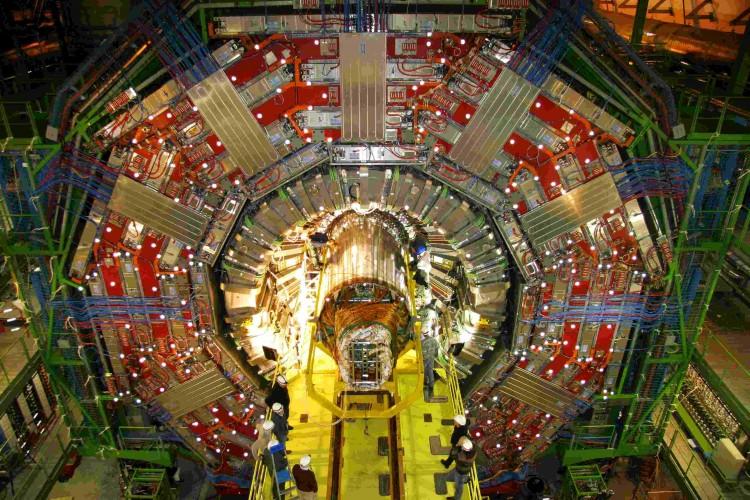
The number of matter particles or fermions contained in the standard model of particle physics has been confirmed as 12.
Trying to explain quantum “spooky action at a distance” using any kind of signal puts Einstein’s relativity against our concept of a smooth spacetime.

The mystery behind why some stars explode may be solved by a theoretical particle that could also help us predict climate change on Earth.

“In 1963, when I assigned the name ‘quark’ to the fundamental constituents of the nucleon, I had the sound first, without the spelling, which could have been ‘kwork’.”

The European Organization for Nuclear Research (CERN) has shown a particle with a mass which matches that of the hypothesized Higgs boson or so-called god particle.
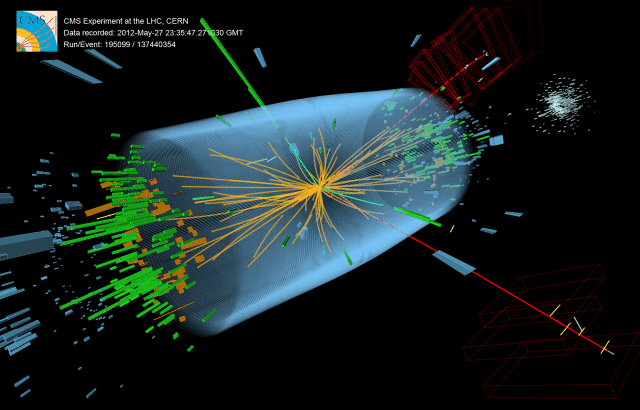
Italian physicists have hypothesized the existence of parallel matter to explain an experimental anomaly that cannot be interpreted using standard physics.

Majorana particles may have been detected for the first time since their theoretical existence was first proposed in the 1930s, with potential applications for quantum computing.
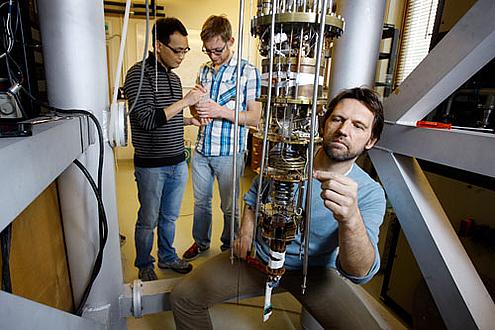
The properties of antimatter have been further elucidated with microwave spectroscopy as part of the ALPHA experiment at CERN.

The laboratories that discovered neutrinos traveling faster than light now backtrack and state that they have found two possible glitches in their system that could account for this anomalous result.

Scientists analyzing data from the ATLAS experiment found a new particle—the Chi-b(3P). (ATLAS Experiment © 2007 CERN)

New research from the European Organization for Nuclear Research (CERN) shows significant progress in the hunt for the subatomic Higgs boson, yet its short-lived existence or non-existence still cannot be conclusively proven.

The European Organization for Nuclear Research (CERN) has managed to trap anti-hydrogen atoms for at least 16 minutes and believes this relatively stable form of antimatter will allow further studies of these rare and mysterious particles.
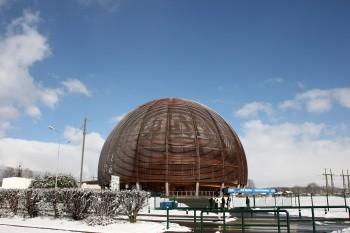
Scientists at CERN were able to create and capture antimatter, according to a statement released this week.

The four known forces in physics—gravity, electromagnetism, and the strong and weak nuclear forces—might soon be joined by a fifth, known as the long-range spin-spin interaction.
The number of matter particles or fermions contained in the standard model of particle physics has been confirmed as 12.
Trying to explain quantum “spooky action at a distance” using any kind of signal puts Einstein’s relativity against our concept of a smooth spacetime.
The mystery behind why some stars explode may be solved by a theoretical particle that could also help us predict climate change on Earth.
“In 1963, when I assigned the name ‘quark’ to the fundamental constituents of the nucleon, I had the sound first, without the spelling, which could have been ‘kwork’.”
The European Organization for Nuclear Research (CERN) has shown a particle with a mass which matches that of the hypothesized Higgs boson or so-called god particle.
Italian physicists have hypothesized the existence of parallel matter to explain an experimental anomaly that cannot be interpreted using standard physics.
Majorana particles may have been detected for the first time since their theoretical existence was first proposed in the 1930s, with potential applications for quantum computing.
The properties of antimatter have been further elucidated with microwave spectroscopy as part of the ALPHA experiment at CERN.
The laboratories that discovered neutrinos traveling faster than light now backtrack and state that they have found two possible glitches in their system that could account for this anomalous result.
Scientists analyzing data from the ATLAS experiment found a new particle—the Chi-b(3P). (ATLAS Experiment © 2007 CERN)
New research from the European Organization for Nuclear Research (CERN) shows significant progress in the hunt for the subatomic Higgs boson, yet its short-lived existence or non-existence still cannot be conclusively proven.
The European Organization for Nuclear Research (CERN) has managed to trap anti-hydrogen atoms for at least 16 minutes and believes this relatively stable form of antimatter will allow further studies of these rare and mysterious particles.
Scientists at CERN were able to create and capture antimatter, according to a statement released this week.