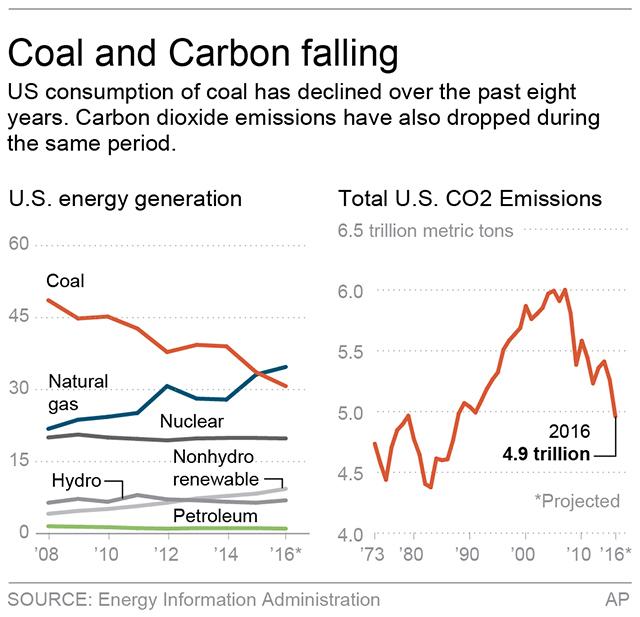
HANGZHOU, China—Mostly unnoticed amid the political brawl over climate change, the United States has undergone a quiet transformation in how and where it gets its energy during Barack Obama’s presidency, slicing the nation’s output of polluting gases that are warming Earth.
As politicians tangled in the U.S. and on the world stage, the U.S. slowly but surely moved away from emissions-spewing coal and toward cleaner fuels like natural gas, nuclear, wind and solar. The shift has put the U.S. closer to achieving the goal Obama set to cut emissions by more than a quarter over the next 15 years, but experts say it is nowhere near enough to prevent the worst effects of global warming.
The overlooked changes took center stage Saturday in China. Obama and Chinese President Xi Jinping entered the world’s two worst polluters into a historic agreement to ratchet down heat-trapping pollution. Obama hailed “the investments that we made to allow for incredible innovation in clean energy.”
U.S. Department of Energy statistics show jolts in where America gets its volts:
• In 2008, 48 percent of America’s electricity came from coal, the dirtiest power source; now it’s about 30 percent. That’s less than the combined U.S. output of carbon-free nuclear and renewable energy.
• There are now more than three solar power jobs in the U.S. for every job mining coal.
• In just the first five months of 2016, more solar power was generated than 2006 through 2012.
• In 2008, the U.S. imported about two-thirds of its oil, and politicians spoke longingly of energy independence. Now, America imports less than half its oil.
• U.S. emissions of carbon dioxide—the main greenhouse gas—are down more than 10 percent, and this year is on pace to be the lowest in about a quarter-century.
“There were gigantic changes happening in the energy world, gigantic tectonic changes,” said Peter Fox-Penner of the Boston University Institute for Sustainable Energy. “It’s a sea change. There is no question.”
Facing steep obstacles in Congress, Obama never aggressively pursued new emissions-curbing legislation, aside from a half-hearted attempt at cap-and-trade in his first term that was politically disastrous for Democrats. Instead, he relied on executive authority and regulations at home while largely going above lawmakers’ heads by focusing on brokering global deals to curb carbon and other greenhouse gases.
So how much credit does Obama deserve? And how much was completely outside his control? That debate is playing out in Obama’s final months in office, as the president tries to go out with a bang on climate and the environment.
Jack Gerard, president of the American Petroleum Institute, the oil and gas lobby, pointed out that Obama pitched his sweeping pollution limits on coal-fired power plants as the main driver of lower future emissions—but the courts have put those rules indefinitely on hold. Meanwhile, emissions have fallen due to a dramatic increase in cleaner-burning natural gas, which Obama was slow to try to regulate.
“We are leading the world in carbon reductions today, and it’s driven primarily by cleaner-burning, affordable natural gas that was brought to you by innovation and technological advances in the oil and natural gas industry,” Gerard said.
But Brian Deese, Obama’s senior adviser, said the seeds of the fracking technology that enabled the natural gas revolution were found in federal Energy Department research conducted in the 1970s. He noted that the people who warned Obama’s policies—like his “Clean Power Plan” emissions limits—would be disastrous are the same people now celebrating the natural gas revolution.
“You can’t on the one hand argue that the Clean Power Plan is an overarching regulation that’s going to impose all these costs, enforce all these changes in the industry, and on the other hand argue that change is happening independent of what government is doing and therefore these regulations are meaningless,” Deese said in an interview.