Insect Hosts Identified for Medicinal Fungus ‘Winter Worm, Summer Grass’

September 15, 2011 Updated: October 1, 2015
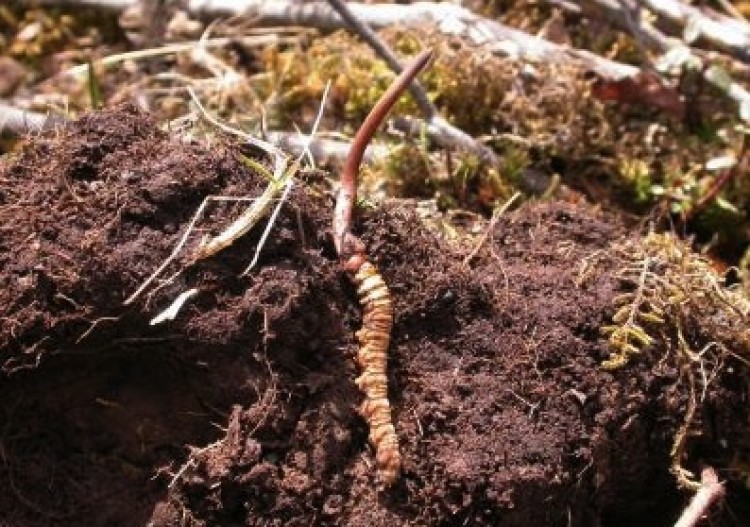
Chinese caterpillar fungus (Ophiocordyceps sinensis) in its natural habitat in Sichuan Province, China. (Wang X-L & Yao Y-J)

Researchers from the Institute of Microbiology of the Chinese Academy of Sciences (CAS), have recognized potential host insects for the Tibetan fungus, Ophiocordyceps sinensis, known in Chinese medicine as the “winter worm, summer grass” (dong chong xia cao).

The fungus, which looks like grass, is known to infest caterpillars and grow to emerge from the caterpillars’ foreheads in spring and summer, so ancient Chinese thought that the caterpillars become grass in the summer, giving rise to the name.

After an extensive survey of the available literature, the scientists concluded that out of 91 species of ghost-moths, 57 are more susceptible to exploitation from this medicinal fungus.

“The fungus has a striking developmental biology,” said study co-author Dr. Yi Jian Yao in a press release.

“As a Sac (ascomycete) fungus, it parasitizes larvae of moths of the family Hepialidae and converts them into sclerotized bodies from which the fungus fruiting body grows," he added.

“So the natural production of this fungus is closely related to its insect hosts."

Thitarodes moth, a host species of Ophiocordyceps sinensis, collected from Qinghai Province, China. (Wang X-L & Yao Y-J)
The fungus was listed as an endangered species in 1999 by the Chinese Forestry Administration and Ministry, due to strict host specificity, confined geographical distribution, and over exploitation by humans in recent decades.

The study analyzed the fungal-larval relation in detail.

This can serve as a foundation for further investigations on the conservation biology of this endangered fungus and its host.

The study was published in the journal Zookeys on Sept. 8.

Read the paper at http://bit.ly/opwE4Y