WASHINGTON—In some ways, art can better express a people’s pain, suffering and aspirations than history books can. At the same time China’s communist regime was showcasing its power with a massive military parade in Beijing, an art exhibit of paintings and sculptures, illustrating the blood-and- tears history of the Chinese Communist Party (CCP)’s tyranny, was on display at the Rayburn House Office Building of the U.S. Congress.
Artwork by well known artists Haiyan, Chen Weiming, Tom Block, Yan Yukun, Bob Hieronimus, and Daxiong told the story of the CCP, as well as serving as an inspiration to all of us.
“We have a show to expose the crimes of the Chinese Communist Party in the past 60 years,” said Wei Jingsheng to reporters on the morning of October 1, when they asked Wei his response to the Beijing celebration.
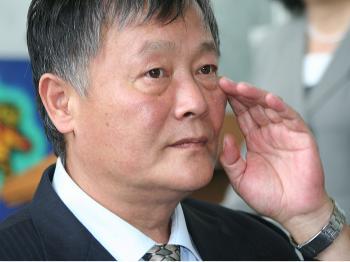
Wei Jingsheng, 59, is much more at home with words than with art. As one of China’s most renowned dissidents, Wei was incarcerated by the Chinese regime for nearly 18 years for advocating democracy, before he was finally released and exiled to the U.S. in 1997. His 1978 essay “The Fifth Modernization—Democracy” challenged the Communist Party’s new leadership’s stance that progress could be made without democracy.
At the news conference at the art exhibit, in the foyer of the Rayburn Building, he said through his interpreter, Ciping Huang, “I am very grateful to the artists—they use the artwork to express exactly what is on our minds.”
Organized by the Wei Jingsheng Foundation and open on October 1 and 2, this art exhibit in the nation’s capital is a way for the proponents of human rights and democracy to observe the 60th anniversary of the founding of the People’s Republic of China by condemning the crimes perpetrated by the CCP over the past 60 years. The major co-sponsors of the exhibit are the “Tear Down This Wall” Foundation, the Human Rights Painting Project of Amnesty International, and the Asia Democracy Alliance. Several other groups, including The Epoch Times, also supported the exhibit.
The concept behind the art exhibit and news conference, which were followed by a seminar the next day, was to include not only the Han Chinese ,who have suffered under 60 years of tyranny, but the minority groups who have also been victimized by the CCP since it took power by force in 1949. The Tibetans, Uyghurs, Inner Mongolians, Burmese, and Vietnamese were represented at the news conference and by the art depicted. (Dr. Quan Nguyen, representing Vietnam, was invited but was ill and could not attend.)
At the seminar, Wei spoke of the Asia Democracy Alliance and the importance of “being united together” among the various ethnic groups and nationalities in confronting their common enemy, “the evil empire of [Chinese] communism.” Wei not only referred to the Tibetans, Uyghurs and Mongolians, but said the peoples of Burma, Vietnam and North Korea have the same common interest of realizing democracy.
The largest piece in the exhibit was a sculpture of the Tiananmen Square Massacre on June 4, 1989 by Chen Weiming. It is 28 feet long. The description says, “…The army opened fire on the protesters and killed thousands of innocent people. Chang An Road, the widest road in the world, was covered with lifeless bodies of these youthful lives.”
Chen said the coming together of several artists to Washington, D.C. to express their ideals of freedom is “very significant.” “The Communist regime in China makes a circle for the artists. If you are ‘in’, then [your life] is okay, but if you are ‘out,’ then it is dangerous.”
Mr. Chen also made a sculpture of House Speaker Nancy Pelosi, depicting the scene when, as a Congress woman two years after the tragedy, she held a banner recognizing the loss of life on that day. Chen was also responsible for the bust of the Dalai Lama. Chen currently lives in Las Vegas after sculpting 18 years in New Zealand.
Tom Block, 46, painted Wei Jingsheng in an expressionist portrait that shows the strain of long years and abuse in prison. Working with Amnesty International, Block created the Human Rights Painting Project, which started in 2001. He has painted around 40 human rights defenders, and Wei was the first one he did. He has spoken about his ideas concerning using art as an activist tool at conferences and universities in the U.S., Canada, Europe and the Middle East.
Hai Yan Wang contributed several art pieces for this exhibit and they weren’t limited to just her homeland China. There are a series of murals that depict the CCP history, entitled “The Crimes of the Chinese Communist Party in the 60 years under its regime.” She signs her paintings simply, “Haiyan.”
Artwork by well known artists Haiyan, Chen Weiming, Tom Block, Yan Yukun, Bob Hieronimus, and Daxiong told the story of the CCP, as well as serving as an inspiration to all of us.
“We have a show to expose the crimes of the Chinese Communist Party in the past 60 years,” said Wei Jingsheng to reporters on the morning of October 1, when they asked Wei his response to the Beijing celebration.
Wei Jingsheng, 59, is much more at home with words than with art. As one of China’s most renowned dissidents, Wei was incarcerated by the Chinese regime for nearly 18 years for advocating democracy, before he was finally released and exiled to the U.S. in 1997. His 1978 essay “The Fifth Modernization—Democracy” challenged the Communist Party’s new leadership’s stance that progress could be made without democracy.
At the news conference at the art exhibit, in the foyer of the Rayburn Building, he said through his interpreter, Ciping Huang, “I am very grateful to the artists—they use the artwork to express exactly what is on our minds.”
Organized by the Wei Jingsheng Foundation and open on October 1 and 2, this art exhibit in the nation’s capital is a way for the proponents of human rights and democracy to observe the 60th anniversary of the founding of the People’s Republic of China by condemning the crimes perpetrated by the CCP over the past 60 years. The major co-sponsors of the exhibit are the “Tear Down This Wall” Foundation, the Human Rights Painting Project of Amnesty International, and the Asia Democracy Alliance. Several other groups, including The Epoch Times, also supported the exhibit.
The concept behind the art exhibit and news conference, which were followed by a seminar the next day, was to include not only the Han Chinese ,who have suffered under 60 years of tyranny, but the minority groups who have also been victimized by the CCP since it took power by force in 1949. The Tibetans, Uyghurs, Inner Mongolians, Burmese, and Vietnamese were represented at the news conference and by the art depicted. (Dr. Quan Nguyen, representing Vietnam, was invited but was ill and could not attend.)
At the seminar, Wei spoke of the Asia Democracy Alliance and the importance of “being united together” among the various ethnic groups and nationalities in confronting their common enemy, “the evil empire of [Chinese] communism.” Wei not only referred to the Tibetans, Uyghurs and Mongolians, but said the peoples of Burma, Vietnam and North Korea have the same common interest of realizing democracy.
The largest piece in the exhibit was a sculpture of the Tiananmen Square Massacre on June 4, 1989 by Chen Weiming. It is 28 feet long. The description says, “…The army opened fire on the protesters and killed thousands of innocent people. Chang An Road, the widest road in the world, was covered with lifeless bodies of these youthful lives.”
Chen said the coming together of several artists to Washington, D.C. to express their ideals of freedom is “very significant.” “The Communist regime in China makes a circle for the artists. If you are ‘in’, then [your life] is okay, but if you are ‘out,’ then it is dangerous.”
Mr. Chen also made a sculpture of House Speaker Nancy Pelosi, depicting the scene when, as a Congress woman two years after the tragedy, she held a banner recognizing the loss of life on that day. Chen was also responsible for the bust of the Dalai Lama. Chen currently lives in Las Vegas after sculpting 18 years in New Zealand.
Tom Block, 46, painted Wei Jingsheng in an expressionist portrait that shows the strain of long years and abuse in prison. Working with Amnesty International, Block created the Human Rights Painting Project, which started in 2001. He has painted around 40 human rights defenders, and Wei was the first one he did. He has spoken about his ideas concerning using art as an activist tool at conferences and universities in the U.S., Canada, Europe and the Middle East.
Hai Yan Wang contributed several art pieces for this exhibit and they weren’t limited to just her homeland China. There are a series of murals that depict the CCP history, entitled “The Crimes of the Chinese Communist Party in the 60 years under its regime.” She signs her paintings simply, “Haiyan.”