More US and Chinese Steel and Aluminum Imports Exempted From Ottawa’s Counter-Tariffs

More US and Chinese Steel and Aluminum Imports Exempted From Ottawa’s Counter-Tariffs
Steel workers are seen at work at the ArcelorMittal Dofasco steel plant in Hamilton, Ont., on March 12, 2025. The Canadian Press/Nathan Denette
|Updated:
0:00

After lifting most of the counter-tariffs on U.S. products in recent months, Ottawa is now extending exemptions from retaliatory duties on certain steel and aluminum imports—not just to its southern neighbour, but also to China.

In a news release issued on Oct. 17, the Department of Finance said the move was made to provide relief to Canadian firms struggling with the effects of Ottawa’s countermeasures in response to trade disputes with Washington and Beijing.

“[F]urther relief from Canada’s tariffs on imports from the U.S. and China have now been implemented for companies that met strict conditions such as demonstrating short supply or existing contractual obligations,” the department said.

The release specified that U.S. goods used in Canadian manufacturing, processing, and food and beverage packaging will continue to be exempted from counter-tariffs, with the current exemption extended for another two months, adding that the exemption now includes goods used in agricultural production.

The same applies to American goods that are used to support public health, health care, public safety, and national security objectives in Canada.

Notably, the release includes a link to a document, titled “Customs Notice 25-19: United States Surtax Remission Order (2025),” which states that “[t]he Order allows the relief of surtaxes paid or payable” under the “United States Surtax Order (2025-1)” or the “United States Surtax Order (Steel and Aluminum 2025)” for “goods imported for use, in Canada, in the manufacture or processing of any good, in the production of any agricultural product or in the packaging of a food product or beverage.”

“The administration of the Order is the responsibility of the Canada Border Services Agency (CBSA),” said customs notice 25-19, which was originally issued in April, and updated on Oct. 17.

Regarding China, the CBSA issued an update to a separate customs notice on the same day, titled “Customs Notice 25-05: China Surtax Remission Order.” That order says, among other rules, that Canadian businesses can qualify for duty remission if the goods they import are listed in “Schedule 2” of the China Surtax Remission Order (2024) and were brought into the country between Oct. 22, 2024, and Dec. 31, 2025.

Schedule 2 of the 2024 remission order covers multiple steel and aluminum products, including plates, sheets, bars, tubes and pipes.

“Schedule 2 covers situations where contractual obligations existed prior to August 26, 2024, requiring the use of Chinese steel or aluminum in products or projects, or where other exceptional circumstances limit the feasibility of resourcing,” the 2024 remission order said.

‘Disappointed’

Ottawa first announced its intent to impose tariffs on Chinese steel and aluminum on Aug. 26, 2024, citing “China’s unfair trade policies.” The tariffs came into force on Oct. 22, 2024, and in July 2025, the Liberals levied additional 25 percent duties on Chinese steel to protect the domestic sector from trade diversion.

Domestic steel makers in Canada say they object to Ottawa’s latest move, with Catherine Cobden, president and CEO of the Canadian Steel Producers Association, expressing her disappointment.

“We are disappointed to see a broad exception to tariffs was given to U.S. producers for another two months, while we suffer from lack of access to their market,” Cobden said in an interview with CBC, adding that it is “inconceivable” that Ottawa seems to have granted a series of new exemptions to companies importing Chinese steel.
Facing the United States, Canada has dialled back its reciprocal tariffs, with the exception of its 25 percent tariffs on U.S. steel, aluminum, and auto imports. Meanwhile, the White House has slapped Canada with multiple tariffs, including 35 percent on products not covered by the United States-Mexico-Canada Agreement as well as 50 percent on aluminum, steel, and copper; 35 percent on softwood lumber; and 25 percent on vehicles and automotive parts, to name a few.

‘Now Is the Time to Talk’

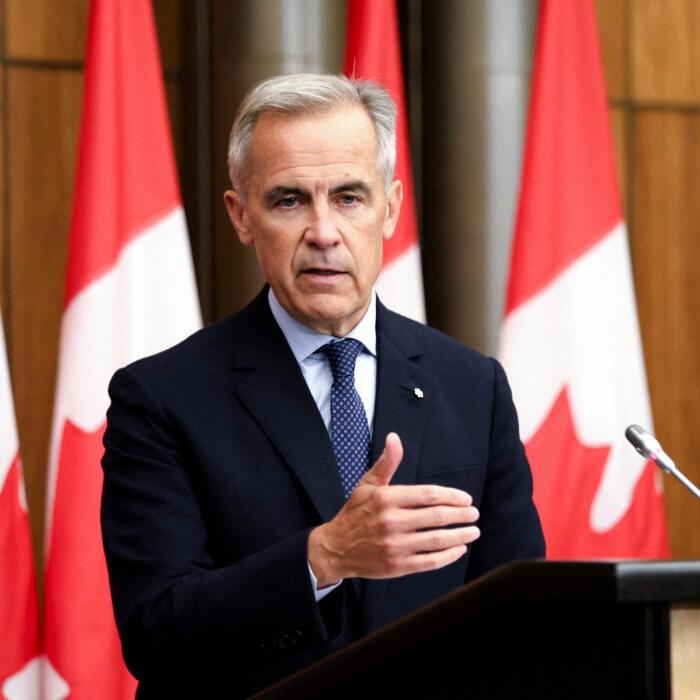
In an Oct. 14 speech at the Empire Club of Canada in Toronto, Ontario Premier Doug Ford called on Prime Minister Mark Carney to retaliate if the country is unable to strike a deal with the U.S. administration under President Donald Trump.

“If [the prime minister] can’t get a deal, we have to hit back,” Ford said.

Carney, for his part, ruled out Ford’s approach when asked during a press conference in Toronto whether he would follow suit and take trade actions against the United States.

“There’s times to hit back, and there’s times to talk, and right now is the time to talk,” Carney told reporters on Oct. 16.

The prime minister added that his team is currently engaged in “deep” and “intensive” negotiations with the Americans on several tariffed sectors, including energy, aluminum, and steel.
Meanwhile, Foreign Affairs Minister Anita Anand met with her Chinese counterpart Wang Yi on Oct. 17, during her visit to Beijing. The two discussed trade issues of “respective sensitivity” that included agriculture and agri-food products, such as Canadian canola, seafood, and meat, along with Chinese products like electric vehicles, according to a readout by Global Affairs Canada.

The readout did not indicate whether the countries reached a deal on tariffs, but it notes the ministers agreed that “regular and candid communication is essential to build trust, enhance cooperation and address respective concerns.”

Carolina Avendano and Jennifer Cowan contributed to this report.