Scientists are watching the birth of a planet orbiting a star 450 light years away and say what they learn could answer some of the biggest questions concerning how planets form around other stars.

During the past two decades, astronomers have discovered 300 “hot Jupiters,” but for the first time they’ve found one that has two close-in planetary companions.

A new star map includes the most comprehensive images anyone has ever seen of the Milky Way’s cold interstellar gas clouds where new stars are born.

U.S. researchers have narrowed down their search for radio signals from intelligent life among the stars.

Tau Ceti, one of our closest sun-like stars, has a planetary system, including a world in the habitable zone.

Astronomers have found a brand-new star in the center of a rotating disk of gas and dust, the youngest solar system ever found.

During its youth, the sun may have emitted a series of shock waves that caused the planets in our solar system to form at different times.

Until 2.5 years ago, a young solar system was emitting large amounts of infrared radiation due to the circumstellar disc of rocky debris surrounding it.

NASA’s Kepler mission has revealed a solar system containing two worlds that are the closest known planets.

Two unusual new exoplanets have been discovered through the Kilodegree Extremely Little Telescope (KELT) project, using its North telescope in Arizona.

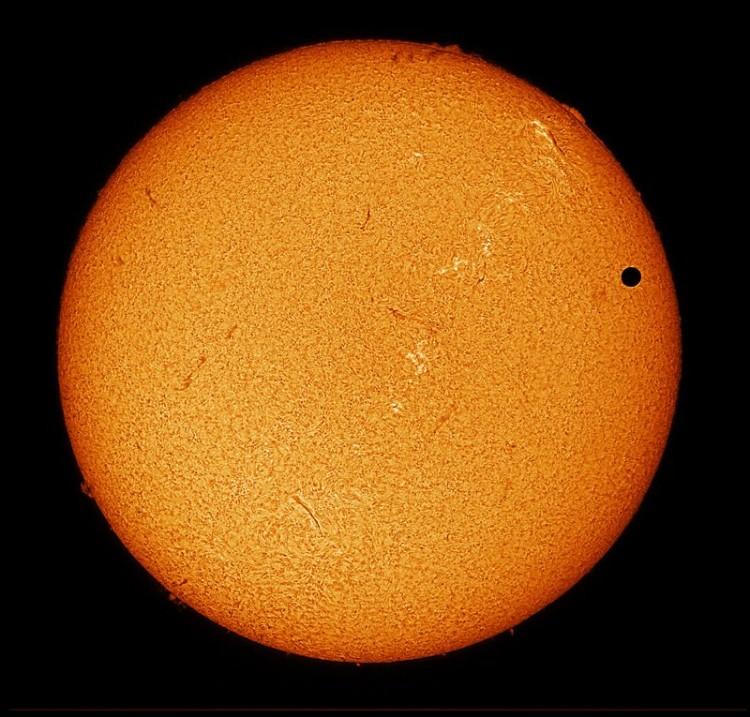
A once-in-a-lifetime event will take place on June 5/6 when Venus will be visible as a tiny black dot moving across the sun. The next Venus transit isn’t due until 2117.

A once-in-a-lifetime event will take place on June 5/6 when Venus will be visible as a tiny black dot moving across the sun. The next Venus transit isn’t due until 2117.
Skies in the western United States, China, and Japan will be graced by a rare and beautiful celestial phenomenon this weekend: an annular solar eclipse.

More celestial action is on the cards for sky watchers this weekend with Saturn set to oppose the sun on Sunday, April 15.

Massive bursts of solar wind and magnetic fields from the Sun can cause huge sunquakes, according to new UK research.

As solar systems develop around young stars, exoplanet “pileups” and “deserts” may result from the generation of specific orbits.

Scientists are watching the birth of a planet orbiting a star 450 light years away and say what they learn could answer some of the biggest questions concerning how planets form around other stars.
During the past two decades, astronomers have discovered 300 “hot Jupiters,” but for the first time they’ve found one that has two close-in planetary companions.
A new star map includes the most comprehensive images anyone has ever seen of the Milky Way’s cold interstellar gas clouds where new stars are born.
U.S. researchers have narrowed down their search for radio signals from intelligent life among the stars.
Tau Ceti, one of our closest sun-like stars, has a planetary system, including a world in the habitable zone.
Astronomers have found a brand-new star in the center of a rotating disk of gas and dust, the youngest solar system ever found.
During its youth, the sun may have emitted a series of shock waves that caused the planets in our solar system to form at different times.
Until 2.5 years ago, a young solar system was emitting large amounts of infrared radiation due to the circumstellar disc of rocky debris surrounding it.
NASA’s Kepler mission has revealed a solar system containing two worlds that are the closest known planets.
Two unusual new exoplanets have been discovered through the Kilodegree Extremely Little Telescope (KELT) project, using its North telescope in Arizona.
A once-in-a-lifetime event will take place on June 5/6 when Venus will be visible as a tiny black dot moving across the sun. The next Venus transit isn’t due until 2117.
A once-in-a-lifetime event will take place on June 5/6 when Venus will be visible as a tiny black dot moving across the sun. The next Venus transit isn’t due until 2117.
Skies in the western United States, China, and Japan will be graced by a rare and beautiful celestial phenomenon this weekend: an annular solar eclipse.
More celestial action is on the cards for sky watchers this weekend with Saturn set to oppose the sun on Sunday, April 15.
Massive bursts of solar wind and magnetic fields from the Sun can cause huge sunquakes, according to new UK research.
As solar systems develop around young stars, exoplanet “pileups” and “deserts” may result from the generation of specific orbits.