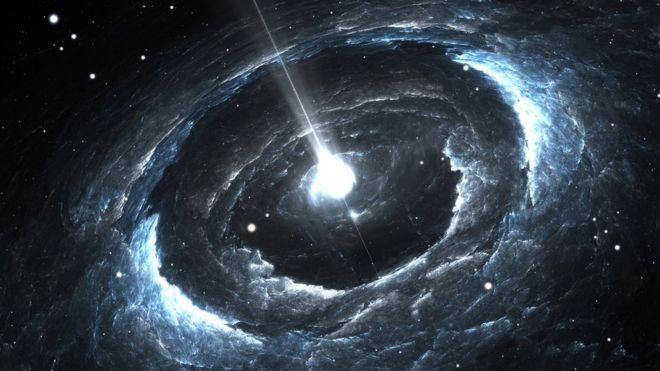
The universe is expanding 9 percent more quickly than expected, telling us there’s something we’re missing. Could it be a new type of particle?

The Hubble Space Telescope has broke a new record, peering 13.4 billion years into the past to observe an infant galaxy that may have formed just 400 million years after the Big Bang.

A journey to the beginning of the universe lurched forward Monday with a trek over just a few hundred feet.

Large disk galaxies, much like our own Milky Way, may have existed in the early days of the universe.

Astronomers have discovered a giant swirling disk of gas 10 billion light-years away—a galaxy-in-the-making that is actively being fed cool primordial gas tracing back to the Big Bang.

Dr. Robert Lanza, one of Time magazine’s 100 most influential people, believes science must recognize the importance of human consciousness.

For the first time scientists have observed the dust contents of galaxies as seen just 1 billion years after the Big Bang.

Going faster than the speed of light is impossible, according to Albert Einstein’s Special Relativity Theory, yet theoretical physicists bend their minds to the task, wondering if there’s a way around the rules.

Have you ever looked up in the night sky and wondered, “Why is space black?”
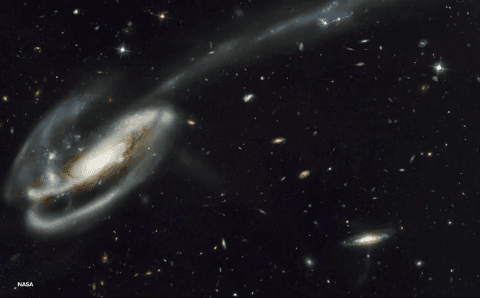
From our perspective, time is always moving forward, but according to some theoretical research, it might be possible that the Big Bang also created a mirrored universe where time moves backwards relative to our own understanding.
We believe, though we cannot yet prove, that our multiverse of universes is 11-dimensional. So think of this 11-dimensional arena and in this arena there are bubbles, bubbles that float and the skin of the bubble represents an entire universe, so we’re like flies trapped on fly paper.

The recent BICEP2 observations – of swirls in the polarisation of the cosmic microwave background – have been proclaimed as many things, from evidence of the Big Bang and gravitational waves to something strange called the multiverse.

If the Big Bang theory is just a “theory,” are there other hypothetical explanations for the origin of the known universe?
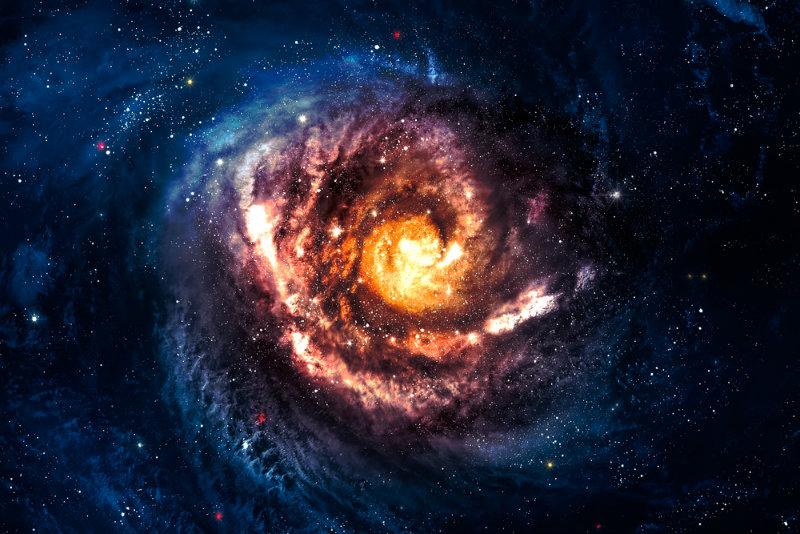
Black holes could be portals to other universes; they may defy Einstein’s relativity theory or quantum mechanics; they may contain singularities, an ultra-complex substance. Here’s a look at what we think we might know about these deep mysteries.