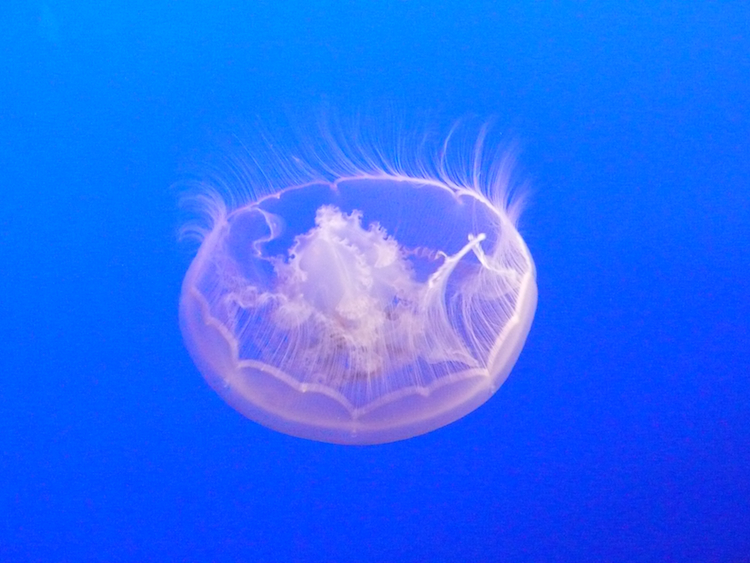
SCIENCE IN PICS: Moon Jellyfish

The moon jelly, Aurelia aurita, is also known as the saucer jelly due to its large disc-shaped umbrella, which can grow up to about 40 cm (16 inches) in diameter.
SCIENCE IN PICS: Moon Jellyfish
The moon jelly usually swims near the water surface keeping the umbrella and tentacles spread widely to catch prey. Cindy Drukier/The Epoch Times
|Updated:
<a href="https://www.theepochtimes.com/assets/uploads/2015/07/file_download-1.jpg" rel="attachment wp-att-155517"><img class="size-large wp-image-155517" src="https://www.theepochtimes.com/assets/uploads/2015/07/file_download-1-599x450.jpg" alt="" width="590" height="442"/></a>

The moon jelly, Aurelia aurita, is also known as the saucer jelly due to its large disc-shaped umbrella, which can grow up to about 40 cm (16 inches) in diameter.

This species mostly inhabits warm and tropical coasts of the Atlantic, Pacific, and Indian Oceans. It feeds on plankton, including larval mollusks, crustaceans, and tiny worms.

In the juvenile stage, jellyfish generally exist as polyps, which maybe be free-floating or attach to a substrate, rather like sea anemones.

As the polyp grows, it may reproduce asexually by budding, producing individuals that will grow into mature jellyfish with the disc or umbrella on top.

Many long thread-like tentacles arise from the umbrella. They are equipped with stinging cells for self defense and predation. The cells are triggered when touched.

Arsh Sarao
Arsh Sarao
Author
Arsh Sarao is a health reporter for The Epoch Times. She holds a Master's degree in Biotechnology and a Bachelor's degree in Biology and Chemistry. She taught life sciences for 11 years before working as an editor for Epoch Inspired for 7 years. She focuses on health, wellness, and traditional value topics.