This copy is for your personal, non-commercial use only. Distribution and use of this material are governed by our Subscriber Agreement and by copyright law. For non-personal use or to order multiple copies, please contact The Epoch Times Reprints.
Lost Knowledge: Amazing Inventions That Made the Ancient World Ahead of Its Time
Earthquake monitoring, steam engines, surgery, and advanced materials: A journey through ancient inventions that were ahead of their time—and did not survive.
The human achievement lies not only in inventions, but also the ability to preserve, transmit, document, and make knowledge accessible. Illustration by Epoch Magazine Israel; Jeng Bo Yuan/Shutterstock, Windmemories/CC BY-SA 4.0, Alexandros Michailidis/Shutterstock
The human achievement lies not only in inventions, but also the ability to preserve, transmit, document, and make knowledge accessible. Illustration by Epoch Magazine Israel; Jeng Bo Yuan/Shutterstock, Windmemories/CC BY-SA 4.0, Alexandros Michailidis/Shutterstock
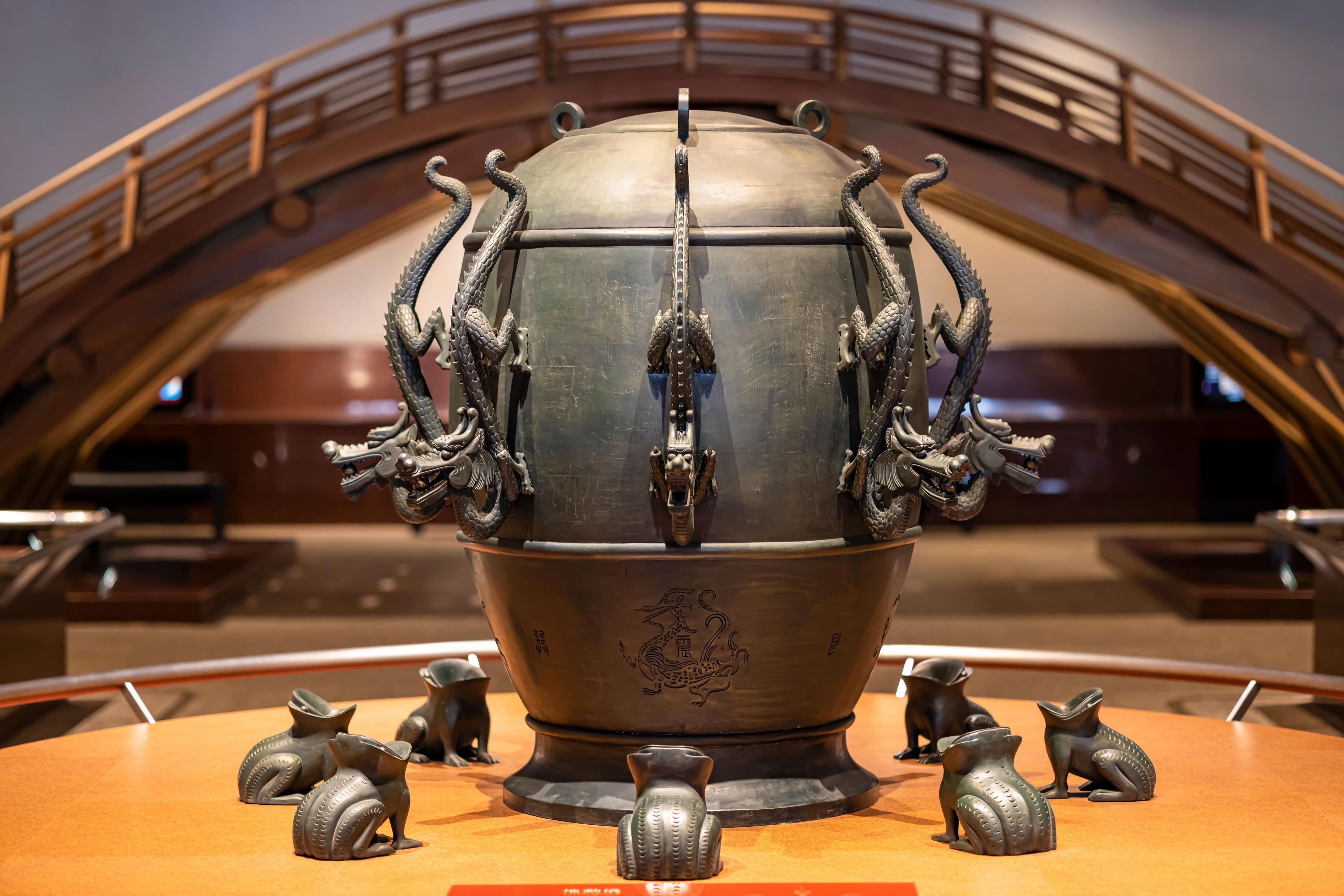
In the year 138 CE, in the imperial court of China’s Han dynasty, stood a large bronze vessel that, at first glance, looked more like a ceremonial piece than a scientific instrument. It was wide, heavy, and ornate, with eight dragons positioned around its rim. In the mouth of each dragon rested a small bronze ball, beneath which waited a toad with its mouth open.
One day, a sharp metallic sound rang out—one of the eight balls had dropped into the mouth of the toad beneath it. However, no one in the imperial court felt the slightest shaking. The ground did not tremble, the walls did not crack, and no cries split the air of the city.
It would have been easy to dismiss the device as faulty. Yet before long, a messenger arrived with news of an earthquake that had struck to the west, far from the emperor’s court. The mysterious instrument, as it turned out, had detected the distant event and accurately indicated its direction.
This was a seismoscope—an earthquake detector—invented by Zhang Heng, a Chinese astronomer, mathematician, and inventor, almost 1,700 years before instruments known as “seismographs” were developed at the end of the 19th century by the British seismologist John Milne and others.
Zhang’s device features eight dragons, each representing a primary direction of the compass and designed to show where an earthquake had occurred. When an internal mechanism, supposedly a pendulum or a similar oscillating system, detected a seismic wave, it released a ball from the mouth of one of the dragons into the vessel beneath it, producing a sound.
Stories like this captivate us partly because they unsettle the way we are accustomed to thinking about human progress. We tend to picture human knowledge as a slow but steady climb up a ladder—from ignorance to discovery to refinement. Each generation stands on the shoulders of the last, getting a little smarter and knowing a bit more with each step.
However, the history of human knowledge doesn’t always follow a straight ladder. Sometimes, it resembles an archive that was partly burned, a clever machine that once worked perfectly but was never replicated, or an idea that simply arrived too early—long before the world knew what to do with it.
A replica of Zhang Heng's seismoscope at the National Museum of Natural Science in Taiwan. Jeng Bo Yuan/Shutterstock
This isn’t some romantic claim that the ancients knew everything. Quite the opposite. In most areas, the ancients did not possess the kind of modern knowledge we have today, and they did not fully comprehend the underlying principles of what they had created.
But after reviewing the well-documented and substantiated cases from history, one arrives at an interesting observation: many innovations we consider hallmarks of the modern world—automatic machines, steam power, complex surgery, durable materials, and astronomical calculations—had emerged in the past in early forms, at times remarkably sophisticated, only to be forgotten, abandoned, or wiped out by the fall of a civilization.
In his book “Lost in Time,” technology expert Jack Bialik set out to explore this phenomenon: human knowledge that once existed, then vanished, and was sometimes rediscovered later. He opens the book with a quote attributed to Socrates: “I know that I know nothing” —not as a philosophical flair, but as a sober warning against the overconfidence of our own time.For Bialik, the challenge isn’t only what we don’t know about the future, but also how little we understand about the past.
Benjamin B. Olshin, an interdisciplinary researcher who studies the history and philosophy of science and technology, painted a similar picture in his book “Lost Knowledge.”
The archaeological evidence, he says, complicates any simple narrative of constant forward progress in human civilization. There have been periods of great human organization, technological expertise, and industriousness, followed by periods of decline or cataclysmic collapse. Olshin noted that great ruins from Central America to the Middle East demonstrate high levels of construction, measurement, organization, and production, yet these civilizations did not always succeed in passing that knowledge on.
The classic example is ancient Rome, with its paved roads, aqueducts, sewage systems, heated baths, durable concrete, sophisticated administration, and large-scale urban planning. After the fall of the Western Roman Empire, many of these capabilities vanished entirely, while others survived but were no longer maintained at the same scale or level of organization.
Were there other cultures, Olshin asks in his book, sophisticated civilizations with advanced administrative, scientific, and technological systems that disappeared or fell into decline, of which we have no records? He pointed to tales from the ancient Greeks, Chinese, and other traditions of lost cities, forgotten inventions, and the recurring narrative that highly advanced societies rose and fell in ancient antiquity.
A view of the new water feature installed at the Baths of Caracalla which reflects the ancient Roman ruins like a mirror, in Rome on April 4, 2024. Tiziana Fabi /AFP via Getty Images
Inventions That Came Too Soon
To understand just how complicated this picture is, it is worth looking at the steam engine—an invention that we usually associate with the Industrial Revolution but had actually appeared in a surprising earlier form.
An industrial steam engine harnesses steam pressure to create mechanical motion, such as driving a piston, a wheel, a pump, or a locomotive. In the 18th century, Thomas Newcomen’s atmospheric steam engines—and especially James Watt’s later improvements—turned this technology into an immense economic force; they pumped water out of mines, ran machinery in factories, and eventually helped power trains and ships.
Yet as early as the 1st century CE, Hero of Alexandria, a mathematician and engineer in Roman Egypt, had described in ancient texts a device called the aeolipile, a kind of “wind ball.” It was a hollow sphere into which steam was channeled from a heated cauldron. When steam escaped through bent tubes on the sphere’s side, the resulting jets caused it to spin.
Replica of an aeolipile, a type of "wind ball" from the first century AD. Shutterstock
In modern terms, this was one of the earliest known instruments to turn steam pressure into rotary motion. While it did not run a factory, pump water out of mines, or change the ancient economy, it showed that, almost 1,700 years before the Industrial Revolution, steam could be a source of mechanical motion.
Hero also described a device that we might call an automatic vending machine, or more precisely, an automatic dispenser of holy water. The mechanism was simple and elegant: a person inserted a coin, which then fell onto a small arm or tray; the weight of the coin opened a valve, and a measured quantity of water flowed out; as the coin slid further, the valve closed. The device was apparently intended for temples, where water was sold or distributed for purification.
Yet the seemingly modern idea—payment, automatic mechanism, a fixed quantity of product, with no human vendor—was already there.
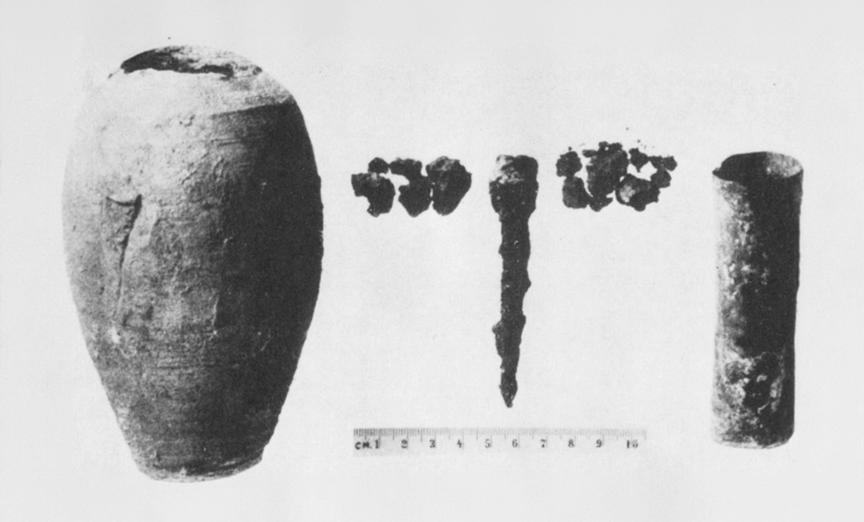
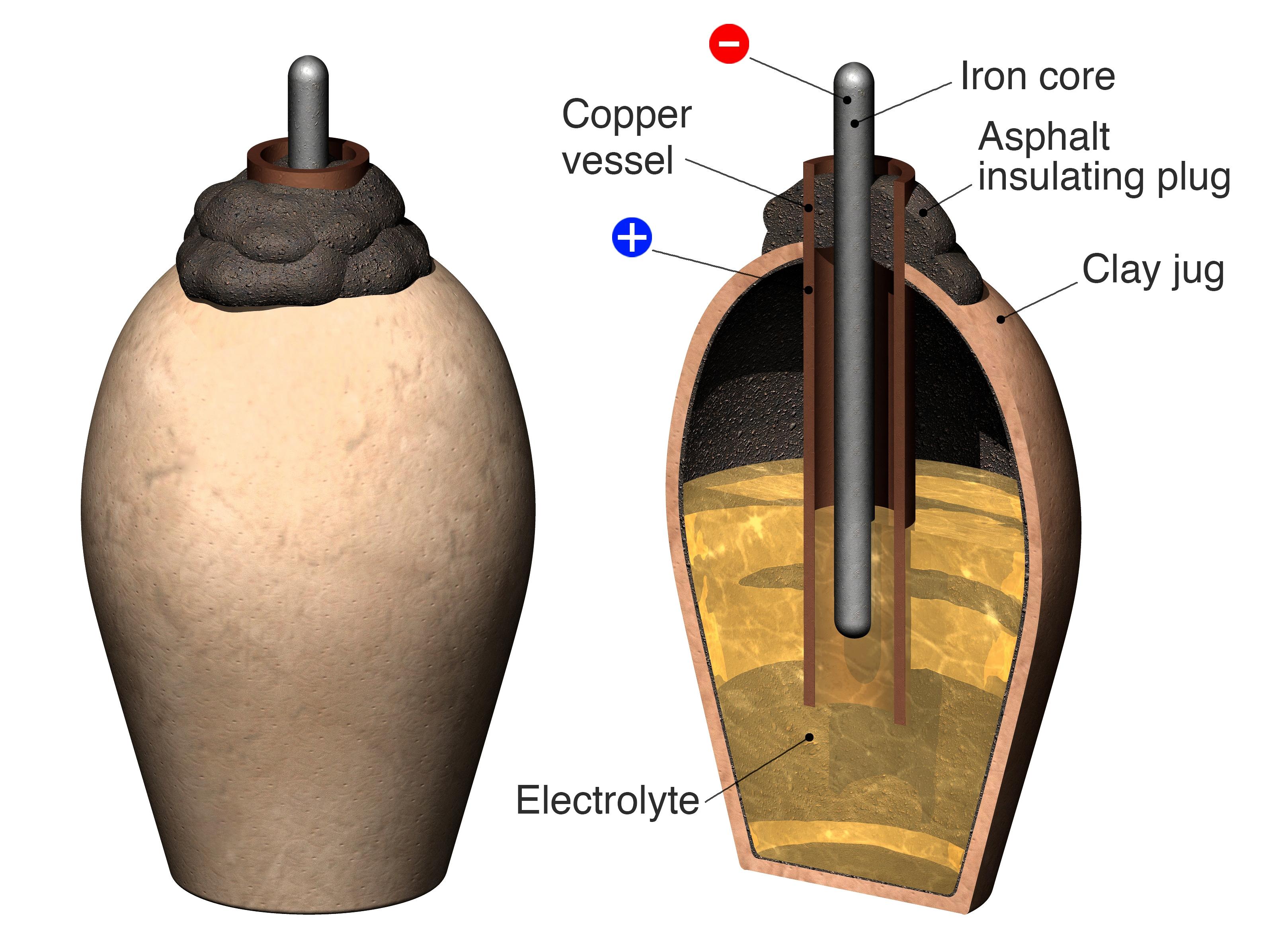
One of the most intriguing and controversial cases is known as the “Baghdad Battery.” Discovered in present-day Iraq and dated to the Parthian or Sassanid period (around the 1st century CE), it is a small clay vessel containing a copper cylinder and an iron rod.
Components of the "Baghdad Battery" from the first century AD, as presented by Wilhelm König in the mid-20th century. Courtesy of Alexander Bazes
In 1938, Wilhelm König, an archaeologist working at the Baghdad Museum, proposed that this was an ancient galvanic cell—a device capable of generating electrical voltage through a chemical reaction, based off the fundamental principle of how a battery works.
His idea generated intense interest—and considerable skepticism—because no system of wires or proof of use of electrical devices was found. What’s more, the original artifacts are believed to have disappeared after the 2003 looting of the museum. As a result, many archaeologists for years regarded the “battery” theory plausible yet unproven.
In January 2026, researcher Alexander Bazes published a paper proposing a new reconstruction. He proposed that earlier reconstructions had overlooked the possible role of the outer clay vessel itself. If the entire vessel functioned as part of the electrochemical system, rather than merely as a “casing,” a higher voltage can be obtained (compared to what was produced in earlier experiments)—upward of 1.4 volts, close to the voltage of a modern AA battery.
Bazes suggested that the device was not necessarily designed to power an “electrical appliance” as we imagine today, and it was more likely used in chemical processes such as thin metal plating—a process known today as electroplating—or etching via an electrochemical reaction.
Nevertheless, this remains a case open to interpretation. If Bazes’ hypothesis gains wide acceptance, it would be exciting evidence of ancient electrochemical knowledge; if not, it serves an excellent example of how an ancient artifact can raise more questions than answers.
An illustration of the operation of the Baghdad Battery. Javier Jaime/Shutterstock
Surgery Before the Operating Room
When we picture ancient medicine, the first image we conjure is usually one of medicinal herbs, amulets, potions, and rituals. However, the history of ancient medicine also includes far bolder procedures: surgical incisions, skull drilling, eye operations, dental work, and significant attempts to manage pain.
The symbolic birth of modern anesthesia took place on Oct. 16, 1846, at Massachusetts General Hospital in Boston. Dentist William Morton publicly demonstrated the use of inhaled ether as a surgical anesthetic during an operation to remove a tumor from a patient’s neck.
Morton’s demonstration is considered one of the greatest breakthroughs in the history of medicine because it ushered in a new era in surgery: the possibility of operating on patients without them feeling the full extent of the pain or having to undergo the procedure while fully conscious.
Yet forms of general anesthesia had appeared much earlier. In 11th-century medieval Islamic medicine, for instance, Ibn Sina, commonly known as Avicenna, was credited with developing formulas for anesthetic or sedating substances. These were administered by placing sponges soaked in the substances at the patient’s nostrils so the vapors could be inhaled.
In his book “The Canon of Medicine,” Morton described a general anesthesia formula containing opium, nutmeg, agarwood, and other substances, and recounted the use of such anesthesia in operations to amputate injured limbs.
According to Chinese historical sources, physician Hua Tuo, active at the end of the Han period in the 2nd and 3rd centuries CE, was credited with the use of a drug called Mafeisan, a drink that reportedly rendered patients unconscious enough for surgery. The recipe itself has not survived, so it is impossible to know today exactly what the drug contained or how effective it was. But these accounts show that the aspiration to operate without pain is not a 19th-century invention.
In fact, far older surgical procedures existed even before accounts of full anesthesia. A notable example is trepanation—drilling or cutting a hole in the skull. This may sound unimaginable, but archaeologists have discovered more than 1,500 skulls that had undergone such a procedure from various periods and cultures around the world. In many cases, signs of healing are visible around the edges of the hole, indicating that the patient not only survived the procedure but lived for years afterward.
A skull from around 2100 BC that was discovered in Jericho and shows evidence of "trepanation" surgeries. Wellcome Images/CC BY 4.0/Wikimedia Commons
The practice dates back at least 12,000 years in North Africa and 9,000 years in Jericho. The exact reasons for these operations are not always clear; some may have been performed to treat head injuries, severe headaches, seizures, or intracranial pressure. In any case, this was a procedure that required remarkable skill and courage.
Ancient cataract surgeries, too, deserve attention. Cataract occurs when proteins in eye’s lens break down and form cloudy patches, and it can lead to severe vision impairment and even blindness. Today, cataract surgery is a very common operation, in which the clouded lens is removed and replaced with an artificial one.
The ancient world, of course, had no artificial lens and no surgical microscope. And yet, in 7th century BCE India, physician Sushruta described in his book “Sushruta Samhita” what later became known as couching: inserting a needle or sharp instrument into the eye to push the clouded lens out of the line of sight.
It was a highly risky procedure—the tiniest mistake could cause infection, bleeding, or blindness—and it also required delicate anatomical understanding and impressive manual control. This technique later spread, by various routes, to other regions of Asia and all the way to Europe.
An Indian doctor performs the cataract procedure known as "couching." Wellcome Collection/CC BY 4.0/Wikimedia
Dentistry, too, developed far earlier than commonly assumed: the 19th century. Drilled molars dating back 7,500 to 9,000 years were found in Pakistan. The signs of healing on these teeth indicate that this was not a post-mortem decoration, but treatment performed on living patients, apparently to relieve pain or treat decay. Though no evidence of an alternative filling was found near the teeth, researchers do not rule out the possibility that the teeth were filled with some substitute material that did not survive to this day.
In Slovenia, a jaw about 6,500 years old was found with a cracked tooth that had been filled with beeswax, the same wax that bees secrete to build honeycombs. In this case, the wax apparently served as an ancient sealing material to cover a sensitive area and reduce pain.
Sometimes, ancient knowledge was hiding in plain sight, and we simply failed to recognize its significance. This is true, to some extent, of Leonardo da Vinci’s drawings of the heart. Around 1514, da Vinci studied the structure of the heart and illustrated it with extraordinary precision. Among other things, he depicted the trabeculae, a tangled network of muscle fibers lining the inner walls of the heart’s chambers.
For centuries, these trabeculae were mainly understood as a developmental remnant from embryonic life with no significant function in adults. That changed with a 2020 study, which used MRI scans of thousands of people along with genetic and functional data to show that this structure plays a meaningful role in blood flow efficiency and influences the risk of heart disease.
This does not mean that da Vinci “knew” everything modern research has uncovered. But he did observe and beautifully document—500 years earlier—a structure that modern medicine has only recently begun to take seriously again.
Metals, Nanostructures, and Rubber
Another field in which the past turns out to be more complex than we often assume is materials science. Modern stainless steel is usually credited to Harry Brearley, who in 1913 developed a chromium-rich steel in England that stood up well to rust. Chromium forms a thin protective layer on metal surfaces, shielding the iron from oxygen and moisture.
Yet in India, the Iron Pillar of Delhi (dating to 375–415 CE) has stood for more than 1,600 years, rising to a height of more than seven meters and weighing several tons. Though the pillar was not made of modern stainless steel, the fact that it has survived centuries of heat, humidity, and monsoons with remarkably little rust has long fascinated scientists.
The Iron Pillar of Delhi has survived centuries of heat, humidity, and monsoons with remarkably little rust. Shutterstock
Studies show that the pillar’s iron composition—particularly its relatively high phosphorus content — along with certain manufacturing conditions, enabled the formation of a stable protective layer on its surface.In other words, while it is not the same material used for sinks and kitchen appliances today, it reflects sophisticated ancient metallurgical knowledge that managed to achieve extraordinary durability under harsh conditions.
China offers another example: the Sword of Goujian, a bronze sword over 2,000 years old unearthed in Hubei province. Despite being found in a damp tomb environment, it remains remarkably well preserved and exceptionally sharp. Because bronze is not iron, rust is not the issue here; rather, other corrosion processes were in play.
Its preservation is apparently attributable to a combination of favorable burial conditions, a relatively sealed scabbard, and the composition of the blade’s surface, part of which is rich in tin. Here, too, the simple reality of an ancient sword surviving in such remarkable condition demonstrates that knowledge of materials, alloys, and preservation techniques was far more sophisticated than the simplistic image of a “primitive world” suggests.
The unearthed 2,000-year-old Sword of Goujian remains remarkably well preserved and exceptionally sharp. Windmemorie/CC BY-SA 4.0/Wikimedia
And then there are Damascus swords. During the Crusades, European warriors marveled at the swords of their Muslim rivals, describing them as extraordinarily sharp, strong, and flexible, with a beautiful wavy pattern resembling frozen water in metal.
For years, researchers sought to understand the sources of these special properties. In 2006, researchers examined a 17th-century Damascus blade with an electron microscope and identified carbon nanotubes alongside nanowires of cementite, a compound of iron and carbon.
Carbon nanotubes are known today as extraordinary materials in terms of strength and conductivity. They are used in composite materials, electronics, sensors, energy storage, and more.
The ancient swordsmiths were not practicing “nanotechnology” in the modern sense. They did not observe atoms or discuss nanotubes. Yet their traditional manufacturing processes—which apparently began with wootz steel produced in South Asia and Sri Lanka, then traded and refined by smiths in the Middle East—created microscopic and nanoscale structures within the steel that enhanced the blade’s performances.
The wavy texture that characterized the blades of Damascus swords. Shutterstock
This knowledge was practical, handed down through tradition, and often kept secret: which ore to choose, how to smelt it, at what temperature to cool it, how much carbon to add, and how to forge it without ruining the pattern. When the trade routes shifted and key raw materials became unavailable, the recipe was lost along with them.
Not all ancient chemical knowledge served warfare, however. In Central America, long before Charles Goodyear developed the modern vulcanization process—which heats raw, soft, and sticky rubber with certain substances to make it durable and elastic—the Olmecs, and later Mesoamerican cultures as well, knew how to process latex—the milky sap of the local rubber tree Castilla elástica—and mix it with juice from a climbing plant called Ipomoea alba.
The mixing changed the material’s properties, making it more flexible and durable and thus suitable for manufacturing balls, ritual objects, and other practical items. In other words, even before chemistry existed as a laboratory science with formal formulas, people were systematically altering materials through experimentation, tradition, and observation.
When the Sun Stood at the Center
The most famous case of knowledge appearing before its time—and then being forgotten? Astronomy.
For centuries, the geocentric view dominated the educated world: earth at the center, with the sun, the moon, and the planets revolving around it. This theory was rooted in Greek philosophy, including the works of Plato and Aristotle in the 4th century BCE, and was later given a sophisticated mathematical formulation by Ptolemy in the 2nd century CE. The Ptolemaic model was complex, intricate, and practical, and persisted for a very long time.
Then, in the 16th century, Nicolaus Copernicus published the heliocentric model, placing the sun at the center with earth as one of the orbiting planets. The idea shook the European worldview and is considered a key step leading to the Scientific Revolution.
But Copernicus was not the first person to propose such a theory. As early as the 3rd century BCE, the Greek astronomer and mathematician Aristarchus of Samos had proposed that earth rotates on its axis and revolves around the sun. His original writings on the subject did not survive, and we know of his ideas mainly through references by other authors, including Archimedes. For centuries, Aristarchus’ idea remained marginal, apparently because it was too radical for a world not yet ready to accept it.
A 2025 study by the University of Sharjah in the United Arab Emirates found that the 14th-century Syrian astronomer Ibn al-Shatir, too, identified flaws in the geocentric model and proposed that the sun, not the earth, lies at the center, apparently predating Copernicus by about 200 years.
No exploration of lost ancient knowledge would be complete without the Antikythera mechanism. In 1901, green and corroded bronze fragments were recovered from a shipwreck near the Greek island of Antikythera. For years, researchers struggled to understand what they had found.
Visitors look at a fragment of the 2,100-year-old Antikythera Mechanism at Museum in Athens, Greece on Aug. 26, 2018. Shutterstock
Only through X-rays and computed tomography did its true complexity emerge: an intricate device with tiny gear wheels, plates, dials, and inscriptions. Today, it is generally believed to be an ancient Greek astronomical calculator, designed to analyze and predict astronomical phenomena—the positions of the sun and moon, eclipse cycles, and maybe even calendar events.
Though only a small portion of the original mechanism survived, what remains is enough to demonstrate a stunning level of mechanical design. By all conventional understanding of the ancient world, a device this advanced simply shouldn’t have existed in the 1st or 2nd century BCE. Yet it did.
This may be one of the most important takeaways from our journey through lost ancient knowledge—the human achievement lies not only in inventions, but also the ability to preserve, transmit, document, and make knowledge accessible. Without that continuity, even the most brilliant invention becomes fragile in the face of time.
This article was originally published by Epoch Magazine Israel.