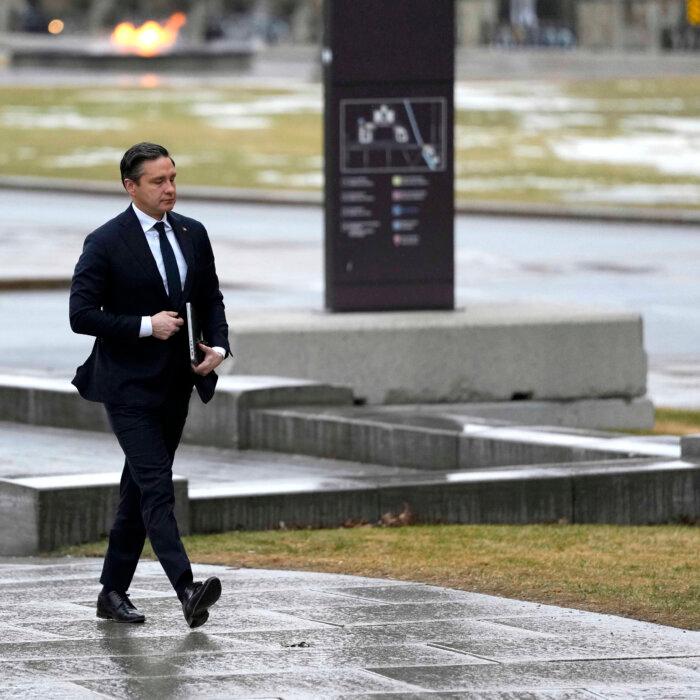
Conservative Leader Pierre Poilievre says he will release a proposed “auto pact” that he says could win U.S. support and “rebuild our auto sector” in Canada. He says the pact includes items like better aligning regulations and tax reductions.
On March 13, Poilievre set off for a weekend of meetings with officials in Detroit, Michigan, to discuss Canada-U.S. relations. He said upon his return, he'll outline a proposed plan to safeguard the Canadian auto industry and jobs.
“We have carefully studied what the American auto industry is looking to achieve, and we have calibrated a plan that will allow us to repatriate and massively increase our auto production on this side of the border, while at the same time making it attractive to the United States on the other side of the border,” he said at a March 13 press conference in Windsor.
To achieve that, Poilievre said the plan would have to align Canada’s regulations with those of the United States and eliminate the GST on all Canadian-made vehicles—in exchange for “tariff-free access for our autos.”
Poilievre did not provide further details of his new pact, but said he believes “we can get the Americans to accept this proposal” as it “will be advantageous” to both countries.

“[W]e believe this is not only the realistic plan to rebuild our auto sector, it is literally the only hope of keeping our auto sector in Canada,” he added.
The visit to Detroit is part of a week-long trip to the United States, where Poilievre said he will advocate for Canada’s auto and energy sectors.
The Tory leader will return to Windsor on March 15 to hold a press conference before heading to Houston, Texas, the following day to meet with energy executives and visit an energy facility. On March 17, Poilievre is scheduled to meet with state officials, energy, agriculture, and business leaders in Austin, Texas.
Auto, Energy Sectors
While on the trip, Poilievre and Conservative MPs Kathy Borrelli, Harb Gill, and Chris Lewis met with U.S. lawmakers, as well as executives from General Motors and Ford, as well as energy sector leaders.‘No Replacing’
Poilievre criticized Carney’s recent move to significantly reduce tariffs on Chinese EVs. The move was done in exchange for China reducing tariffs on Canadian agricultural products.“[The prime minister’s] idea that he’s going to replace the American market with China or other overseas markets for automobiles is an illusion. It is impossible. Almost all of our automobile exports go to the United States. There is no replacing that market,” Poilievre told reporters.
During his trip in China, Carney said his government is seeking a “strategic partnership” with Beijing. Amid U.S. criticism of Canada’s recent China deals, Carney said his government isn’t pursuing a free-trade deal with Beijing.
‘Leverage’
Asked by reporters in Windsor on March 13 about his approach to negotiating with the United States, Poilievre said he would “build up as much leverage as possible” to bargain for the removal of U.S. tariffs on Canadian automobiles, softwood lumber, aluminum, steel, and other products. His proposals include building up a stockpile of energy resources and minerals that he said could be supplied to allied nations under favourable trade terms.“I’m proposing that we massively increase our energy production, something that is extremely important to the United States, especially now with what’s happening in the Strait of Hormuz, and that would be able to reduce gas prices on the American side of the border,” he said. The Strait of Hormuz is a narrow waterway between Iran and Oman that connects the Persian Gulf to the open ocean and serves as one of the world’s most important oil transit chokepoints, and has been disrupted by the ongoing Iran war.
On March 6, Canada-U.S. Trade Minister Dominic LeBlanc met with U.S. Trade Representative Jamieson Greer in Washington for the first time since the freezeout.
In a statement, LeBlanc’s office said they had a “constructive and substantive discussion” about the coming review of the Canada-United States-Mexico Agreement and broader bilateral trade issues.