A Quebec laser company acquired by a Chinese firm in 2016 is taking the federal government to court after Ottawa blocked the proposed appointment of an executive to its board on national security grounds.
The federal government imposed security-related conditions on the acquisition of CorActive High Tech Inc. in 2017, after Chinese company Han’s Laser Technology Industry Group acquired a majority stake in November 2016.
CorActive High Tech Inc. manufactures specialized fibre-laser and optical fibre technology.
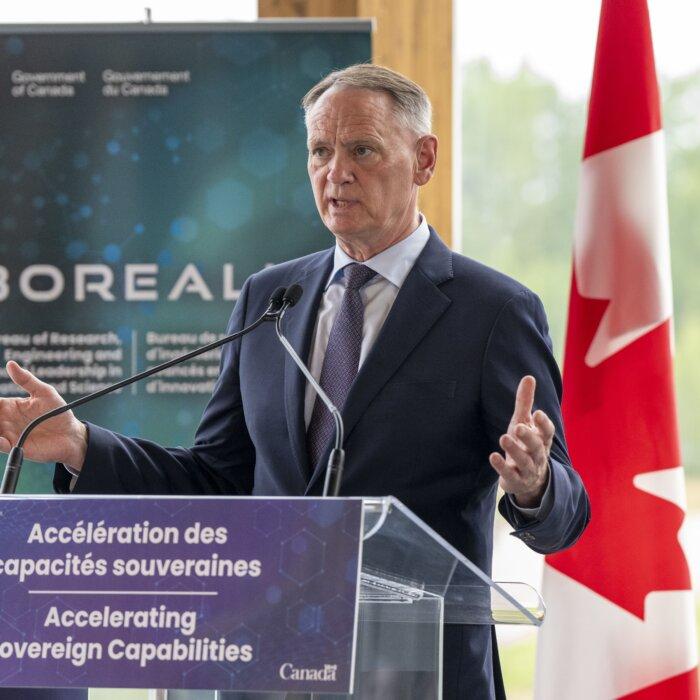
Industry Minister Mélanie Joly blocked the proposed appointment of Xiaokai “Denver” Zeng to CorActive’s board in June, citing concerns that sensitive technology could be transferred in ways that “benefit foreign militaries,” according to court filings. Zeng heads Han’s Laser Corp., the U.S. subsidiary of China-based Han’s Laser Technology Industry Group. Zeng became an American citizen in 2024.
In a Federal Court filing seeking judicial review, CorActive says the decision to block Zeng’s appointment was “substantively unreasonable” and is asking the court to quash the decision, according to documents provided to the Epoch Times.
Ottawa’s approval of the Han’s Laser acquisition saw both companies commit to restrictions intended to block sensitive technology from being transferred in ways that could benefit foreign militaries. This included granting Ottawa authority to decide on any approvals of non-Canadians to the CorActive board.
The court application also says past attempts to appoint Zeng to the board in 2024 and 2025 were “rejected without reasons” and says he has already undergone security screening in the United States.
“This included review by the Federal Bureau of Investigation, U.S. Department of Homeland Security and other U.S. government agencies,” the application says. “This recent, rigorous, screening by Canada’s closest security partner demonstrates the absence of any legitimate concerns about Mr. Zeng.”
“There is no reasonable basis to conclude that Mr. Zeng’s appointment would give rise to any improper transfer of sensitive CorActive technology,” the application said.
Second Court Challenge
CorActive says that having Zeng on its board will assist the company in “staying competitive” as it is experiencing declining sales and losing several key employees.
The court filing states that Zeng’s extensive experience and links with the parent company will make sure “capital is applied strategically, safeguarding the future of the business and high-tech Canadian jobs.”
Court documents show Han’s Laser has invested roughly $11 million in CorActive since acquiring it in 2016.
CorActive also filed a second court challenge late last month against the federal government’s decision to renew the security conditions imposed when it was acquired by Han’s Laser in 2017.
The two cases are related because the restriction on appointing Zeng stems from the broader conditions imposed under the 2017 undertaking, but they challenge separate federal decisions.
In the second challenge, CorActive says the overwhelming majority of its sales are for telecommunications and industrial uses rather than defence. It says it made only one sale to a defence customer outside Canada in 2025, in a deal worth less than $30,000.
“CorActive’s technology is no longer sensitive in nature, as demonstrated by the fact that Han’s Laser has almost entirely stopped purchasing CorActive technology, despite owning CorActive,” the second application reads, adding that there’s “no reasonable basis” to think there could be an “unauthorized transfer of sensitive CorActive technology” that could benefit foreign militaries.
U.S. government records show that prior to its takeover by Han’s Laser, CorActive fulfilled several five-figure contracts to supply the U.S. military with fibre-optic technology in 2008, 2009, 2012, and 2014.
The company now says it is falling behind competitors in Europe, China, Canada and the United States, partly because the security conditions imposed by Ottawa in 2017 have made it more difficult to secure investment and support from its Chinese parent company.
‘More Vigilant’
Norsat supplied satellite and radio communications technology to government and military customers, including the U.S. Department of Defense. Following Hytera’s acquisition, the Pentagon reviewed its contracts with Norsat and said it took appropriate measures where necessary.
Then-Prime Minister Justin Trudeau said an initial government review of the takeover unearthed “no significant national security concerns” and didn’t require any further reviews.
Canada’s decision not to immediately follow its Five Eyes allies in restricting Chinese telecommunications company Huawei’s involvement in 5G networks became another point of tension.
The United States began imposing significant restrictions on Huawei in 2018, including limits on federal procurement, and expanded those measures in 2019 and 2020 to restrict the company’s access to U.S. technology and telecommunications networks.
Australia barred Huawei and Chinese telecommunications equipment maker ZTE from its 5G networks in 2018 and New Zealand followed suit soon after. The UK imposed initial restrictions on Huawei in January 2020 and removed the company from its 5G networks later the same year.
The Epoch Times reached out to the ISED and Joly for comment but didn’t hear back by publication time.