The Philippines summoned China’s ambassador and lodged a formal protest over videos published by state-owned China Daily that Manila said used racist and dehumanizing portrayals of Filipinos.
Philippine Foreign Affairs Undersecretary Leo Herrera-Lim conveyed the government’s objection to Chinese Ambassador Jing Quan on July 16 and demanded the material’s removal, according to the Department of Foreign Affairs.
The Philippine Embassy in Beijing separately sent a letter to China Daily’s editor-in-chief demanding the immediate removal of the videos.
“China Daily went beyond legitimate political debate by resorting to demeaning, dehumanizing, and racist depictions of Filipinos,” the department said.
“Disagreement over legal and political issues does not justify resorting to imagery that has no place in the public discourse of responsible states.”
The protest followed China Daily’s publication of an animated video showing a monkey in recognizable Filipino clothing holding a document marked “South China Sea Arbitration Award.”
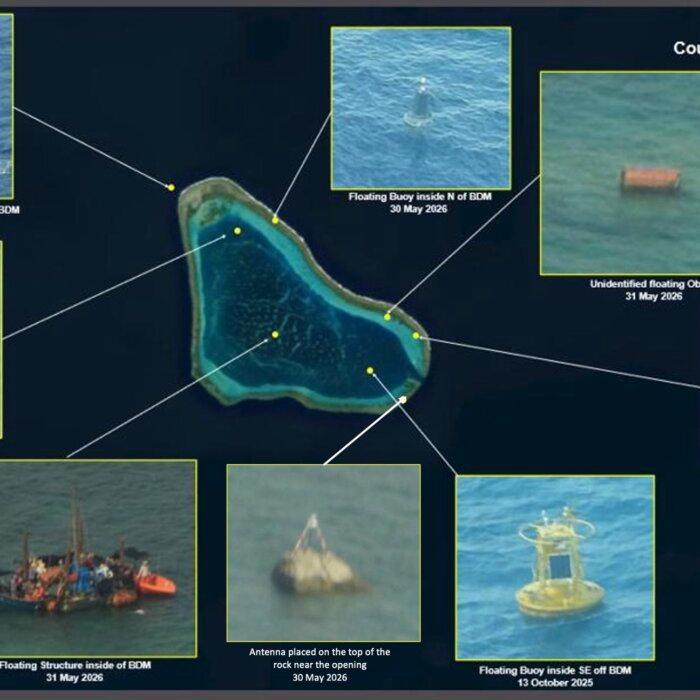
Arms marked “USA” and “Japan” cast the character into the sea, where it is struck by a water cannon fired from a vessel resembling a Chinese coast guard ship.
‘Dehumanizing’ Portrayal
“The louder certain Philippine politicians sing, the further they stray from the truth,” its description said.
The Chinese-language headline equated the arbitration award with “marine garbage.” The accompanying text accused the Philippines of embracing the United States, Japan, and other outside powers and warned that it would become their victim.
Philippine Foreign Affairs said the visual portrayal demeaned Filipinos broadly and the material was part of a series of China Daily opinion videos attacking the arbitration award.
Philippine Defense Secretary Gilberto Teodoro Jr. said the post provided a “revealing insight” into the “Chinese communist apparatus” and its attitude toward the Filipino people.
“When one resorts to the debasement of another person, it is a sure sign that one’s argument is bereft of legitimacy, truth, and reason,” Teodoro said.
China Daily is a state-owned and state-run outlet operating within the Chinese Communist Party’s tightly controlled media system.
Philippine Officials Condemn Material
National Security Adviser Eduardo S.L. Oban Jr. said the video was “far from satire” and called it “a calculated attempt to discredit a legal truth that has remained legally intact for a decade.”
Oban said Beijing’s inability to overturn the arbitral award had led the party-state to “abandon reason in favor of bullying and racist imagery intended to distract from its unlawful actions.”
“Racist caricatures and manufactured narratives cannot erase legal facts,” he said. “They only expose the absence of a credible legal answer.”
Senate President Sherwin Gatchalian drew a distinction between political expression and racial degradation.
“There is no room for racism in free speech,” he said.
Philippine Coast Guard spokesman Rear Adm. Jay Tarriela called the video “outright racism and an open mockery of international law.”
China Daily later targeted Tarriela directly in a July 17 post, criticizing his early education background in Japan and suggesting that his public statements aligned with Tokyo’s maritime activities.
Chinese Foreign Ministry spokesman Lin Jian declined to comment at a July 17 press conference about Manila’s condemnation and takedown demand. Lin then repeated Beijing’s rejection of the arbitration proceedings.
The diplomatic protest came days before the Philippines was scheduled to host ASEAN foreign ministers and dialogue partners in Metro Manila from July 22 to 24, including an ASEAN-China ministerial meeting.
Tribunal Rejected Beijing’s Claims
The Philippines brought the case against China under the U.N. Convention on the Law of the Sea in 2013.
The tribunal’s July 12, 2016, award rejected the legal basis for China’s claims to historic rights over resources within much of the South China Sea.
It found that none of the disputed Spratly Islands was capable of generating a 200-nautical-mile exclusive economic zone and that China had violated the Philippines’ sovereign rights in parts of its exclusive economic zone.
The decision did not rule on sovereignty over islands or delimit a maritime boundary between the two countries.
China refused to participate in the case and continues to reject the result. The tribunal said the award was final and binding on both parties.
The ruling remains central to Manila’s objections to Chinese coast guard and maritime militia operations in waters within the Philippines’ exclusive economic zone.
Despite Manila’s formal protest and takedown demand, the video remained accessible on China Daily’s English- and Chinese-language websites and its Facebook and YouTube accounts at the time of publication.