Taiwanese President Lai Ching-te urged lawmakers on July 17 to approve a NT$210 billion (about $6.5 billion) military drone plan, saying the self-governed island must carry more responsibility for its own defense as Chinese pressure against it increases.
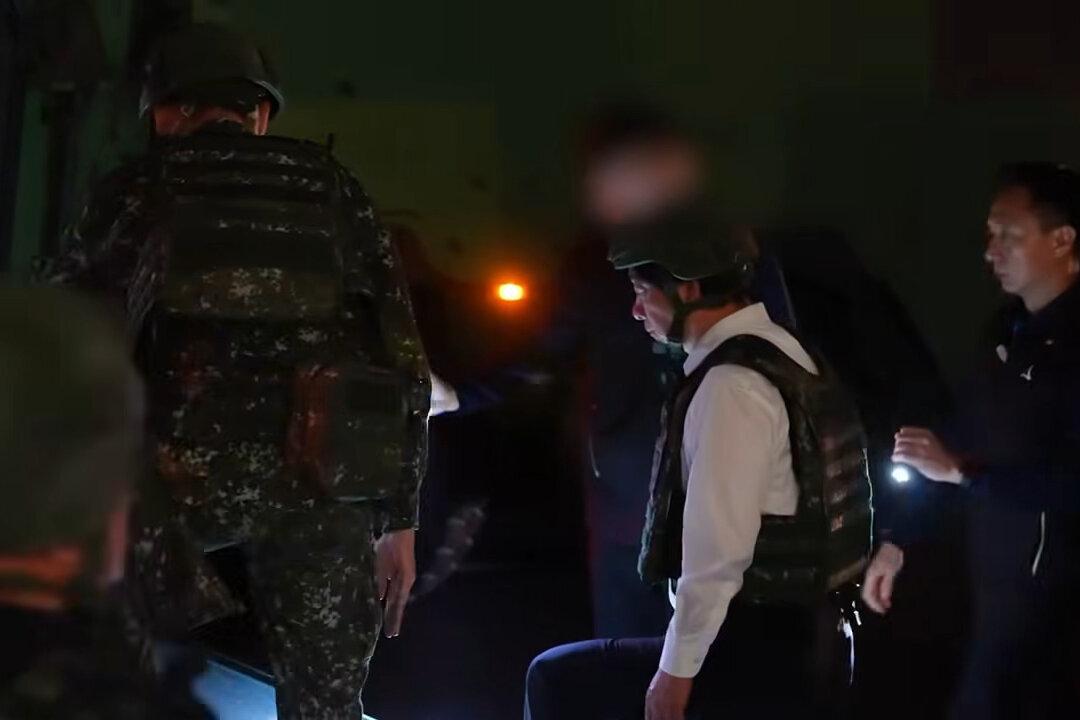
“We must respond to the international call for collective defense and responsibility sharing,” Lai said during a visit to the National Chung-Shan Institute of Science and Technology’s aviation research facility in Taichung.
He called for the funding to move through a special budget rather than Taiwan’s regular annual budget, saying stable, multiyear funding was needed to bring the planned systems into service quickly.
Lai’s appeal follows a public call from Washington’s top representative in Taiwan for the island to build a large force of unmanned systems.
“Nothing will deter conflict more effectively than turning Taiwan into a hornet’s nest of air, surface, and subsurface drones,” American Institute in Taiwan Director Raymond Greene said at a July 2 drone industry forum in Taichung.
Greene also urged deeper U.S.–Taiwan cooperation on drone production, autonomous systems, robotics, and trusted supply chains, though he did not endorse a specific Taiwanese funding bill.
Lai’s Democratic Progressive Party controls the Executive Yuan, Taiwan’s Cabinet, while the opposition Kuomintang (KMT) and Taiwan People’s Party (TPP) hold a majority in the Legislative Yuan. Both opposition parties have filed their own drone-funding proposals, which take different approaches to how the money should move and which government ministry should oversee it.
The Executive Yuan’s version, approved by the Cabinet on June 18, would authorize up to NT$210 billion (about $6.5 billion) from August 2026 through December 2031 for coastal surveillance drones, coastal attack drones, and small one-way attack unmanned boats.
Earlier Defense Plan Narrowed
The drone bill follows the legislature’s decision to narrow a larger defense proposal from Lai’s administration.
The Executive Yuan originally sought an eight-year special budget of NT$1.25 trillion (about $38.7 billion) covering specified U.S. weapons purchases, commercial acquisitions, domestically commissioned programs, and U.S.–Taiwan cooperative projects.
The legislature instead enacted a NT$780 billion (about $24.1 billion) law centered on specified U.S. arms purchases.
Lai said the NT$470 billion (about $14.5 billion) difference cut out international cooperation, commissioned work, domestic research, defense-industry development, and the drone program.
“The most important part, of course, was the drones, and that entire amount was removed,” he said.
The NT$210 billion proposal is a new bill intended to return military unmanned systems to the government’s acquisition plans. The money has not been appropriated by the legislature.
Competing Funding Models
The administration is seeking rapid Defense Ministry procurement through a special budget, while the KMT proposes a broader six-year defense-and-industry system financed through annual budgets and coordinated by the economic ministry.
The KMT bill would provide NT$40 billion (about $1.2 billion) annually for six years, totaling NT$240 billion (about $7.4 billion). The money could support procurement, mass production, maintenance, personnel training, testing facilities, industrial clusters, and assistance for smaller companies and startups.
The bill calls for an unmanned defense system based on equipment that is “large-volume, affordable, intelligent, and distributed.” It also addresses military adaptations of commercial-standard systems, resistance to interference, electromagnetic-pulse protection, and battlefield survivability.
The TPP has proposed a separate permanent industry framework. Its bill would give the economic ministry responsibility for the broader drone sector while assigning military applications to the Defense Ministry.
The TPP proposal provides for military testing grounds, separate certification of military and nonmilitary supply chains, military communications and data-link infrastructure, and prioritizing Defense Ministry procurement and training involving locally manufactured, lower-cost drones.
Lai said that military procurement and industrial development require different agency responsibilities and funding streams. He said the economic ministry already has a six-year NT$44.2 billion (about $1.4 billion) program to build the industry and supply chain, while the Defense Ministry needs separate funding to purchase operational systems.
The bills therefore differ over special or annual funding, which ministry should coordinate the programs, and how resources should be divided among immediate military procurement, research, production, testing, and industrial development.
Beyond the Number of Drones
Taiwan’s defense debate also concerns how the systems would be used after they are purchased.
Lai Ta-wen, a policy analyst at the Division of Defense Strategy and Resources within Taiwan’s Institute for National Defense and Security Research (INDSR), wrote that current military planning focuses primarily on surveillance, attack, and first-person-view one-way attack drones.
The INDSR analyst said logistics, communications relay, aerial sentry, electronic warfare support, and fire direction missions had not been fully incorporated into the wider operational plan. He recommended adopting mission-based requirements, common interfaces, modular payloads, and testing under conditions resembling Taiwan’s ports, coastlines, cities, and outlying islands.
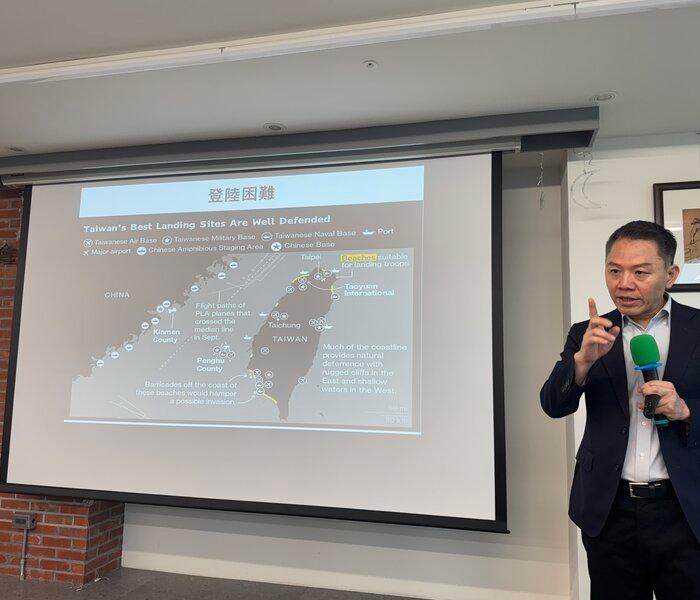
A February report by the Center for a New American Security (CNAS) proposed a layered defense using aerial, surface, underwater, and ground-based unmanned systems to disrupt a possible Chinese assault before it reaches Taiwan’s beaches.
“Without clear doctrine and rigorous training … even a large drone arsenal cannot translate into an effective operational capability,” CNAS researchers Stacie Pettyjohn and Molly Campbell wrote.
Beijing claims Taiwan as part of its territory and has not ruled out the use of force to bring the island under its control. Taiwan rejects Beijing’s sovereignty claims.
President Lai said Chinese military intimidation, political infiltration, and pressure beyond China’s borders have intensified. He urged the governing and opposition parties to support the military drone proposal, saying national security should not become a bargaining chip in partisan conflict.
The Executive Yuan, KMT, and TPP proposals remain before the Legislative Yuan, each offering a different approach to military procurement, industrial development, agency control, and the use of annual or special funding.