Chinese leader Xi Jinping is approaching the People’s Liberation Army’s 2027 centenary with five of the seven members appointed to its top command in 2022 either expelled or under investigation.
The Chinese Communist Party (CCP) said its Central Committee will convene its Fifth Plenum in October. The meeting could provide an opportunity to fill some of those positions, although the announced agenda does not mention personnel appointments.
The CCP charter gives the Central Committee authority to determine the composition of the Central Military Commission (CMC). The previous plenum used that authority in October 2025 to elevate Zhang Shengmin, then the military’s top discipline official, to CMC vice chairman.
Senior Command Hollowed Out
The CMC appointed in 2022 originally had seven members: Xi, Zhang Youxia, He Weidong, Li Shangfu, Liu Zhenli, Miao Hua, and Zhang Shengmin.
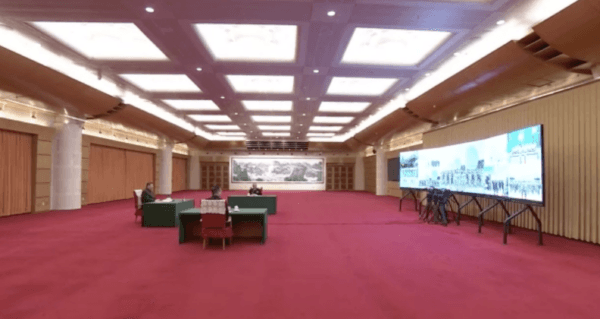
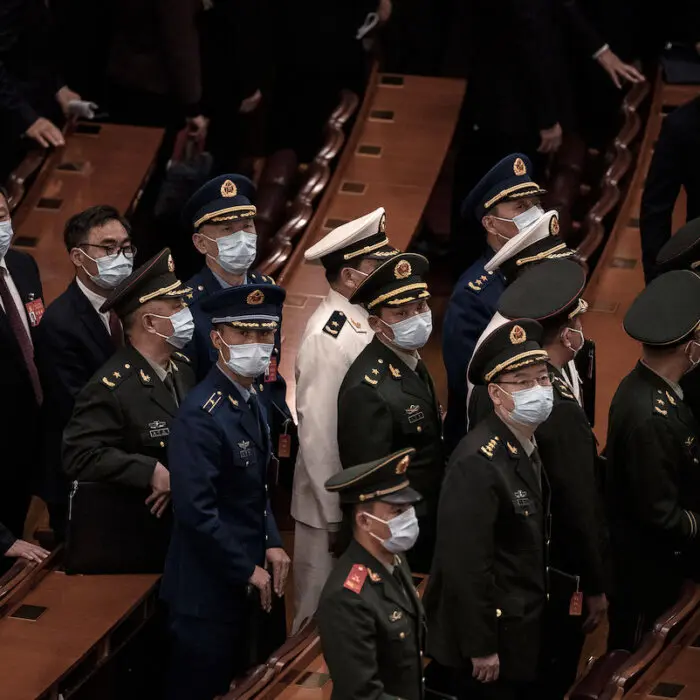
The Defense Ministry announced in January that Zhang Youxia and Liu were under investigation for suspected serious disciplinary and legal violations.
Zhang and Liu remained listed on the CCP’s online leadership roster as of Aug. 6, but neither has publicly resumed former duties.
The review also tracked 52 key PLA leadership positions. It found that 11 were formally filled, 23 were being handled by interim or acting officials, 12 appeared vacant, and the status of six was unclear.
CSIS assessed that the vacancies had not significantly disrupted routine military operations because the PLA’s centralized bureaucracy remained in place. It found some evidence, however, that leadership losses may have impeded the planning of larger and more complex exercises.
Acting lieutenant generals appeared able to maintain smaller-scale daily operations, according to CSIS. The organization said it remained unclear whether those officers possessed the authority or experience to make major changes or handle an unexpected crisis.
Plenum Offers Personnel Test
Sun Kuo-hsiang, a professor in the Department of International Affairs and Business at Nanhua University in Taiwan, told the Chinese edition of The Epoch Times the depleted military commission makes CMC appointments more likely than a broader replenishment of the Politburo.
“The likelihood of filling vacancies on the military commission is greater than that of filling Politburo vacancies because the commission’s current leadership is too thin,” Sun said.
Sun said any decision to add several Politburo members would be highly consequential because it could indicate that the vacancies had begun to affect the party leadership’s operations.
Such appointments would also suggest that Xi wanted reliable replacements in place before the CCP’s 21st Party Congress, which is expected in 2027, he said.
The Fifth Plenum’s announced agenda does not list personnel changes.
The Fourth Plenum in 2025 nevertheless provides a recent precedent for an unannounced personnel decision. That meeting elevated Zhang Shengmin to CMC vice chairman even though the appointment had not been identified in advance as a central item on the agenda.
6 Full Generals Publicly Active
Xi promoted Zhang Shuguang and Wang Gang to full general on July 3.
Zhang Shuguang was identified as secretary of the CMC Discipline Inspection Commission and head of the military’s supervisory commission. Wang was identified as Air Force commander.
Their promotions followed the December elevation of Eastern Theater Command chief Yang Zhibin and Central Theater Command chief Han Shengyan.
Publicly disclosed appointments and recent activity identify six full generals carrying out senior duties:
CMC Vice Chairman Zhang Shengmin
Defense Minister Dong Jun
Eastern Theater Command chief Yang Zhibin
Central Theater Command chief Han Shengyan
Air Force commander Wang Gang
CMC discipline chief Zhang Shuguang
The count is a reconstruction from publicly disclosed appointments and activity. Beijing does not publish a complete current roster clarifying the status of every serving general.
CSIS said Xi’s usual pool of senior candidates had been “heavily winnowed.” The organization also found that only 17 of the 67 military members and alternate members originally appointed to the current CCP Central Committee had not been purged or placed under investigation as of its April update.
Xi could look beyond the surviving military members of the CCP Central Committee, CSIS said. It cited his 2022 elevation of He Weidong, who was not then a Central Committee member or alternate and skipped a PLA grade to become CMC vice chairman. The think tank said the purges had left the CMC without an operational-track military leader and that developing a new group of officers with comparable experience could take years.
Loyalty Screening Complicates Rebuilding
Shen Ming-shih, a research fellow at Taiwan’s Institute for National Defense and Security Research, told the Chinese edition of The Epoch Times that officers closely associated with Zhang Youxia or Liu Zhenli could remain vulnerable as Xi seeks to eliminate their remaining influence.
Additional removals among those officers would further restrict the field of potential candidates for senior appointments, Shen said.
Li Linyi, a China affairs commentator, told the Chinese edition of The Epoch Times that the absence of an announced successor to former Political Work Department Director Miao Hua suggested that Xi was proceeding cautiously in selecting an official responsible for political supervision and senior military personnel.
“Xi has placed the security of his own power above the completeness of the military command system,” Li said.
The July promotions placed one of the two new full generals at the center of the continuing discipline campaign. Zhang Shuguang’s disclosed appointments have largely involved military discipline inspection and supervision rather than operational command.
Wang Gang’s promotion, by contrast, formally identified a full-general commander for the Air Force.
Disagreement Over Zhang Shengmin
Independent Chinese political commentator Cai Shenkun offered a different assessment of Zhang Shengmin’s future.
Comparing Zhang’s role with that of former Vice President Wang Qishan during Xi’s earlier anti-corruption campaign, Cai told the Chinese edition of The Epoch Times that Zhang may have completed his principal political assignment and could be replaced or retired at the next party congress.
Zhang has nevertheless continued to perform senior duties. He presided over the July promotion ceremony at which Zhang Shuguang took over his former discipline post, while Zhang Shengmin remained CMC vice chairman.
Under the CCP charter, the Central Committee can change the military commission’s membership. The party’s July 30 announcement says the October plenum will consider a Politburo work report and further party discipline measures, but it does not say whether military appointments will be taken up.