Credit ratings indicate a borrower’s ability to pay interest and fully repay its debt upon maturity. Moody’s said the latest downgrade was due to “a marked deterioration in the province’s credit fundamentals.”
As well, the province’s total debt is projected to hit $183 billion in 2026–27, before rising to $209.9 billion the following year, and $234.6 billion in 2028–29.
Responses
B.C. Premier David Eby defended his government’s budget in response to the Moody’s decision. He said at an unrelated event in Metro Vancouver on March 19 that his administration made a “very clear choice” between making cuts to “meet a credit rating” and “prioritizing British Columbians.”“We have to meet people where they’re at,” Eby said. “They are sicker, and they stay in hospital longer. We need to ensure high-quality health-care services and services for British Columbians generally. We have to build these projects to get our province moving.”
The premier acknowledged that rolling out the February budget was “incredibly challenging,” citing rising health care and infrastructure costs among other factors.
“Were we going to, as the Conservatives suggested, make health-care bear the brunt of cuts to be able to meet a credit rating?” he said. “Or were we going to make sure that we were doing all we can to deliver services for British Columbians, find efficiencies in government and grow the economy to make sure that we’re able to pay for the services British Columbians deserve?”
He added that the province “is going broke” under the Eby government.
“Bond rating agencies are giving this NDP budget the equivalent of an F,” Halford wrote. “Five credit downgrades in just four years and the NDP still won’t change course.”
Halford said the provincial government should table a budget that serves British Columbians’ needs.
‘Unlikely’
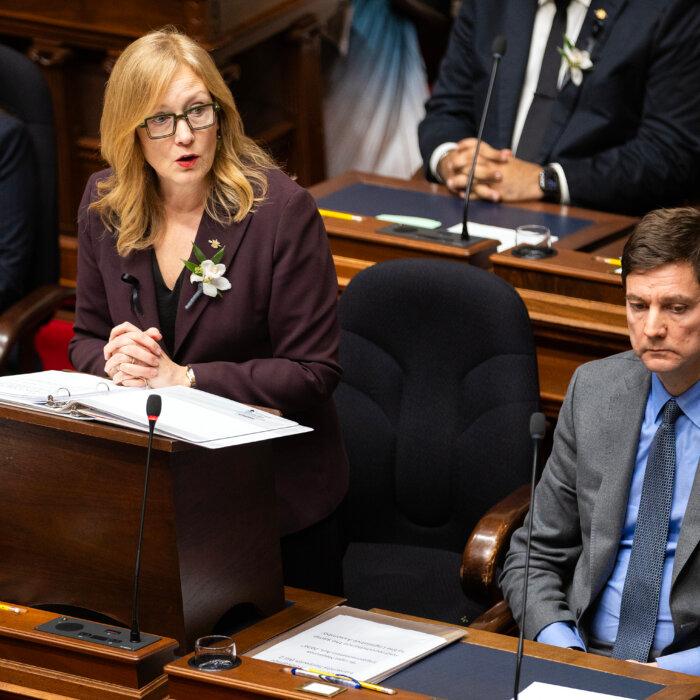
While announcing the proposed budget in the provincial legislature on Feb. 17, B.C.’s Finance Minister Brenda Bailey said the province was making “disciplined decisions” so that “Budget 2026 reduces the deficit, carefully and thoughtfully over time.”“We are scrutinizing government spending and ensuring as many dollars as possible reach the front lines in classrooms and emergency rooms,” she said.
Moody’s noted in its March 19 news release that the B.C. government “continues to rely heavily on borrowing to fund operating deficits and to fund its capital program,” which could lead to higher borrowing costs.
“The rise in leverage also reduces fiscal flexibility and weakens debt affordability, with interest costs projected to rise to 6.0% of revenue in 2026–27 and 7.9% in 2028–29, from an estimated 4.7% in 2025–26,” the agency said.
The estimates align with B.C.’s budget forecast, which projected the province’s interest bite—the share of revenue consumed by debt servicing costs—would rise from 6.2 percent in 2026–27 to 8.2 percent in 2028–29. Meanwhile, the province’s debt-to-GDP ratio is projected to rise from 30.6 percent this year to 37.4 percent over the same period.
Moody’s said B.C.’s outlook remains “negative,” adding that the “lack of an articulated timeline” to return deficits to balance would make a credit rating upgrade for the province “unlikely.”
“The outlook could be stabilized if the province is able to implement a credible plan that will slow debt growth and materially reduce projected deficits faster than under our current projections,” the agency said.