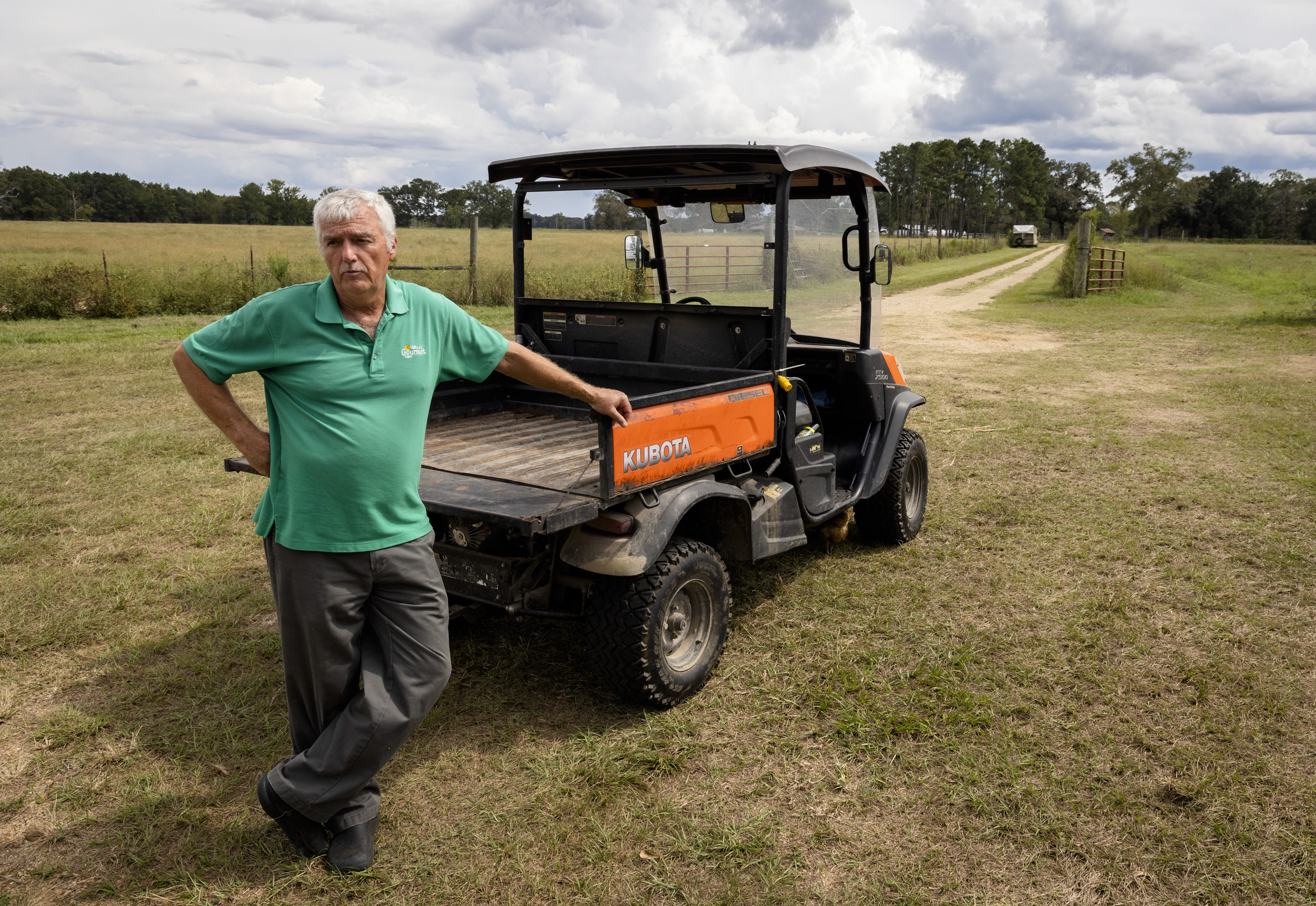

PETAL, Miss.—Standing in a field where his cattle graze, Ben Simmons takes a long look around the land where his farm sits and recalls a version of Mississippi that no longer exists.
When he was a boy, the country roads surrounding the small town of Petal, Mississippi, were dotted with sprawling family farms alive with the sights of tractors harvesting crops and fields lined with cattle and chickens.
“Back then, people knew where their food came from,“ Simmons told The Epoch Times. ”Most people raised their own food, and those that didn’t knew the people that grew their produce and raised their meat.”
Many of the properties along these Perry County roads that once housed farms are now empty fields. Thanks to “intrusive” government regulations and a new generation that is less interested in agriculture, the number of independent farms is declining, Simmons said.
In the heart of Mississippi’s Pine Belt, Simmons raises beef, chicken, and pork with the objective of providing healthy meat to consumers and sharing the farm’s journey with younger generations to “cultivate an interest in regenerative farming so that Mississippi’s agricultural heritage continues.”
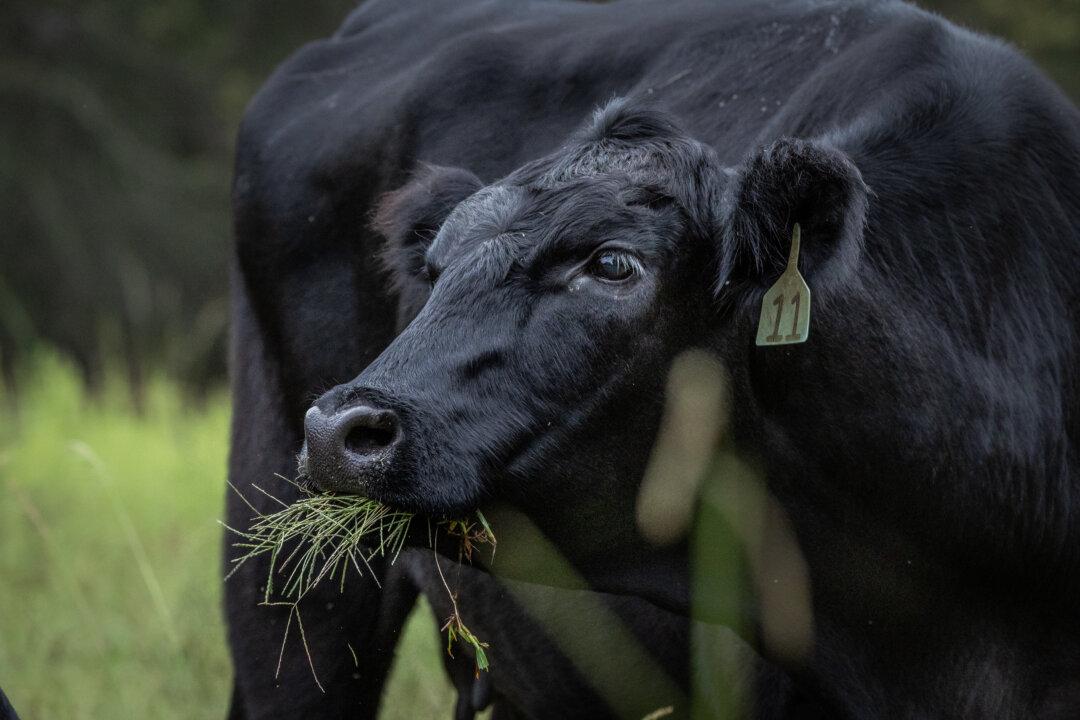
“[Animals graze on] diverse forage pastures that regenerate our soils and protect the ecosystem,” Simmons said.
Simmons has emerged as a mentor to young people interested in regenerative agriculture and conventional farmers wanting to make the switch.
“We want to help and encourage a new generation of folks to farm, and show experienced farmers a new way,“ said Simmons, whose two sons help him manage the farm. ”When you know how your food is raised and where it comes from—when you shake hands with the farmer who raises and grows your food—you can know the quality of food you are getting.”

Conventionally raised animals are confined to grow-out houses where they live in cramped conditions, Salatin told The Epoch Times. They are fed large amounts of genetically modified corn and soy and may never be exposed to natural light. These conditions often negatively affect their health, so vaccinations and antibiotics become necessary, according to Salatin.
Inspired by Salatin, Simmons said, he and his wife visited farms that incorporate regenerative techniques.
“Pigs don’t belong on concrete floors, chickens shouldn’t live in chicken houses, and cows don’t thrive in feedlots,“ Simmons said. ”These environments aren’t natural, and force farms to feed copious amounts of antibiotics due to the constant stress and risk of infection.”
“Cows should only eat grass and natural forage every day,“ he told The Epoch Times. ”The use of grain in cows has many negative health effects to the animal and their products, be it dairy or meat. Pigs love to root around in the ground looking for roots, grubs, acorns, and other tasty morsels. And chickens, well, they like to be chickens and eat a balanced diet of fresh forage, insects, and freshly milled or cracked non-GMO grains.”
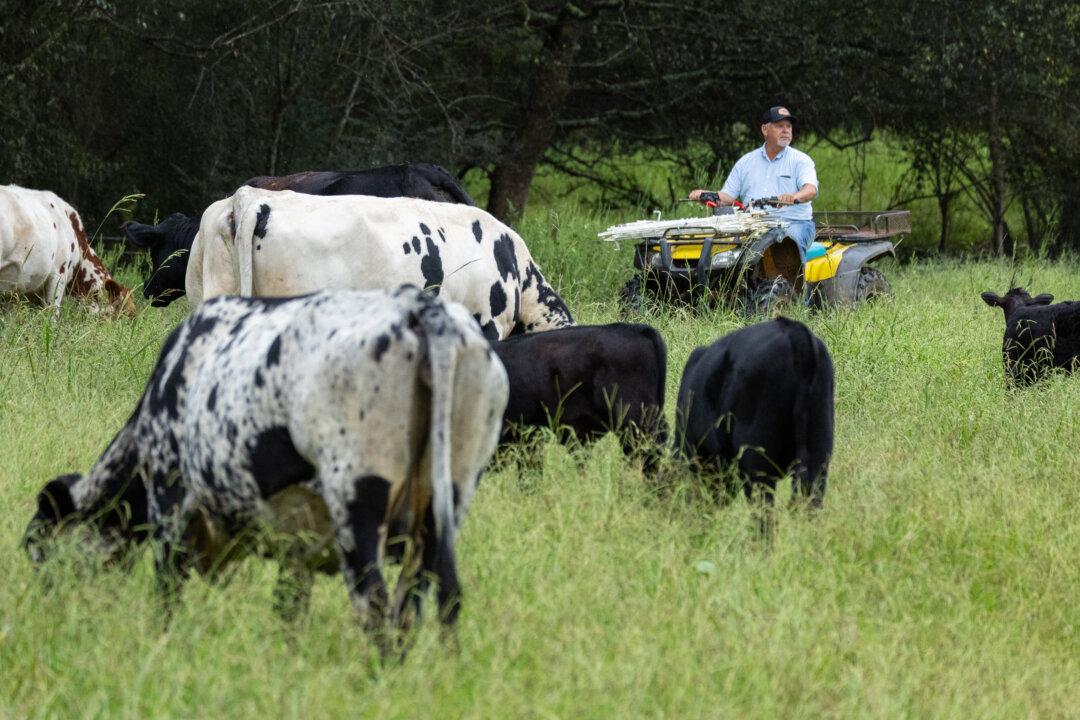
The animals at Nature’s Gourmet Farm have expansive areas in which to roam freely and are moved frequently, according to Simmons. This, he said, is rotational grazing.
They raised their three boys around cattle and horses, she said. The family moved to their farm in Pelahatchie in 2012 but did not start selling beef until last year. MaryJo told The Epoch Times that their steers are 100 percent antibiotic free and hormone free from birth.
Barefoot Springs is growing. The Perrys are adding sheep to graze behind the cattle and planning to sell pastured poultry in the spring. They are considering the addition of pork. Restaurants are contacting them for ground beef.

MaryJo applauded Simmons for the contributions he makes to newer farmers.
“[Simmons] has a passion for seeing more farmers do what he does because there is a demand and he can’t satisfy the demand alone,“ she said. ”That networking is one way to change the landscape of farming in Mississippi.
“Farming has been a way of life in Mississippi for centuries, and we’re at risk of losing that tradition if we don’t work together, help existing farms, and make it easier for the younger generation to start their own farm or take over their family farm.”
Regenerative farming is not inherent knowledge, Allen Williams, cofounder of the Soil Health Academy and Understanding Ag, told The Epoch Times. That is why it is important for those who are experienced in the techniques to share their knowledge, according to him.
“Most farmers and ranchers learned how to produce conventionally,” said Williams, who taught agriculture at Mississippi State University. “We taught them how to farm and ranch conventionally, not regeneratively, so they’re doing what they know.”
“[Regenerative farming is] a learned experience,” Williams said.
“You learn by educating yourself, and you get educated by workshops and visiting regenerative farms,“ he told The Epoch Times. ”It’s essential to form a network of peers and mentors to help you on the journey.”
Williams’s group Understanding Ag helps farmers, ranchers, and growers implement regenerative principles and practices.
Williams holds a doctorate in livestock genetics from Louisiana State University and pioneered many of the early regenerative grazing protocols and forage finishing techniques. He now teaches those principles to farmers globally.
Unlike conventional farms, which mostly produce one type of food annually, many regenerative farms and ranches have a diverse crop rotation and multiple species of livestock, all produced on the same acres or overlapping acres each year, according to Williams. An acre may provide foraging for cattle, sheep, pigs, laying hens, broilers, and turkeys.

Regenerative farmers and ranchers in Mississippi are also able to better withstand the challenges of extreme rainfall and drought than their conventional counterparts, Williams told The Epoch Times.
“Soils that are managed regeneratively are much more deeply aggregated, which means that they have more pore space in the soil,“ he said. ”Rainfall is more easily absorbed and retained.”
“Regenerative soils are more biologically active, which provide resilience by ... [increasing the] fertility ... [of] the plants,“ added Williams, who has taught Soil Health Academy workshops at Simmons’s farm. ”Crops are healthier and animals eat those plants, so they are healthier.”
Simmons sells non-GMO feed that he sources from a farm in northwest Georgia. He has also guided other regenerative farmers through the process of getting grants to build a Department of Agriculture processing plant.
Robert Harrison, who served in the Marine Corps, is the cofounder of Pearl River Pastures in Poplarville, Mississippi.
He started buying feed from Simmons and having chickens processed there. Over the course of conversations about regenerative farming, Simmons encouraged Harrison to add a Department of Agriculture processing plant and helped him navigate the process.

Robert said he is grateful to mentors such as Simmons.
“There is competition between every farmer because you’re all trying to make a living,“ he said. ”At the same time, more of us are needed to fill the demand, and [Simmons] knows this.
“We can only produce a set amount that is manageable for our farms, so to expand the number of regenerative farms in Mississippi, and get more locally produced healthy food to people, it’s important we support each other, and help more regenerative farmers get their start.”
Will McHard, 22, works for Simmons and plans to start his own regenerative farm, mostly focusing on cattle on land that is in his family and his wife’s family.
McHard earned a forestry degree and is helping Simmons plant trees on pastures for crops and shade.
“My dad grew up in Illinois and my mom in Iowa,“ McHard said. ”Both of their families had farms with mostly corn. I saw conventional farming up there, and how they usually operate in the red. This model is more sustainable, and more inviting to younger people getting their start.”
“I think that the people my age who are running away from maintaining their family farm, or getting into farming, would be pleasantly surprised by what they can do with a regenerative model,“ McHard told The Epoch Times. ”It can be a more profitable model because you’re cutting out the middleman and you don’t incur so much start-up debt.”