Hegseth made his comments at the annual Shangri-La Dialogue in Singapore on May 31. His words departed from the Biden administration, which said that conflict with China “is neither imminent nor inevitable.”
The differences between the two major U.S. parties on Taiwan are more complex and complementary than most people realize. Some in the press claim that Hegseth risked “escalating” disputes with China. In bigger ways, however, the Trump administration sought to deescalate. Nowhere did Hegseth commit to defending Taiwan if the People’s Liberation Army (PLA) were to attack, for example. Neither has President Donald Trump made such a commitment.
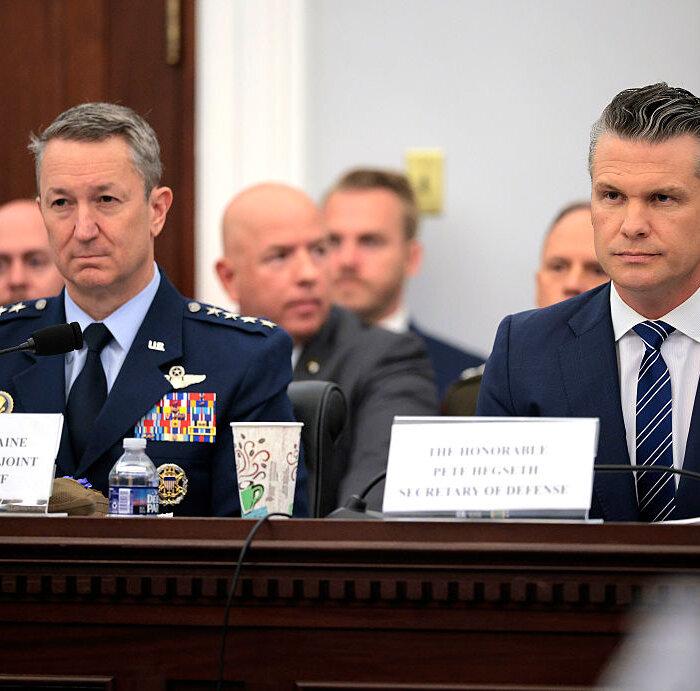

The second Trump administration is exhibiting a return to the former Taiwan policy of “strategic ambiguity.” Most people in the Biden administration sought to preserve this policy, and may be cheering its return. Strategic ambiguity incentivizes Taiwan to increase its defense spending, and leaves an offramp for the United States should it decide not to go to war with China.
Yet Hegseth’s tough policy toward the CCP was evident in his call on U.S. allies and partners to increase their defense spending. “We ask, and indeed we insist, that our allies and partners do their part,” he said at the dialogue. “NATO members are pledging to spend 5 percent of their GDP on defense, even Germany. So it doesn’t make sense for countries in Europe to do that while key allies in Asia spend less on defense in the face of an even more formidable threat, not to mention North Korea.”
Trump has mooted the strategy of not committing to defend allies that do not meet a minimum defense spending cutoff. In the past he argued that countries like Japan and Korea obtain their own nuclear deterrents, which would also shift some burden of defense to these allies. It would decrease the risk of the U.S. getting into a war with a nuclear-armed adversary, because Japan and Korea’s nuclear deterrent would deter that war.
That empowerment of allies is apparent in the increased tempo of joint training exercises with U.S. partners.
“A critical part of working with our partners is increasing interoperability—learning how to sail, fly, and fight as one,” Hegseth said.
Trump’s approach to insisting on greater defense spending by allies has led the Europeans to increase their defense spending, which allows the United States to redeploy forces to Asia for the deterrence of China. The resulting peace and stability, said Hegseth, “only multiply when our allies and partners are also strong.”
In the past, U.S. foreign policy was not only based on U.S. national interests, but on those interests being served through establishing the United States as a global leader and champion of freedom, liberty, markets, democracy, and human rights. American values, rather than just U.S. national interests, served as the basis for attracting nations around the world into our alliance systems. These helped keep the United States safe through forward deployment of U.S. forces as tripwires and balancers against countries like communist China, the former USSR, North Korea, and Iran.
As the Trump administration has made clear, and contrary to its detractors, it values these international alliances and partnerships. They strengthen through the tough love of insisting on greater partner defense spending and closer adherence to U.S. export controls imposed against adversaries. The days of the United States providing a free security umbrella to the world are over, as is the easy provision of technology to China and Russia. As the U.S. national debt increases, U.S. allies must pay their fair share, or get left behind.
The figure Hegseth quoted in his speech, of 5 percent of GDP, is a big ask, but necessary to keep the peace in today’s more dangerous world. Our democratic liberties are well worth the price.