Beijing is using clubs and water cannons to take Philippine territory while gaslighting the country through propagandistic cultural, academic, political, and media campaigns. But Manila is wise to the Chinese Communist Party’s (CCP’s) subversion of Philippine democracy and increasingly pushes back.
The Defense Secretary has plenty of top cover. On Aug. 3, the spokeswoman at Malacañang, the presidential palace, backed Teodoro publicly, calling his approach “an expression of love for our country.”
On Aug. 4, China’s foreign ministry spokesman issued a veiled threat in response to the Philippine government’s statements. The spokesman demanded that a small handful of “anti-China forces” in the Philippines “stop making provocations and creating trouble, and stop attacking and smearing China.” He continued, “Otherwise, they will bear the consequence for their despicable acts.” These are chilling words from Beijing, which in June sanctioned Teodoro and his family.
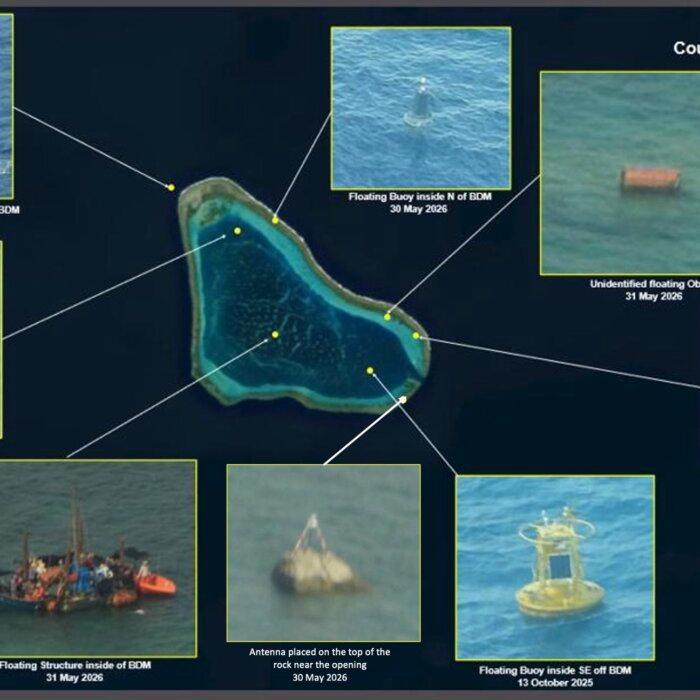
The Philippine push against CCP excesses comes in the context of Beijing’s takeovers of Philippine maritime resources since Manila evicted the U.S. military in 1991 from its two main bases in the country. Beijing has exploited the power vacuum and its economic influence in Manila and Washington by gradually taking control of Mischief Reef in 1994, Scarborough Shoal in 2012, and by making ever-increasing claims further afield.
According to a social media post by SeaLight on July 27, “SeaLight mapped Chinese and Philippine organizations tied to the CCP’s United Front system that now play major roles in teacher training, language testing, curriculum development, internships and job placement across the sprawling Chinese-language education system in the #Philippines.”
The report notes that since 1991, the Philippine Chinese Education Research Center (PCERC), which is associated with the Chinese Embassy and Jinan University, “has run a ‘Blood-Transfusion Plan’ that as of 2022 had already imported more than 5,000 mainland teachers to fill Chinese school posts. In 2004 it added a matching ‘Blood-Generation Plan,’ reported in the Philippine press, which sends Filipino-Chinese high-school graduates to Chinese universities for four-year Chinese-language teaching degrees on condition they return home to teach for at least five years.”
Like all universities in China, Jinan University is required by Chinese law to cooperate with China’s intelligence agencies, calling into question whether Chinese intelligence is operating in the Philippines through such academic exchanges.

Four days after the release of the Stanford report, the Philippine Defense Department noted on July 31 that the department is engaged in an investigation of “foreign malign influence, co-optation, and covert interference.” The department emphasized that its investigation is not against the Filipino–Chinese community.
Manila has generally emphasized that its pushback against the CCP’s territorial and influence operations is not against Chinese trade, investment, and Filipino–Chinese persons. On Aug. 2, the Swiss building materials company Holcim, for example, announced that it would sell its Philippines unit for at least $807 million to China’s Huaxin Building Materials. Manila typically welcomes this kind of Chinese investment.
While building materials may be relatively innocuous, China’s increasing investment in strategic Philippine sectors such as telecommunications, finance, and power generation warrants further investigation.
While Jinan University has attempted to invoke academic freedom to defend its program in the Philippines, the Philippine Defense Department said that no true academic freedom can exist in a country like China that criminalizes free speech.
“Genuine academic freedom cannot exist within state-owned propaganda channels where free speech is suppressed, dissenting views from the party line are immediately criminalized, and history itself is heavily censored, most notably the violent suppression of students at Tiananmen Square,” it said.
The Philippine Defense Department also raised the CCP’s human rights abuses against Uyghurs, which is genocide by the United Nations definition.
The CCP’s aggressive actions against the Philippines include physical violence against Philippine military and coast guard personnel in the South China Sea and dehumanizing propaganda, including most recently the above-mentioned video, which is AI-generated. It depicts the Philippines as a monkey and an international arbitration award as “litter.”
A court in The Hague issued an award recognizing the legitimacy of the Philippines’ exclusive economic zone (EEZ) and invalidating China’s nine-dash line. China Daily, a state-controlled media outlet, released the video on July 10.
On July 30, Rear Admiral Jay Tarriela, the spokesman for the Philippine coast guard on the issue of the West Philippine Sea (the name for the South China Sea in the Philippines), gave his support to the investigation of China’s influence in Philippine academia and made the connection between the CCP’s propaganda and violence.
“The same playbook we confront at sea — coercion disguised as routine, aggression framed as law enforcement — operates on land through narratives disguised as scholarship and influence disguised as cultural exchange,” he wrote on social media. “Water cannons target our vessels; disinformation targets our minds. Both are assaults on our sovereignty.”
Until the CCP stops such acts against democracies like the Philippines, Manila’s allies should increase economic sanctions and tariffs on China, along with diplomatic repercussions such as the expulsion of CCP diplomats. If that leads to reciprocal actions by Beijing, so be it. The free world must disengage from CCP influence to be truly free.