A Chinese state-owned entity was the third globally to successfully recover an orbital-class booster rocket in a controlled manner.
China Aerospace Science and Technology Corp. (CASC), through a subsidiary, achieved the first such recovery for China and the second for any nation after the United States. This indicates that China’s reusable rocket technology is second only to that of the United States, including SpaceX.
The innovation is a serious threat because CASC both serves the Chinese Communist Party and allegedly cooperates with Russia on many related technologies, including space weapons, the destruction of adversary satellites, autonomous drone munitions, and integrated air and missile defense.
CASC reportedly has plans to destroy SpaceX satellites upon which the United States and its partner militaries rely.
The CASC recovery was the first-ever globally to use a massive net on a sea platform. CASC was only the third company to achieve the feat after SpaceX in 2015 and Blue Origin in 2025. The booster came from the 63-meter (207-foot) Long March 10B rocket, which can launch a payload of 16 metric tons (35,000 pounds) into low-Earth orbit (LEO).

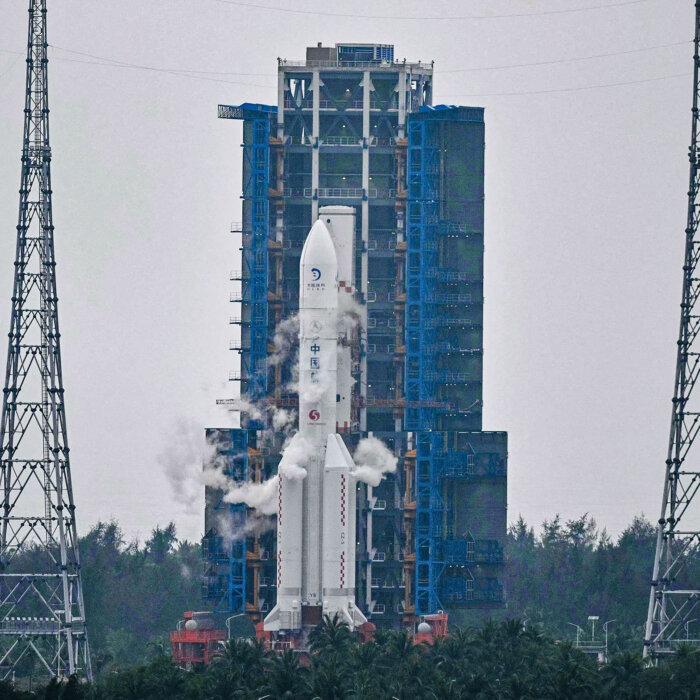
The CASC booster had a five-meter (16.4-foot) core diameter. As a world first, it deployed hooks rather than legs for its landing, an impressive technological innovation. There is apparently a seven-meter diameter recoverable Chinese rocket under development as well.
The 10B launched on July 10 from Hainan Island in China’s south. The booster used automation to land itself on a maritime platform outfitted with a large tensioned-cable net about 430 kilometers (267 miles) downrange in the South China Sea.
CASC argues that these innovations allow hooked reusable rockets to carry a larger payload given the reduced mass of no landing legs. Downrange recovery also decreases the extra fuel required to return the booster to the original launch site for some recoverable rockets. The CASC subsidiary that developed the system is the China Academy of Launch Vehicle Technology.
The recovery system will likely decrease the cost of China’s satellite launches and assist a plan to land Chinese astronauts on the moon by 2030. It will provide China’s military with a new dual-use technology that will threaten U.S. assets in space and on land through Chinese satellite constellations, counterspace weapons, launch surge capacity, and a strengthened missile industrial base that also makes intercontinental ballistic missiles.
SpaceX has used its recoverable Falcon 9 rocket to send more than 12,000 Starlink satellites into space. SpaceX was instrumental in creating the United States’ Starshield, a constellation of satellites that provides the U.S. military with secure communications and espionage capabilities.
SpaceX is providing a new data network to the U.S. Space Force and a system to track moving objects on Earth and in the air. Not only Starshield, but cheaper Starlink terminals are also used extensively by the U.S. military for communications, counter-drone operations, and long-range one-way attack drones.
The Chinese regime is allegedly acting aggressively against SpaceX systems through a CASC plan proposed to Russia to limit the systems through a multi-step process, including: international law regulatory limitations on SpaceX satellites; competition for limited frequency bands and orbital slots acquired from international organizations; power suppression, electromagnetic, and cyberinterference aimed at SpaceX satellites; and finally a kinetic option of eliminating satellites through low-cost one-to-many weapons able to destroy SpaceX satellites in orbit.
For this job, CASC allegedly proposes a weapon sufficiently inexpensive to destroy satellites more quickly than SpaceX can launch them.
CASC is the first Chinese entity to achieve a controlled booster recovery, but many more companies in China are trying. At least some of them will likely succeed in the near future, further accelerating the already exponential growth in Chinese launches, which went from 39 in 2020 to more than 90 in 2025.
This year, China is targeting 140 launches. These launches will likely exceed the number of U.S. launches as China’s launch-and-recover technology matures.
Within the next year or two, expect more Chinese launch recoveries and the accelerated growth of Chinese satellite clusters to rival the systems of SpaceX and Amazon Leo (formerly Project Kuiper). Amazon Leo seeks to radically expand global broadband access through 3,236 LEO satellites.

China’s plans to compete with SpaceX and Amazon are ambitious, and they will be directly served by its recoverable rocket innovations. The planned Chinese satellite constellations include the Guowang (National Network) and Qianfan (Thousand Sails) systems that together are planned to have more than 28,000 satellites in LEO.
The constellations already have more than 350 satellites in orbit that serve not only Chinese commercial entities but also likely military and intelligence clients. They will be critical to the global deployment of Chinese military drones that rely on robust, dependable guidance, communications, and surveillance from global satellite systems.
Qianfan, which plans to launch 15,000 satellites into orbit by 2030, will compete with U.S. efforts to capture the global satellite broadband market. Qianfan already has trial deals inked with Brazil, Turkey, Malaysia, and Kazakhstan. If these countries want to retain their democratic partnerships and access to U.S. and allied markets, they should cancel their deals with China.
The rise of reusable rocket technologies in China will put U.S. and allied national security at risk. China’s rapidly progressing missile and space technologies should be slowed through the imposition of U.S. and allied export control restrictions on precision components, semiconductors, machine tools, and raw materials that supply China’s and Russia’s launch sectors as the two countries purposefully evade sanctions through transshipping to each other.