Kazakh officials announced on Nov. 6 that Kazakhstan will join the Abraham Accords. U.S. President Donald Trump called the decision “a major step forward in building bridges across the world” and noted that Kazakhstan is the first country to join the Accords during his second term.
Some analysts describe the move as largely symbolic, since Kazakhstan already has diplomatic relations and limited economic engagement with Israel. However, the decision carries broader strategic significance.
Even a small Central Asian republic joining the Accords strengthens U.S. diplomatic influence and expands Washington’s sphere of influence in a region long contested by Russia and increasingly courted by China. It also reinforces U.S. leadership in shaping global alliances.
U.S. officials said the agreement will enhance Israeli–Kazakh cooperation in defense, cybersecurity, energy, and food technology. Trump emphasized that other nations are “lining up” to join and described Kazakhstan’s inclusion as part of a growing wave of peace and prosperity.
The announcement came just before Trump hosted a summit in Washington with leaders of the five Central Asian nations. Ahead of the summit, U.S. Secretary of State Marco Rubio met with Kazakh President Kassym-Jomart Tokayev to discuss expanding trade, investment, and cooperation in energy, technology, and infrastructure.

Trump’s negotiation of the Israel–Hamas truce reopened political space for a revival of the Abraham Accords, which were launched in 2020 with the United Arab Emirates (UAE) and Bahrain and later joined by Morocco and, pending ratification, Sudan. Kazakhstan’s entry paves the way for other Turkic nations in the Caucasus and Central Asia. These countries see alignment with the United States and Israel—and distance from the Chinese, Russian, and Iranian axis—as strategically advantageous. The Abraham Accords have become a central component of a growing pro-U.S. coalition among Muslim-majority nations.
Kazakhstan’s participation also aligns with broader U.S. objectives of securing critical mineral supply chains and expanding access to the Trans-Caspian International Transport Route, also known as the Middle Corridor. This trade route links Central Asia to Europe, bypassing Russia and Iran, providing the West with an increasingly vital alternative amid conflicts in Ukraine and the Middle East.
Kazakhstan’s vast reserves of rare-earth elements and other critical minerals—including lithium, tungsten, and copper—make it a valuable partner in Washington’s effort to reduce dependence on China, which currently supplies about 70 percent of U.S. rare-earth imports and has repeatedly threatened export restrictions.
For Kazakhstan, cooperation with the United States supports its “multi-vector” foreign policy, balancing relations with Russia, China, and the West to preserve sovereignty. With Russia’s influence weakened by the war in Ukraine and China expanding its economic reach across Central Asia, joining the Abraham Accords allows Kazakhstan to strengthen ties with Washington without directly provoking either neighbor.
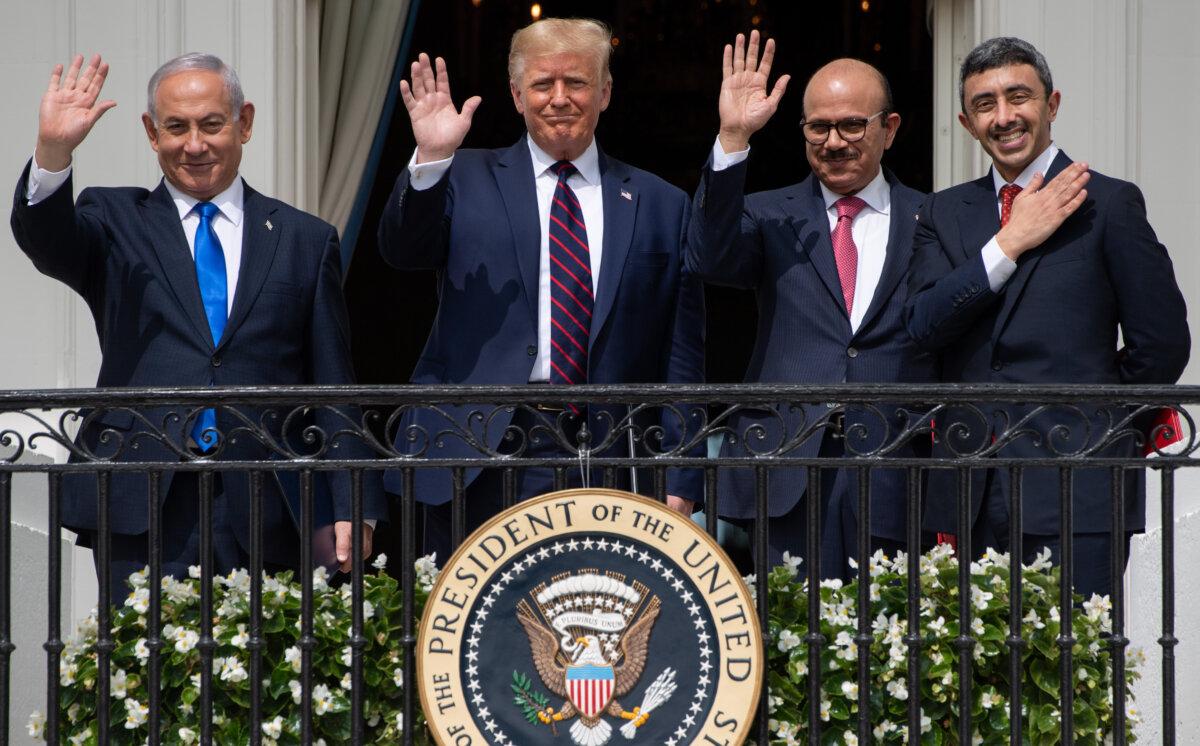
The inclusion of Central Asian nations broadens the Abraham Accords beyond their original Arab–Israeli framework into the wider Eurasian sphere. Azerbaijan and Uzbekistan, both maintaining close ties with Israel, are considered likely future participants, while Saudi Arabia continues to signal interest in normalization.
For the United States, this expansion represents a strategic gain in the great-power competition with China. Muslim-majority nations that strengthen ties with Israel through the Abraham Accords are aligning, at least implicitly, with a U.S.-backed security and economic order. Each new member reinforces American influence in regions where Beijing has relied on transactional economic engagement. Kazakhstan’s decision is a diplomatic victory for the United States that counters both China’s investment dominance and Russia’s security leverage in Central Asia.
The renewed momentum of the Abraham Accords highlights a shifting geopolitical architecture. They are no longer limited to Middle Eastern normalization but have become a broader strategic instrument in the U.S.–China competition. As the framework expands into new regions and aligns Muslim-majority states with U.S. interests, it strengthens Washington’s position while constraining Beijing’s diplomatic power.