This copy is for your personal, non-commercial use only. Distribution and use of this material are governed by our Subscriber Agreement and by copyright law. For non-personal use or to order multiple copies, please contact The Epoch Times Reprints.
This handout photo made available by the Iranian Army Office on March 12, 2025, shows local officials and navy personnel attending a joint Iranian-Russian-Chinese military drill in the Gulf of Oman. The navies of Iran, Russia, and China were holding military drills off the coast of Iran that week in a bid to boost cooperation, according to Iranian media. Iranian Army Office/AFP via Getty Images
China is reportedly supplying Iran with hundreds of Man-portable air-defense systems (MANPADS) through a route originating in Xinjiang and transiting Pakistan, despite denials from Beijing and Islamabad.
Iran is expected to receive within weeks the first shipment of up to 400 Chinese man-portable air defense systems, under a $60 million–70 million deal. The contract covers Chinese QW-12 and FN-16 shoulder-fired missile systems, designed to bring down low-flying aircraft, helicopters, and drones. It was signed with Zhongqing Baoshang International Investment, a Hong Kong-based company acting as intermediary between Iran and the Chinese supplier.
Under the plan, the systems are to be flown first from Urumqi, in China’s Xinjiang Uyghur Autonomous Region, then transited overland through Pakistan into Iran. Sources did not specify whether the Pakistan-to-Iran leg would move by air or road. Tehran has explored alternative overland routes for moving Chinese military equipment and dual-use components, in order to reduce the risk of disruption.
A rail corridor running roughly 6,500 miles from Chinese hubs such as Xi'an through Kazakhstan and Turkmenistan into Tehran’s Aprin dry port has moved China-origin freight into Iran since 2014 and was expanded by China in 2025, cutting transit time to about 15 days. The congressional U.S.-China Economic and Security Review Commission states more broadly that China facilitates export-control evasion for Iran through networks of transshipment and shell companies based in Hong Kong, China, and third countries, used to supply dual-use components for Iran’s drone and missile programs.
The reported deal would represent one of Tehran’s largest known efforts to rebuild short-range air defenses since its war with the United States and Israel, which exposed gaps in Iran’s ability to protect military sites and strategic infrastructure.
Both China and Pakistan have denied culpability. Pakistan’s military media wing, Inter-Services Public Relations, told Anadolu that “[all] such speculations are baseless and devoid of truth.” Similarly, when asked about the weapons shipment to Pakistan during a regular press conference on July 30, Foreign Ministry spokesperson Mao Ning responded, “The report is not true and has no factual ground at all.”
The recent MANPADS shipment was not the first. In April, reports surfaced that China was preparing to deliver MANPADS to Iran within weeks, with indications that Beijing was routing the shipments through third countries to mask their origin. A spokesperson for the Chinese Embassy in Washington denied the claim to CNN. Days later, U.S. intelligence also saw signs that Beijing was weighing whether to transfer advanced radar systems to Iran, again potentially through third countries to obscure direct involvement.
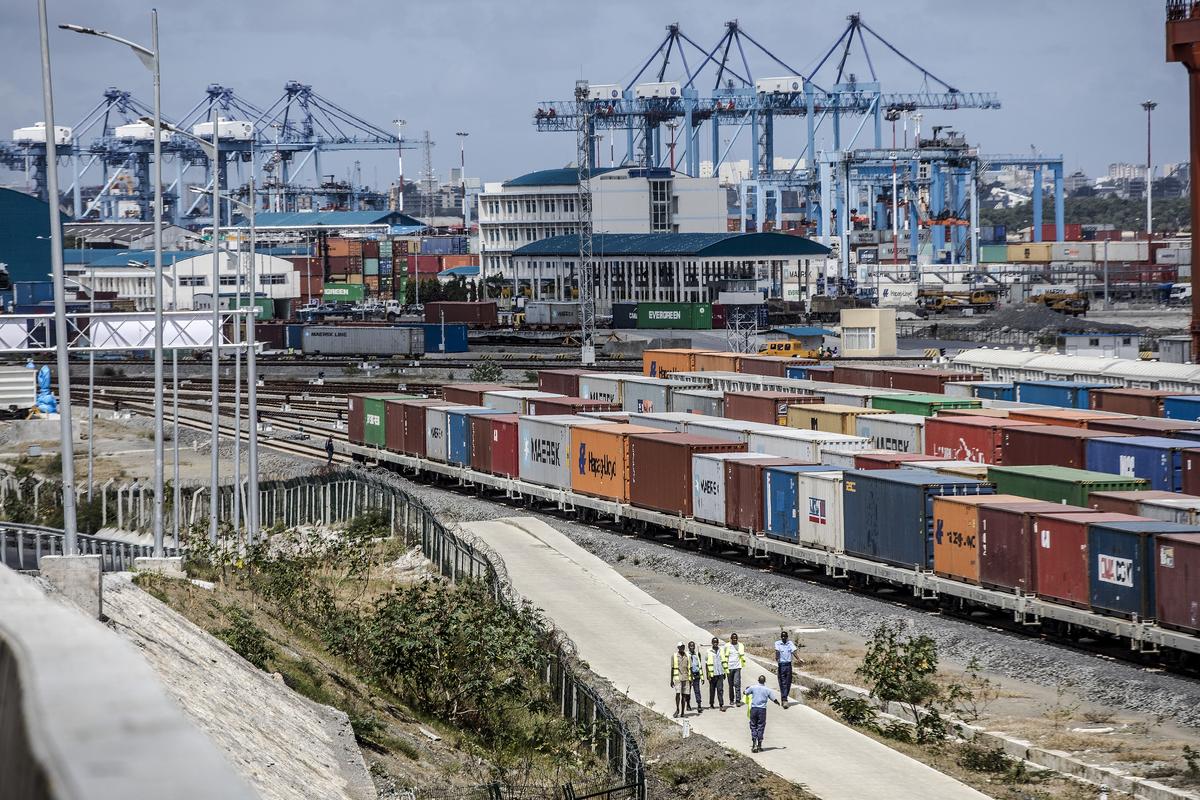
Shipping containers sit beside railway lines running into Mombasa port in Mombasa, Kenya, on Sept. 1, 2018. Luis Tato/Bloomberg via Getty Images
The denials come despite a direct assurance Chinese leader Xi Jinping is reported to have given President Donald Trump. In a July 24 Truth Social post, Trump wrote that Xi told him at their May meeting in Beijing that China would not, under any circumstances, give or sell weapons to Iran and that the pledge extended to Chinese companies. Trump said he took Xi “at his word.”
U.S. Treasury and State Department records predate and complicate that assurance. On June 10, 2026, the State Department announced sanctions on 13 individuals and entities in Iran, Belarus, and China, including Hong Kong, for sourcing or purchasing weapons, explicitly including MANPADS, on behalf of Iran’s Islamic Revolutionary Guard Corps. The action followed a May 8, 2026, designation round and was taken to enforce U.N. Security Council Resolution 1929, which bars member states from supplying, selling, or transferring conventional weapons such as MANPADS to Iran.
The State Department’s accompanying fact sheet names specific intermediaries: Sajjad Ahadzadeh, head of Iran’s Center for Innovation and Technology Cooperation, is described as having approached China-based Yushita Shanghai International Trade Co. Ltd., itself designated by Treasury on May 8, 2026, to procure MANPADS. A Belarus-based entity, Armory Alliance, is separately described as an intermediary between China-based companies and Iran that helped facilitate the purchase of hundreds of MANPADS.
Treasury’s Office of Foreign Assets Control has continued building on that framework. A follow-on OFAC action targeted additional nodes in the same procurement network, citing the Center for Innovation and Technology Cooperation’s continued effort to acquire MANPADS from Chinese suppliers. The designations rest on Executive Order 13382, which targets proliferators of weapons of mass destruction and their supporters, and Executive Order 13902, which targets actors in Iran’s financial sector.
This is not the first documented instance of Chinese entities supplying Iran’s weapons programs through intermediaries. A 2023 State Department sanctions action designated a network of seven individuals and six entities in Iran and China for supporting Iran’s Ministry of Defense and Armed Forces Logistics and its ballistic missile program, including Iran’s defense attaché in Beijing, who the department said had coordinated defense-related procurement from China.
Separate reports indicate that Iran is close to a deal with China to purchase supersonic anti-ship cruise missiles, though it is unclear whether that deal was concluded. NBC News reported in May that a missile believed to have downed a U.S. F-15 over southwestern Iran was likely manufactured in China, though the circumstances remain under investigation.
Pakistan’s role in the reported route is significant given its “iron brotherhood” with China and a recent change in its transit policy. On April 25, Pakistan’s Commerce Ministry formally activated a transit corridor to Iran via the China-Pakistan Economic Corridor and Iranian overland routes, designating six transit routes to relieve a backlog of more than 3,000 Iran-bound containers stranded at Karachi and Port Qasim by the U.S. naval blockade.
The blockade targets vessels entering or leaving Iranian ports but has no jurisdiction over land and air cargo that never enters Iranian waters. The reported Urumqi-to-Pakistan air route, followed by an overland leg into Iran, would bypass the naval blockade entirely.
Rep. Raja Krishnamoorthi (D-Ill.), a senior member of the House Permanent Select Committee on Intelligence and the House Select Committee on Strategic Competition with the CCP, sent a formal letter on Aug. 6 to Secretary of State Marco Rubio, Defense Secretary Pete Hegseth, and CIA Director John Ratcliffe, asking, “What is the determination on the extent Pakistani leadership knew of the deal and proposed transfer?” He also asked whether the administration finds Beijing’s denial credible and set an Aug. 16, deadline for written answers.
Views expressed in this article are opinions of the author and do not necessarily reflect the views of The Epoch Times.
Antonio Graceffo, Ph.D., is a China economy analyst who has spent more than 20 years in Asia. Graceffo is a graduate of the Shanghai University of Sport, holds an MBA from Shanghai Jiaotong University, and studied national security at American Military University.